JIT Liquidity Strategy 2026: Mechanics, Math, and Risk
Learn how just-in-time liquidity works, calculate fee share, model gas and inventory risk, and evaluate a JIT attempt without profit projections.
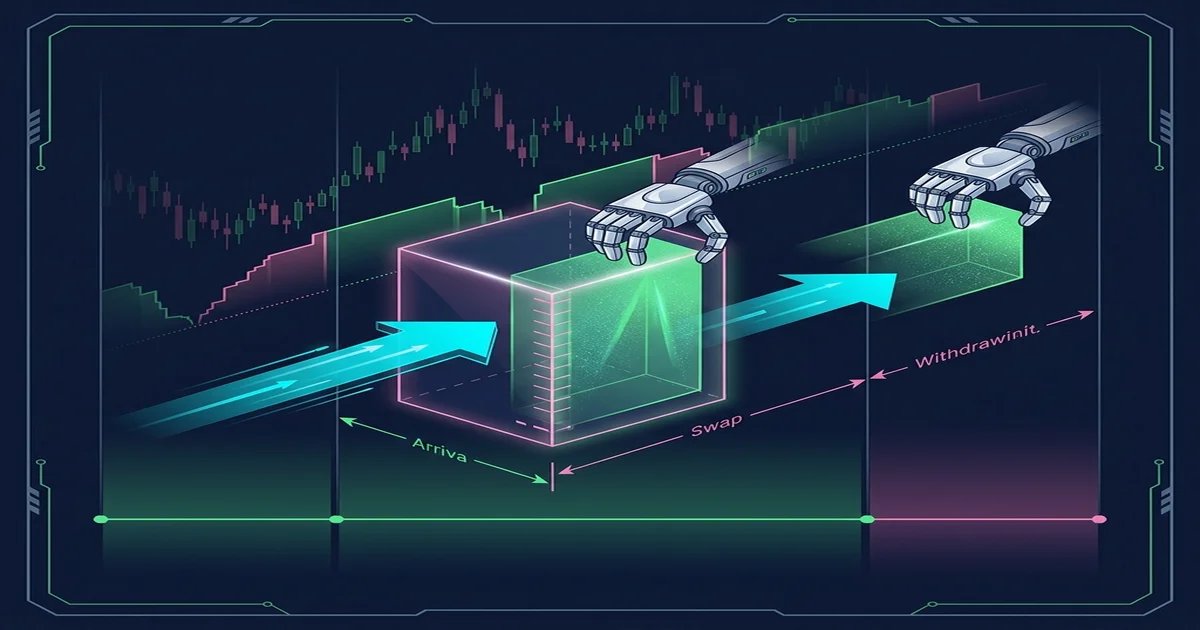
Answer first — Just-in-time (JIT) liquidity adds a concentrated-liquidity position immediately around a target swap and removes it after the swap. The position can receive a share of the swap fee, but it also takes inventory, gas, ordering, and adverse-selection risk. A valid evaluation uses the pool's actual liquidity math and records every cost; fixed capital thresholds, monthly-income ranges, and guaranteed fee capture are not defensible without a reproducible dataset.
The Execution Sequence
A conceptual JIT sequence is:
- Detect a candidate swap and read the current pool state.
- Select a tick range that would be active during the swap.
- Calculate the token amounts needed to mint the position.
- Simulate
mint -> target swap -> burn/collectin the intended order. - Submit through a route that supports the required ordering.
- Confirm the final state and rebalance the resulting inventory.
If the target transaction changes, does not arrive, or moves outside the assumed range, the position may receive less fee than modeled or remain exposed to price movement.
Fee-Share Math
Let:
Fbe the fee generated by the target swap inside the active range;Pbe the existing active liquidity;Jbe the JIT liquidity active for that swap.
The simplified JIT fee share is:
gross JIT fee share = F * J / (P + J)
This is only a teaching approximation. Real calculations must account for the pool's tick transitions, liquidity changes across ticks, exact input or output, rounding, protocol fee settings, and token amounts required by the position.
The net result is:
net result =
collected fees
+ value of withdrawn inventory
- value of deposited inventory
- mint, burn, collect, and rebalance gas
- builder or routing payment
- slippage and adverse selection
- failed-attempt cost
- capital financing cost
The withdrawn token mix often differs from the deposited mix. Valuing only the fees while ignoring inventory change overstates the result.
Why Simulation Is Essential
JIT depends on transaction order and pool state. Simulation should verify:
- the position is active during the target swap;
- the target swap remains valid with the additional liquidity;
- all calls succeed in the intended order;
- the final token balances match the accounting model;
- the bundle or transaction enforces a safe failure condition;
- approvals, deadlines, slippage, and gas limits are explicit.
Simulation is not a guarantee. Another state change, a different ordering decision, or non-inclusion can invalidate the result.
Main Risks
Ordering risk
The mint must occur before the target swap and the exit after it. If the routing mechanism does not enforce that order, the position can be exposed without receiving the expected fee.
Inventory risk
The swap changes the position's token composition. The operator may need to rebalance at a worse price, and that cost can exceed the fee.
Adverse selection
A large swap may be informed flow, part of another arbitrage, or a response to a price move elsewhere. Supplying liquidity to that flow can leave the LP holding the asset that is about to underperform.
State-staleness risk
Active liquidity, tick, fee growth, token price, and gas can change between detection, simulation, and execution.
Contract and approval risk
Minting concentrated liquidity requires interaction with pool and position-manager contracts. Verify contract addresses, token approvals, deadlines, and recipient fields.
Privacy and information leakage
A publicly visible JIT transaction can reveal the strategy and invite competition or ordering attacks. Private routing can reduce public exposure but does not guarantee confidentiality or inclusion.
Reproducible JIT Test
- Pin the chain, pool address, fee tier, and contract version.
- Record the reference block and complete pool state.
- Save the target transaction or a clearly defined synthetic swap.
- Calculate the position range and required token amounts.
- Simulate the ordered sequence on a fork of the reference state.
- Report deposited and withdrawn token amounts separately.
- Include every gas unit and routing payment.
- Price inventory using a declared timestamp and source.
- Repeat across different liquidity and volatility conditions.
- Publish failures and exclusions with successes.
This method supports a claim about the measured sample only. It does not establish an expected return for another operator, pool, or period.
Decision Table
| Question | Evidence required before execution |
|---|---|
| Will the position be active? | Tick-range calculation on fresh state |
| Is ordering enforced? | Bundle or transaction semantics and simulation |
| Is the fee estimate complete? | Tick-level fee calculation |
| Is inventory risk bounded? | Final token balances and rebalance policy |
| Can the attempt fail safely? | Atomic revert or explicit unwind path |
| Is the route private? | Provider documentation and observed lifecycle |
| Is the opportunity net positive? | Full ledger, not fee income alone |
Where FRB Fits
FRB Agent currently focuses on supported atomic-arbitrage and liquidation workflows. It does not claim a production JIT-liquidity strategy. JIT requires concentrated-liquidity position management, target-order visibility, tick-level accounting, and an inventory rebalance engine. The simulation and risk-accounting principles in this guide still apply to evaluating any atomic workflow.
FAQ
Is JIT liquidity a sandwich attack?
It can use a three-part ordered sequence around a target swap, but the economic effect and classification depend on implementation and order flow. The operator should evaluate user impact, protocol rules, and applicable legal obligations.
Does more JIT liquidity always capture more fees?
The simplified share rises with J, but required token inventory, price range, tick crossings, gas, and rebalance risk also change. Gross fee share is not net profit.
Can private order flow guarantee a JIT fill?
No. Provider policy, builder choice, competition, transaction validity, and chain state can all affect inclusion and ordering.
Is JIT suitable for a fixed amount of capital?
There is no universal threshold. Required inventory depends on the pool state, chosen range, token prices, target size, and desired liquidity share. Calculate it per candidate.
Primary References
Related Articles
Further reading & tools
Discussion
No notes yet. Add the first observation, or share the link with your team on X (@MCFRB).