MEV Bot SaaS vs Self-Hosted 2026: Real Cost…
**Answer first** — SaaS MEV bots (Telegram bots, web-app snipers) win on time-to-first-trade and ongoing maintenance — you pay 0.5–1% per trade and someone else handles infrastruct
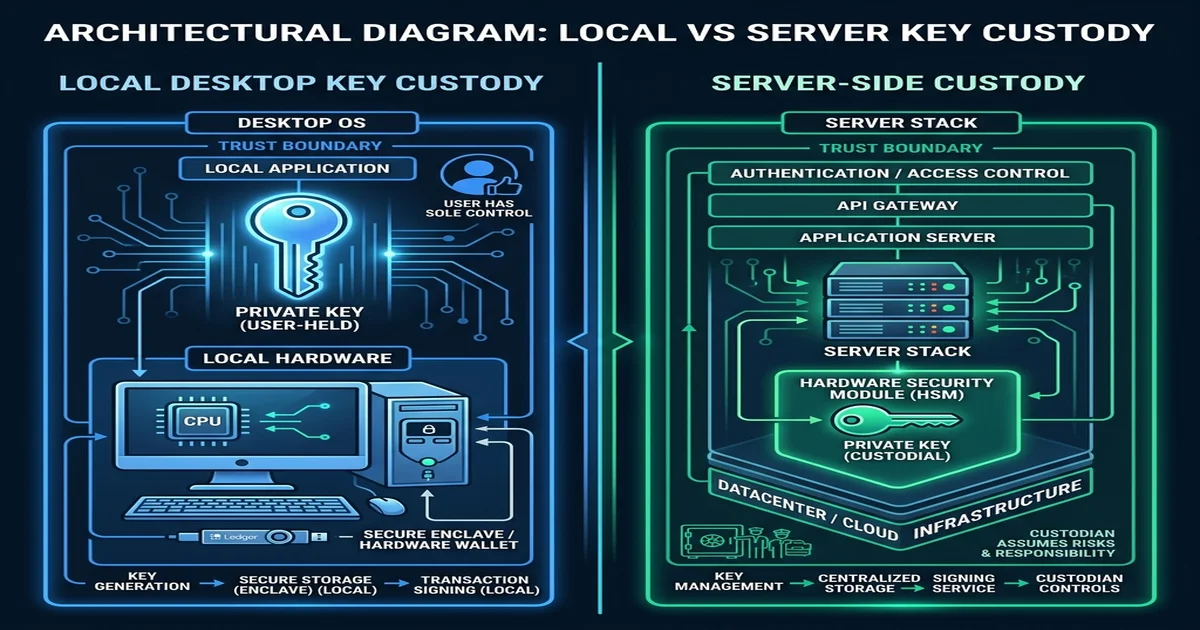
Answer first — SaaS MEV bots (Telegram bots, web-app snipers) win on time-to-first-trade and ongoing maintenance — you pay 0.5–1% per trade and someone else handles infrastructure. Self-hosted MEV bots (desktop agents, custom code on a VPS) win on total cost of ownership above ~$30k working capital, give you non-custodial guarantees, and let you tune execution paths SaaS won't expose. The crossover point for most users is around $3,000–$5,000 of monthly trading volume: below that, SaaS is cheaper net of your time; above that, self-hosted pays for itself within months. A desktop agent like FRB Agent sits in the middle — self-hosted execution with SaaS-like UX.
The Two Categories In One Table
| Dimension | SaaS MEV Bot | Self-Hosted MEV Bot |
|---|---|---|
| Time-to-first-trade | 5–10 minutes | 2 hours – several days |
| Per-trade fees | 0.5–1% | 0% (you pay gas only) |
| Monthly infrastructure cost | $0 (built into fees) | $50–$2,000 |
| Custody model | Hosted hot wallet | User-controlled keys |
| Latency tuning | Provider-defined | User-controlled |
| Execution paths | Provider-defined | Any path the user implements |
| Upgrade cadence | Automatic (good and bad) | User-controlled |
| Failure recovery | Provider problem | User problem |
| Audit-ability | Closed source | Self-inspectable |
| Best for | Memecoin sniping, casual MEV | Serious MEV, multi-chain, high volume |
Where SaaS Wins
Onboarding speed. Open Telegram, message a bot, deposit, trade. Photon, BonkBot, Maestro, Trojan, Bullx, GMGN — all variants of "be trading within 10 minutes." For someone whose alternative is "spend a weekend installing infrastructure," SaaS removes a real barrier.
Maintenance is somebody else's problem. When an RPC dies, when a chain upgrades, when a router contract changes, the SaaS provider fixes it. You wake up to a working bot. For self-hosted setups, all of these are your problem.
Mobile-first UX. Most SaaS bots work from a phone. Most self-hosted setups don't. If you trade from the move, SaaS wins on accessibility.
Copy-trading and discovery features. SaaS bots invest heavily in features around discovering opportunities — trending tokens, copyable wallet lists, alert systems. Self-hosted users typically build these themselves or pay for separate data feeds.
Where Self-Hosted Wins
Fee economics at scale. Take a trader doing $30,000/month in volume:
- SaaS at 0.5% = $150/mo in fees
- SaaS at 1% = $300/mo in fees
- Self-hosted = $0/mo in fees, $50–$300/mo in infrastructure (RPC, VPS, node)
At $30k/mo volume, SaaS and self-hosted are roughly even at the 0.5% rate, and self-hosted wins by 2x at the 1% rate. At $100k/mo, self-hosted is a clear win. At $300k+/mo, SaaS is unconscionably expensive.
Custody guarantees. Self-hosted means the private keys live on your machine, not on a SaaS provider's infrastructure. If the provider is hacked, goes bankrupt, gets seized, or simply turns malicious, your funds are still yours. See Best Wallet for MEV Traders 2026 for the full wallet-architecture framing.
Execution tuning. Self-hosted lets you:
- Pick your own RPC (private, low-latency, with MEV-protection)
- Customize bundle structure (revert guards, slippage caps, post-conditions)
- Route through specific relays (Flashbots, BloXroute, MEV-Share, Jito, etc.) per strategy
- Run multi-chain from one configuration
SaaS providers expose a subset of these. Some of the subset matters — the rest is "trust the provider's defaults."
Privacy from the provider. SaaS providers can see every trade you make. Some sell or share this data. Self-hosted, your trading activity stays between you and the chain.
True Cost Of Ownership Math
Three example operators:
Operator A: Casual memecoin sniper, $5k inventory, ~$10k/month volume
- SaaS fee at 0.5%: ~$50/mo
- Self-hosted: $80/mo infrastructure + 2 hours setup + ~1h/month maintenance
Net: SaaS wins. Time saved is worth more than the $30/mo difference.
Operator B: Serious solo MEV operator, $40k inventory, ~$80k/month volume
- SaaS fee at 0.5%: ~$400/mo
- Self-hosted: $200/mo infrastructure (better RPC + node) + 1 day setup + ~3h/month maintenance
Net: Self-hosted wins financially. The custody and execution control are bonuses.
Operator C: Multi-chain searcher, $200k inventory, ~$500k/month volume
- SaaS fee at 0.5%: ~$2,500/mo (and SaaS often doesn't support all chains)
- Self-hosted: $1,000/mo infrastructure + dedicated dev time
Net: Self-hosted is the only viable answer. SaaS fees alone would consume entire months of strategy alpha.
The crossover point is consistent across capital tiers: when monthly fees exceed your time-cost-of-management, self-hosted wins.
The Hybrid: Desktop Agents
Desktop MEV agents (like FRB Agent) are a third category that splits the difference:
- Installation is one binary. Closer to SaaS UX than to VPS-setup self-hosted.
- Execution is local. Closer to self-hosted custody and latency than to SaaS.
- Fee models vary by product. FRB is free to download and applies a 20% fee to qualifying net profitable executed trades where fee logic applies.
- Maintenance is split: the agent's core updates are pushed by the vendor; the user controls RPCs, wallets, and strategy parameters.
For users between Operator A and Operator C — say $5k–$200k inventory — a desktop agent often beats both pure SaaS (lower fees, non-custodial) and pure self-hosted (less setup time, vendor handles core updates).
See Truly Non-Custodial vs Telegram Bot 2026 for the specific custody contrast between SaaS Telegram bots and desktop agents.
Hidden Costs Of SaaS
A few costs that don't show up in the per-trade fee:
- Withdrawal latency: Some SaaS bots impose minimum balances or batch withdrawals. Your "available" capital is less than your total balance.
- Slippage tax: Some providers route your trade through their own liquidity-providing flows, which can capture extra basis points beyond the disclosed fee.
- Outage cost: When the SaaS provider has an incident (and they do), you can't trade. The opportunity cost during volatility is asymmetric — you lose access to the most profitable windows.
- Account closure risk: Providers can shut down accounts for ToS violations, regulatory reasons, or arbitrary calls. Your inventory may not be immediately retrievable.
None of these are catastrophic alone. They add up to roughly 0.1–0.3% extra cost per trade beyond the headline fee for most users.
Hidden Costs Of Self-Hosted
The fairness in this comparison:
- Your time: Setup, monitoring, debugging, upgrading. For a casual user this can be 10+ hours per month.
- Infrastructure failures: A VPS reboot, an RPC subscription expiry, a node sync issue — all on you. Outages mean missed trades.
- Security responsibility: With self-custody comes self-responsibility. A wallet breach is yours alone to absorb.
- Capital efficiency during downtime: While debugging, your capital sits idle.
For some operators these are net positives (control = better outcomes). For others they're real drag.
When To Use Each
A practical decision tree:
-
Do you trade < $5k/month volume? SaaS. The infrastructure overhead doesn't pay for itself at this size.
-
Do you trade $5k–$30k/month and want non-custodial? Desktop agent (like FRB Agent). Best balance of UX, custody, and economics at this tier.
-
Do you trade $30k–$200k/month? Desktop agent if you want maintained infrastructure, fully self-hosted if you have the technical comfort and want maximum tuning control.
-
Do you trade $200k+/month? Self-hosted, with dedicated devops if your team is large enough. SaaS fees alone become a meaningful drag on returns at this volume.
-
Do you trade across more than 3 chains? Lean toward self-hosted or a multi-chain desktop agent. Most SaaS bots are single-chain (or strong on one chain and weak on others).
What FRB Agent's Model Looks Like
FRB Agent is free to download and use. A 20% fee applies to qualifying net profitable executed trades where fee logic applies. Users run the binary on their own machine, use their own RPCs, and remain responsible for gas, slippage, failed transactions, liquidity changes, and market losses.
Compared to SaaS:
- Net-performance fee basis → costs depend on qualifying profitable execution rather than raw volume
- Keys stay local → no provider-side custody risk
- Multi-chain in one binary → no per-chain SaaS to onboard separately
Compared to fully self-hosted custom code:
- No development overhead → install in minutes
- Provider maintains core execution paths → user doesn't have to track every chain upgrade
- Built-in MEV-protection routing → don't have to assemble Flashbots integration yourself
The trade-off is the same as any vendored software: you trust the vendor's binary, you trust the upgrade flow, and you trust the published behavior matches the actual execution. Open-source self-hosted code wins on auditability; vendored desktop agents win on setup and maintenance.
Bottom Line
There's no universal answer. The decision is a function of your capital, your technical comfort, and your threat model:
- Casual + low volume → SaaS
- Serious + medium volume + non-custodial preference → Desktop agent
- Sophisticated + high volume → Self-hosted
What's NOT defensible is SaaS at high volume (you're paying a tax for convenience that you don't need) or self-hosted at very low volume (you're spending hours saving cents). Match the tool to the actual operation.
Further Reading
Frequently asked questions
At what volume does self-hosted beat SaaS?
Around $30,000/month volume. Below that, time-cost-of-management favors SaaS. At $30k SaaS at 0.5% costs $150/month vs $50–300 infrastructure for self-hosted — roughly even. At $100k+/month, self-hosted is meaningfully cheaper. At $300k+, SaaS fees are unconscionable.
What hidden costs does SaaS carry beyond per-trade fees?
Slippage tax through provider-managed routing (extra 0.1–0.3% per trade), withdrawal latency (capital sits idle during transfers), outage cost during volatility windows (the most profitable moments), and account-closure risk for ToS or regulatory reasons.
How does a desktop agent differ from both pure SaaS and pure self-hosted?
Desktop agents can combine local non-custodial execution with vendor-maintained core code. FRB Agent is free to download and applies a 20% fee to qualifying net profitable executed trades where fee logic applies.
What's the recommended setup at $200k+/month volume?
Self-hosted custom code with dedicated operations can fit sophisticated teams; a maintained multi-chain desktop agent can fit solo operators. Compare total costs, custody, and fee basis before deciding.
Is SaaS more dangerous than self-hosted?
Different risks. SaaS: provider hack/insolvency, account freezes, lower control. Self-hosted: your time, infrastructure failures on you, security responsibility entirely yours. Neither is universally safer — it depends on whether your operational discipline exceeds the provider's.
Related Articles
Further reading & tools
Discussion
No notes yet. Add the first observation, or share the link with your team on X (@MCFRB).