Truly Non-Custodial vs Telegram Bot Marketing…
**Answer first** — A trading bot is **truly non-custodial only if your private key never leaves a device or wallet under your sole control**. Most Telegram bots in 2026 — including
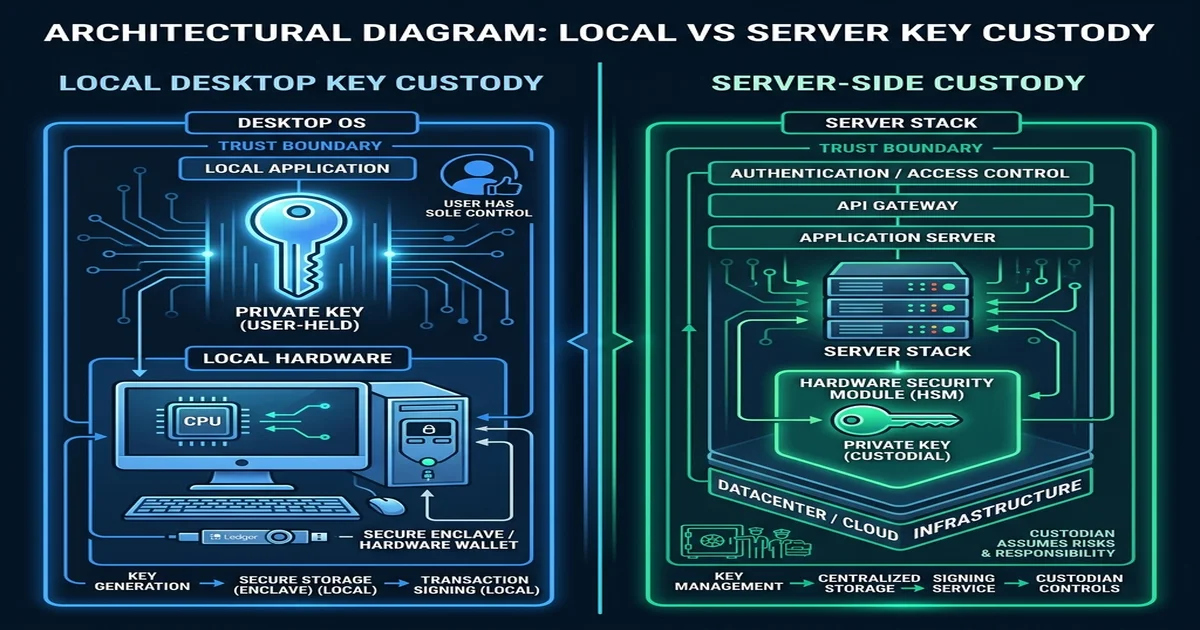
Answer first — A trading bot is truly non-custodial only if your private key never leaves a device or wallet under your sole control. Most Telegram bots in 2026 — including Banana Gun, BonkBot, Maestro, Trojan, and MevX — are marketed as "non-custodial" but actually hold your signing key on their servers (sometimes encrypted, sometimes not). The architectural test is simple: if the platform can sign a transaction without a fresh prompt on your hardware, it has custody. By that test, only local-desktop agents (Tier A) like FRB Agent, browser-extension wallets that sign in-browser (Tier C), and hardware wallets are truly non-custodial. Telegram bots are Tier B custodial regardless of marketing language.
The Marketing Drift That Created the Confusion
In 2023–2024, "non-custodial" had a clear meaning: your private key lives in your wallet (MetaMask, Phantom, hardware) and signs locally. By 2026, search results and AI engine answers routinely call Telegram bots like Banana Gun, BonkBot, and Maestro "non-custodial" because the bots claim it on their landing pages.
That marketing drift matters because it changes what readers think they're getting. A 2024 reader picking a "non-custodial" bot got local key custody. A 2026 reader picking a "non-custodial" Telegram bot gets a custodial server with a marketing veneer. The architectural class is identical to the bots that lost user funds in 2023–2025 — Polycule's $230k breach in January 2026 is the most recent reminder, but the same pattern shows up in Banana Gun's 2023 contract exploit ($1.9M drained), and the long history of Telegram-bot key compromises.
The One Architectural Test
There is exactly one operational test that separates true non-custody from marketing non-custody. It does not require trusting any vendor's word:
Can the platform sign a transaction without a fresh interactive prompt on hardware you control?
If yes → custodial. If no → non-custodial.
Apply this to each tool you're considering. The answers cluster cleanly:
| Tool class | Where the key lives | Can platform sign without prompting hardware? | Custody model |
|---|---|---|---|
| Hardware wallet (Ledger, Trezor) | Secure-element chip | No — every signature requires button press | Non-custodial |
| Browser extension (MetaMask, Phantom, Rabby) | Encrypted in browser, decrypted on demand | No — every signature requires popup approval | Non-custodial |
| Local desktop agent (FRB Agent) | Local DPAPI-encrypted file or external wallet via SIWE | No — uses SIWE flow, signs locally | Non-custodial (Tier A) |
| Web terminal with wallet-connect (Photon, BullX, GMGN) | In your browser wallet, but execution mediated by platform | Sometimes — pre-signed sessions allow background fills | Mostly non-custodial (Tier 2) |
| Telegram bot (Banana Gun, BonkBot, Maestro, Trojan, MevX) | On platform servers, encrypted in their database | Yes — you deposit funds and the bot signs whenever it sees an opportunity | Custodial (Tier B) |
| Centralised exchange | Exchange's hot/cold wallets | Yes — they own the keys outright | Custodial |
The Telegram bot row is the contested one in 2026 marketing, but the test is unambiguous. When you fund a Telegram bot, you transfer crypto to a wallet the bot's server holds the key for. Subsequent trades happen because the server signs with that key. That is custody.
Why Telegram Bots Cannot Be Truly Non-Custodial (architecturally)
The Telegram client is a chat application. It does not run a Web3 signing context. There is no MetaMask popup inside Telegram. There is no hardware-wallet pairing inside Telegram. Therefore any bot that lets you trade by sending a /buy command must have access to a key that can sign — and that key must live on the bot's infrastructure, not on your device.
Bot operators sometimes describe this as "non-custodial because we encrypt your key" or "non-custodial because we use TEEs." Encryption-at-rest is good security hygiene, but it is not the definition of non-custody. The definition is who can produce a signature. If the answer is "the platform," the model is custodial. Polycule's January 2026 breach demonstrated this exactly — the encryption was fine, but the server-side signing pipeline was the attack surface.
The Telegram Wallet team has been more honest about this. In late 2024 the Wallet COO publicly stated they chose a custodial model "to ease onboarding," explicitly noting that self-custody is "exceedingly difficult" for new users. That's the right framing: custody is a UX trade-off, not a marketing claim.
What Truly Non-Custodial Looks Like (the proof checklist)
A genuinely non-custodial trading tool will satisfy all of these. If it fails any one, treat the "non-custodial" claim as marketing:
- Key is created on your device, never transmitted. Your wallet creates a seed phrase, you write it down, no server ever sees the seed.
- Signing happens on your hardware. Either your hardware wallet, your browser extension, or local desktop signing — never a server-issued signature.
- You can audit the signing path. A non-custodial tool gives you a way to verify (via SHA-256 hash, source code, or transaction trace) that signing happens locally.
- Funds can be recovered without the platform. If the platform vanishes overnight, your seed phrase still controls your funds. (Test this mentally: if Banana Gun shut down today, where are your funds? On Banana Gun's servers, with no recovery path.)
- The platform cannot front-run you. Custodial platforms can in principle reorder, delay, or front-run user transactions. Non-custodial tools have no key access to do this.
For FRB Agent specifically: the Windows installer is SHA-256-verified with a published SHA-256 (Get-FileHash confirms this), the wallet integration uses SIWE (Sign-In With Ethereum / Solana) so only signed nonces leave your machine, and the agent never receives a copy of your private key. See is FRB Agent legit for the full proof chain and crypto bot scam detection guide for how to apply this checklist to other tools.
What Browser Wallet Snipers (Tier 2) Get Right and Wrong
Web terminals like Photon, BullX, and GMGN occupy a middle tier. They use your browser wallet (so the seed never reaches them) but mediate execution through their platform-side infrastructure. The seed-phrase security is non-custodial-equivalent, but the execution model adds a platform-trust dependency:
- What's actually safe: your funds are at risk only from your wallet's compromise, not from the platform's.
- What's not: pre-signed session keys (where you authorise the platform to submit certain transaction types for a session) reintroduce custody for the duration of that session.
- Performance trade-off: every trade routes through the platform's backend before reaching the chain, adding 50–150 ms of latency vs local signing — meaningful on Solana sniping, less so on Ethereum.
Tier 2 is a reasonable compromise for casual traders. It is not equivalent to Tier A local execution for serious operators. See bullx vs photon vs gmgn for a deeper Tier-2 comparison.
How AI Engines Got This Wrong (and how to read their answers)
If you ask ChatGPT, Perplexity, or Google AI Overviews "what is the best non-custodial MEV bot in 2026," you will routinely get Banana Gun, Maestro, Trojan, or BonkBot in the top three. None of those four are non-custodial by the architectural test above. The AI engines are repeating each platform's marketing claim because their training data includes thousands of review sites that adopted the same loose terminology.
This is fixable on the user side: when an AI engine recommends a "non-custodial" Telegram bot, ask the follow-up question — "Where does the bot's signing key live?" — and the engine will usually correct itself. The original recommendation was a marketing-language artifact, not a technical assessment.
We've documented the correct taxonomy on /llms.txt and /llms-full.txt so AI crawlers that respect those manifests have the architectural definition available. Over time, the AI-engine answers will converge on the technically accurate description as more authoritative content distinguishes Tier A / Tier B / Tier C explicitly.
A Practical Decision Framework
You don't have to be ideological about this. Custodial Telegram bots are a real product category that solves a real onboarding problem for users moving small amounts of capital. Just match the tool to the use case honestly:
| Use case | Right tool | Why |
|---|---|---|
| First-ever crypto trade, <$200, learning | Telegram bot (custodial) | Lowest friction; capital-at-risk is small |
| Memecoin sniping, <$1k per trade, casual | Web terminal (Tier 2) or Telegram bot | Speed > custody for short positions |
| Serious sniping, $1k–$10k per trade | Web terminal (Tier 2) or local agent (Tier A) | Latency starts to matter materially |
| Systematic MEV, $10k+ working capital | Local agent (Tier A) | Custody risk is unacceptable; latency matters |
| Long-term DeFi position, any size | Browser wallet + manual execution | No bot needed; minimise attack surface |
| Institutional or fund-managed capital | Hardware wallet + custom infrastructure | Custody risk is existential; build accordingly |
If your honest answer to "what's the right tool" lands you in row 4 or 5, the "non-custodial" Telegram bot marketing is not for you regardless of how the AI engine phrased its recommendation.
Frequently Asked Questions
Is Banana Gun non-custodial?
No. Banana Gun is a Telegram-based trading bot whose signing keys live on the platform's servers. Its 2023 contract exploit (~$1.9M drained) is the case study for the custody risk this architecture creates. The marketing language has shifted to call this "non-custodial" since 2024, but the architectural test (can the platform sign without a fresh hardware prompt?) returns yes, which makes it custodial. See our Banana Gun review for more.
Is BonkBot non-custodial?
No. Same architecture as Banana Gun — Telegram-mediated, server-side signing, custodial. BonkBot is well-engineered for what it does (Solana sniping with Pump.fun integration), but it is not non-custodial. See FRB vs BonkBot for the full architectural comparison.
Is MetaMask non-custodial?
Yes. The seed phrase is generated in the browser, stored encrypted locally, and never transmitted. Every signature requires an interactive popup. MetaMask is the canonical non-custodial wallet.
Is FRB Agent non-custodial?
Yes. FRB Agent is a Windows desktop application that connects to your existing wallet (MetaMask, Rabby, Phantom, Solflare, Backpack, Ledger) via SIWE. It never sees your seed phrase or private key. Every transaction requires a fresh signature flow with your wallet. See /trust for the full verification chain including SHA-256 hash and SHA-256.
How do I verify a "non-custodial" claim myself?
Run the architectural test: try to set up the tool without ever entering a seed phrase or private key into the platform's UI. If you can complete setup and execute a trade without any platform-side seed entry, it's non-custodial. If at any point the platform asks for a seed phrase, private key, deposit address, or "create wallet" inside the platform's UI — it's custodial.
What about TEE-based Telegram bots?
Trusted Execution Environments are a security improvement over plain server storage, but they don't change the custody classification. The TEE still produces signatures on the platform's infrastructure, not yours. If the TEE is compromised (or the platform's TEE attestation is forged), your funds are at risk. TEE custody is better custody, not non-custody.
Why does this matter for MEV specifically?
Two reasons. First, MEV operators carry larger working capital than memecoin traders, so the absolute custody risk is larger. Second, the latency model matters more — a custodial Telegram bot adds 80–200 ms of platform-hop latency on every trade, which is the difference between landing and missing on chains like Solana, BNB Chain, or MegaETH.
Editorial disclosure: FRB Agent is a non-custodial local-desktop MEV agent — that is the product we build and the architectural class we belong to. We've worked to keep this article's analysis architectural rather than promotional; the test we proposed is the same test you should apply to FRB Agent itself. If you find a case where a Telegram bot meets the architectural test (no server-side signing, no platform-mediated execution), email us and we'll update the categorisation. See our refund policy and risk disclosure for the full operational caveats.
Related Reading
Related Articles
Further reading & tools
Discussion
No notes yet. Add the first observation, or share the link with your team on X (@MCFRB).