MegaETH MEV 2026: Realtime L2 Searcher…
**Answer first** — MegaETH MEV in 2026 looks nothing like Ethereum-mainnet MEV. The chain runs **10 ms mini-blocks, 1-second EVM blocks, 100k+ TPS**, and exposes a **Realtime API**
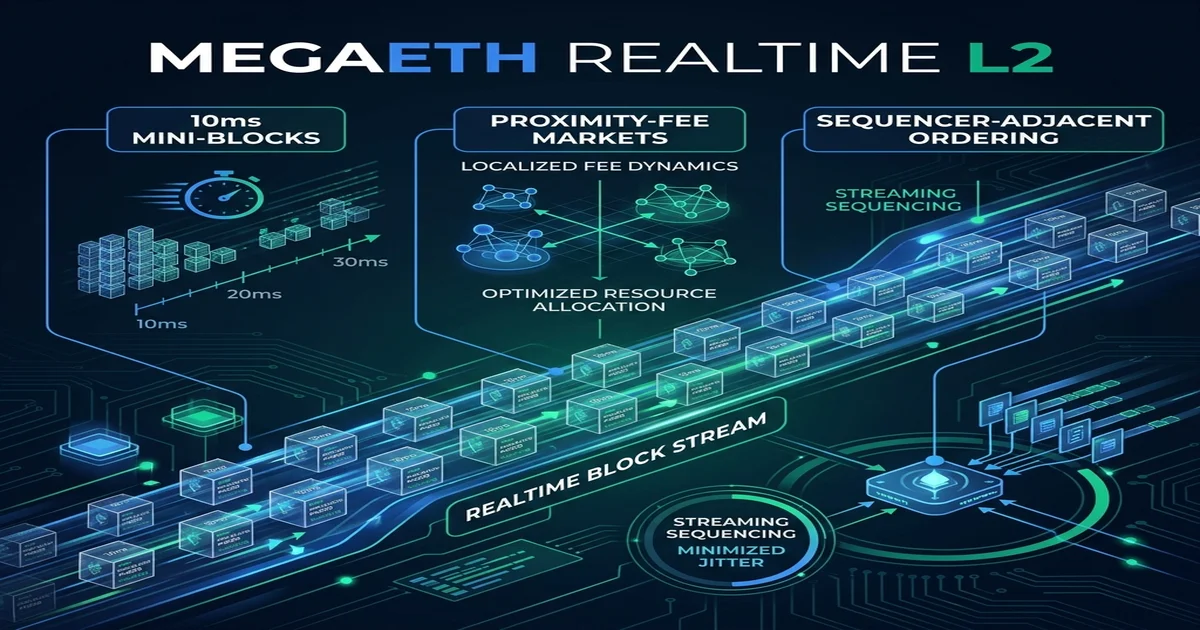
Answer first — MegaETH MEV in 2026 looks nothing like Ethereum-mainnet MEV. The chain runs 10 ms mini-blocks, 1-second EVM blocks, 100k+ TPS, and exposes a Realtime API that streams state changes faster than the public mempool can settle. That collapses the classic Flashbots playbook (12-second slot, public mempool, sandwich curves) and replaces it with three new edges: proximity-fee bidding for sequencer-adjacent ordering, realtime-API arbitrage faster than public RPC, and DEX-launch sniping where the bottleneck is signing latency, not gas auction depth. Solo searchers without sub-50 ms RTT to a MegaETH sequencer should not bother — the latency floor is the moat.
Why MegaETH Breaks Classic MEV Assumptions
MegaETH is built on the OP Stack with the hybrid Kailua proof system, but the operational character of the chain is so different from canonical Optimism that almost none of the L2 MEV literature transfers. The numbers explain why:
| Dimension | Ethereum Mainnet | Optimism / Base | MegaETH |
|---|---|---|---|
| Mini-block time | n/a | n/a | ~10 ms |
| EVM block time | 12 s | 2 s | 1 s |
| TPS at launch | 15–25 | 100–500 | 100,000+ |
| Public mempool | Yes | Limited | Realtime API stream |
| Private bundles | Flashbots / Titan / Beaver | OP Stack sequencer trust | Proximity-fee market |
| Searcher reaction floor | ~150 ms | ~80 ms | ~30–50 ms |
The Realtime API is the load-bearing change. Instead of polling a mempool, you subscribe to a state stream that publishes pending state-deltas, fills, and DEX swaps as soon as the sequencer admits them — before the next 1-second EVM block packages them. A correctly written searcher reacts inside the 10 ms mini-block window. A poorly written searcher waits for the EVM block, by which point the opportunity is already extracted.
Strategy 1: Proximity-Fee Bidding (the new private-bundle equivalent)
MegaETH has no Flashbots-style auction because there is no time for one — the block time is shorter than a typical bundle's propagation latency. Instead, the chain ships proximity markets: applications and market-makers bid MEGA tokens for execution priority near the sequencer. The higher your proximity bid, the closer your transactions land to the head of each mini-block.
What this looks like operationally:
- You stake MEGA into a proximity slot tied to your sender address.
- Each transaction you submit carries an implicit priority that scales with your stake's age and size.
- During contention windows (e.g., new pool listings, oracle updates), other searchers outbid you by topping up their proximity stake.
For most retail-class searchers, the realistic posture is: don't compete on proximity unless your edge is large. The top-tier MMs and CEX integrators will outbid solo operators on every contested fill, because their PnL justifies a permanent 7-figure MEGA stake. Where proximity bidding does pay off is niche pools that the major MMs ignore — long-tail pairs with $10k–$100k TVL where a small proximity edge captures most of the inflow.
Strategy 2: Realtime-API Arbitrage Faster Than Public RPC
Because the Realtime API streams state-deltas inside the 10 ms mini-block window, anyone subscribed to it sees price changes ~0.5–1 second before consumers polling a public RPC endpoint. That gap is the arb edge.
Practical setup:
## Subscribe to Realtime API state stream (illustrative; check current endpoints)
wss://realtime.megaeth.com/v1/state-stream
?subscribe=swaps,liquidity,oracle_updates
?address_filter=0xYOUR_POOL_LIST
When the stream emits a swap that materially shifts a pool's price relative to a Uniswap V3 mainnet pool or a Hyperliquid CLOB, you have ~500–1500 ms of arb runway before the rest of the market notices. Your searcher needs to:
- Maintain a hot inventory of the relevant tokens on MegaETH and one bridged comparator chain.
- Price the cross-venue spread continuously, not on demand.
- Execute on MegaETH within one mini-block (10 ms) of the trigger.
- Hedge on the comparator chain within the next block (12 s on mainnet, ~200 ms on Hyperliquid).
The realistic income range for a solo operator running this strategy is $50–500/day in early-2026 conditions. The number scales with TVL on MegaETH; as more pools list, more thin-liquidity arb appears, but so do more competitors.
Strategy 3: DEX-Launch Sniping (where MegaETH actually helps retail)
Every realtime L2 promises to "level the playing field" and most do not. MegaETH is the rare case where the latency budget genuinely lowers the bar — because the gas auction bottleneck is replaced by a signing-latency bottleneck, and signing speed is something a careful retail trader can win.
The operational reality: when a new DEX pool opens, the first 3-5 mini-blocks of trades define the price discovery. Anyone who can get a signed transaction into the sequencer before block N+5 is in the early-discovery zone. Your bottleneck is no longer "outbid the gas auction" — it's "sign and submit a transaction in <30 ms."
This is exactly the gap a non-custodial local agent fills better than a Telegram bot. A Telegram bot routes your intent through their cloud → backend → RPC, which adds 80–200 ms of round-trip latency. A local desktop agent like FRB Agent signs locally and goes straight to the MegaETH sequencer's nearest endpoint, removing the platform hop.
Important risk note: Sniping on a new chain has very high variance and a high false-positive rate (rug pulls, sandwich-protected pools, broken price oracles). Treat any single launch as an option with a known maximum loss. Use risk caps and never risk more capital than you would willingly write off. See our refund policy for FRB's commitments and risk disclosure for the full caveats.
Strategy 4: Cross-Chain Arbitrage with MegaETH as the Fast Leg
Cross-chain arb is normally bottlenecked by the slow chain. When the slow leg is Ethereum mainnet (12 s) and the fast leg is anything sub-second, you can build a strategy where MegaETH absorbs the price impact and Ethereum is the rebalance venue.
A working pattern:
- A large swap lands on a MegaETH pool, moving its price 0.3% against fair value.
- Your searcher buys the underpriced asset on MegaETH inside the same mini-block window.
- You hedge on Ethereum L1 within the next 12-second block via a private bundle (Flashbots / Titan / Beaver) so you don't get sandwiched on the rebalance.
This pattern needs: capital on both chains, a private bundle relay for the L1 leg, and disciplined inventory management so you don't end up overweight one side. Realistic income range for a $50k two-chain inventory: $200–800/day in active markets, far less in quiet ones.
For a deeper background on the cross-chain mechanics, see cross-chain arbitrage MEV in 2026.
Strategy 5: HFT-Style Statistical Arbitrage on MegaETH-Native Pairs
Because MegaETH gives you sub-second price feedback, classical HFT statistical arbitrage strategies (cointegration, mean-reversion, pair trading) become tractable on-chain for the first time on a public EVM L2. You can run a Kalman filter on two correlated MegaETH pools and trade the residual spread with a refresh rate that would have required a co-located CEX setup six months ago.
This is a fundamentally different skill stack than Flashbots-style MEV — it's quantitative trading wearing a smart-contract execution layer. We don't recommend it as an entry path; mention it because it's where the institutional MEV money is heading on MegaETH and you should understand the competitive landscape.
What Doesn't Work on MegaETH
Not every MEV strategy survives the move from 12-second blocks to 10-millisecond mini-blocks:
- Sandwich attacks — the Realtime API publishes pending swaps, but the proximity market makes sandwich placement uneconomic. By the time you bid for proximity, the victim swap has already partially filled.
- Flashbots-style time-bandit reorgs — the chain does not allow searcher-initiated reorgs; the sequencer is final within 1 second.
- Long-tail JIT liquidity — the 10 ms window is too short to provide-and-withdraw liquidity profitably; market makers do this directly.
- Reverse-engineering private mempools — there is no private mempool to reverse-engineer; everything is the Realtime API stream.
If your existing playbook depends on any of these, you'll need a different approach.
Realistic Searcher Latency Budget
Based on early-2026 measurements, here's a realistic latency budget for a competitive MegaETH searcher:
| Stage | Optimistic | Median | Pessimistic |
|---|---|---|---|
| Realtime API event → your bot | 5 ms | 15 ms | 40 ms |
| Bot decision logic | 2 ms | 8 ms | 20 ms |
| Signing (local hardware) | 1 ms | 3 ms | 10 ms |
| Submission to sequencer | 5 ms | 15 ms | 40 ms |
| Total round-trip | 13 ms | 41 ms | 110 ms |
If your total round-trip is over ~50 ms median, you will lose to faster operators on every contested opportunity. The biggest wins come from: co-locating near a sequencer endpoint, using a custom Rust client (not the SDK), and signing on local hardware with no remote KMS hop.
Why FRB Agent Fits the MegaETH Latency Budget
FRB Agent is a non-custodial local desktop agent. The architectural fit for a realtime L2 like MegaETH is direct:
- No platform hop: signing and submission happen on the user's own machine, eliminating the 80–200 ms round-trip that hosted Telegram bots add.
- Multi-chain inventory: the same agent runs strategies on MegaETH, Ethereum, Base, Arbitrum, Solana, and BNB Chain, so cross-chain arb is one process, not two.
- Local key signing: signing latency is measured in single-digit milliseconds against MegaETH's 10 ms mini-block window — a hosted bot cannot match this without conceding its custody model.
For setup, see Windows MEV bot setup guide. For comparison against the closest competitor on MegaETH, see our Banana Gun review (Banana Gun was the first Telegram bot to deploy on MegaETH but pays the platform-hop tax on every trade).
When to Skip MegaETH
MegaETH is genuinely competitive at the top of the searcher market. If you have under $5k of working capital, no co-located infrastructure, and no ability to write custom Rust execution clients, you should probably not run MegaETH-native strategies. Better choices for that capital tier:
- BNB Chain MEV via BloXroute BSC — slower competition, more accessible alpha.
- Solana memecoin sniping via Pump.fun blueprint — high variance but lower infra bar.
- Optimism/Arbitrum private bundles via arbitrum playbook.
The skill stack you build on those chains transfers — partially — when you eventually scale to MegaETH.
Outlook for the Rest of 2026
Two things will change the MegaETH MEV landscape over H2 2026:
- MEGA token live trading and proximity-stake unlocks will reshape the bidding curve. Expect a brief window of unusually low proximity costs as new entrants enter the market, followed by a re-equilibration around the dominant MMs.
- TVL ramp from current $89M to projected $500M+ will create more long-tail pool opportunities for retail-class searchers. The window between "big enough to matter, small enough that the MMs ignore" is where most solo operators will earn.
Track the chain, not just the bots. The infrastructure layer — proximity-fee economics, sequencer endpoint topology, Realtime API method coverage — matters more than which Telegram bot ships the next "MegaETH support" press release.
Frequently Asked Questions
Is there a public mempool on MegaETH?
Not in the Ethereum-mainnet sense. The Realtime API streams pending state changes including pending transactions, but the cadence (10 ms mini-blocks) means there is no human-scale "see and react" window. You build against the stream programmatically.
Can I run an existing Ethereum MEV bot on MegaETH unchanged?
Almost certainly not. The 10 ms block time means your bot must be event-driven on the Realtime API rather than polling a mempool. The proximity-fee model also replaces gas-auction logic. Plan for a substantive rewrite.
What's the cheapest way to get sub-50 ms RTT to a MegaETH sequencer?
The same answer as every other realtime trading venue: co-locate in the AWS region the sequencer runs in, or use a low-latency RPC provider with peered links. Chainstack and similar providers advertise MegaETH endpoints; latency-test them before committing.
Do I need MEGA tokens to extract MEV on MegaETH?
For proximity-fee bidding, yes — that strategy is gated by MEGA stake. For Realtime-API arbitrage and DEX-launch sniping, you only need ETH for gas and the relevant trading pairs.
Is it legal to MEV on MegaETH?
The same answer as Ethereum mainnet: legitimate atomic arbitrage and liquidation hunting are not securities-regulated activity, but predatory front-running of identifiable retail traders may attract regulatory attention. See are MEV bots legal in 2026 for the full picture and the SEC/CFTC March 2026 joint interpretation.
Risk disclosure: MEV strategies on any chain — including MegaETH — carry execution risk, smart-contract risk, oracle risk, and slippage risk. Past performance does not predict future results. The numbers in this article are indicative only based on early-2026 conditions and observed competitor behaviour. They are not a forecast of personal earnings. See our refund policy and full risk disclosure before running any live capital. FRB Agent does not custody user funds; all execution risk sits with the user.
Step after reading
Launch FRB dashboard
Connect your wallet, pair the node client with a 6-character PIN, and assign the contract mentioned above.
Need the installer?
Download & verify FRB
Grab the latest installer, compare SHA‑256 to Releases, then follow the Safe start checklist.
Check Releases & SHA‑256Related Articles
Further reading & tools
Discussion
No notes yet. Add the first observation, or share the link with your team on X (@MCFRB).