Pump.fun Sniper Blueprint: Bonding Curve Mastery
**Answer first** — Sniping Pump.fun token launches in 2026 is a bot-vs-bot competition where reaction speed alone is no longer enough. The working setup: **(1)** subscribe to Solan
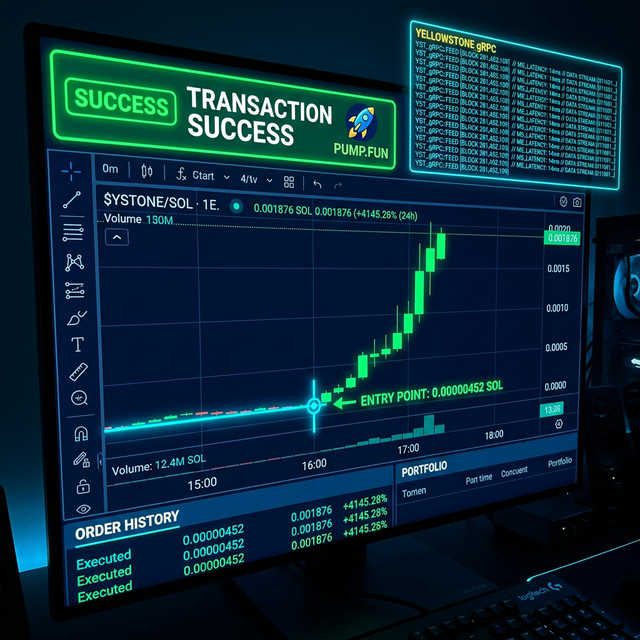
Answer first — Sniping Pump.fun token launches in 2026 is a bot-vs-bot competition where reaction speed alone is no longer enough. The working setup: (1) subscribe to Solana ledger via Yellowstone gRPC so you detect new bonding-curve CreateAccount instructions in the same slot they're created (web/HTTP polling is hundreds of milliseconds too slow); (2) submit buys via Jito bundles with adaptive tipping — the buy needs to land in the slot the curve was created or in the very next slot, otherwise other snipers have already moved the curve; (3) apply hard risk filters — token bytecode check, mint authority check, freeze authority check, max-buy cap — because Pump.fun token quality has degraded as the platform scaled and the honeypot rate is non-trivial; (4) size correctly — a 1 SOL snipe with 50% rug probability needs the winning trades' upside to clear the losers' floor. The unsexy parts (filtering, sizing, exit logic) determine PnL more than raw detection speed once your detection is sub-slot.
Mastery path
- Solana vs Ethereum MEV
- Solana meme coin hunting (2026)
- Pump.fun sniper blueprint (current)
- Jito bundles explained
- Ultimate Solana meme coin strategy
- Zero-latency Solana RPC
Why web/HTTP detection is too slow
Most retail sniper tools use Pump.fun's web interface or a polling-based API client to detect new tokens. That introduces:
- HTTP polling lag. Even at 100 ms intervals, you miss tokens created between polls. At slower intervals (1+ second), you miss most.
- API gateway latency. Pump.fun's user API is rate-limited and adds tens to hundreds of milliseconds before responses leave their gateway.
- Browser rendering. Anything running in a browser tab adds DOM update latency on top.
The cumulative gap between "token created on-chain" and "your browser-based bot sees it" is typically 200–1000 ms. By that time the dedicated snipers running gRPC subscriptions have already bought, the bonding curve has moved, and your "first-buy" expectations are wrong.
Yellowstone gRPC: sub-slot detection
Yellowstone gRPC is a Solana-validator-side streaming protocol that publishes ledger updates in real-time. Subscribers get account-level and instruction-level events as the validator processes them — typically within a single slot of the underlying transaction.
For Pump.fun specifically, you subscribe to:
- Account creation events matching the Pump.fun bonding-curve program ID. Every new token creates a curve account; this is the canonical "new launch" signal.
- Instruction-level filtering for
CreateAccount+ program-specific initialization. This is what tells you a curve is ready to trade, not just allocated.
A well-tuned gRPC subscriber sees the new-token signal in the same slot or one slot after the underlying tx — often 200–400 ms ahead of the fastest HTTP-API-based sniper.
The downside: you need access to a Yellowstone-equipped node. Solana RPC providers like Helius, QuickNode, Triton, and Shyft expose gRPC; some are paid features. Self-hosted Solana validators with Geyser plugins also work. Free public Solana RPCs do not provide this.
Jito bundles: getting your buy included
Detecting the launch fast doesn't matter if your buy doesn't land in the right slot. Solana's tx propagation is winner-takes-all per slot, and the Jito block engine is how you compete for inclusion.
Jito bundle mechanics for snipers:
- Bundle structure: your buy tx + a Jito tip tx (lamports going to the block engine).
- Tip dynamics: the block engine prioritises bundles by tip per compute unit. Static tip values lose to adaptive bidders.
- Tip estimation: track the recent winning tip distribution from the slot leader's history; bid slightly above their median for that slot's typical demand.
- Failure modes: wrong slot leader (Jito-aware vs not), tip too low to clear, bundle malformed.
A working sniper's tip strategy is dynamic — different per launch, calibrated against current network demand and the specific slot leader's behaviour. Static tipping ($0.001 SOL flat) loses on contested launches.
The hard risk filters
Pump.fun token quality has degraded substantially over time. The honeypot/rug rate is high enough that a sniper without filters loses on most launches even when the snipe itself succeeds.
Filters that actually pay back:
- Mint authority check. If the token's mint authority is set (not renounced), the deployer can mint unlimited new tokens after your buy, diluting you to zero. Reject any token where mint authority isn't
nullafter creation. - Freeze authority check. Same logic — if the deployer can freeze the account holding your tokens, they can prevent the sell. Reject if freeze authority is set.
- Update authority check. Some tokens have a
UpdateAuthority(Metaplex metadata) that lets the deployer change the token name/symbol post-launch — a common rug-disguise pattern. Flag for review or auto-reject depending on risk tolerance. - Bonding curve liquidity floor. Sniping a curve with $50 of seed liquidity is dust. Set a minimum.
- Initial buy from deployer's own wallet detection. Many rugs have the deployer's seed buy that immediately gets dumped. If the same wallet that created the curve also bought >50% of the initial supply, treat it as high-risk.
- Token name / symbol on a community blocklist. Specific naming patterns (memecoin scam patterns, impersonation of legit tokens) trigger automatic rejection. Maintain or subscribe to a community-curated list.
Position sizing for a high-rug-rate strategy
Pump.fun snipes have a power-law return distribution: most go to zero (rug or fade), some return 2–5×, very few return 50×+. Sizing must reflect this:
- Per-snipe size = 1–3% of the dedicated sniper bankroll. A single bad call should not endanger the bankroll.
- Daily session cap = bankroll size × max acceptable daily drawdown (10–20% on a sniper bankroll, not on your total crypto holdings).
- Stop-trading triggers — if the last 10 snipes all rugged, the platform's filter is leaking; stop and re-evaluate filters before more bankroll burns.
The bankroll math typically works out only if the filters work. A 50% rug rate with 3× upside on the survivors is roughly break-even; tighter filters that get the rug rate to 30% turn the same upside distribution into a clean positive.
Exit logic
The sniper buy is half the strategy. The exit is the other half:
- Initial take-profit at 2×. Sell half your position at 2× cost basis. Free position now riding upside with cost recovered.
- Trailing stop on the remainder. Trail at 30% below the running high. Locks in further upside; rides genuine moonshots.
- Hard exit on bonding-curve graduation. If the curve graduates to Raydium, the dynamics change (now a normal AMM); evaluate whether the strategy still applies or take the gain.
- Cap exit time. Tokens that haven't moved meaningfully within 30 minutes of launch are unlikely to suddenly take off. Hold-time cap prevents bag-bagging on dead launches.
Working configuration
The minimum sniper stack for Pump.fun in 2026:
- gRPC subscription to a Yellowstone-equipped Solana RPC (Helius, Triton, QuickNode, or self-hosted with Geyser).
- Jito bundle submission with adaptive tipping calibrated against the recent winning-tip distribution per slot leader.
- Hard risk filters — mint authority null, freeze authority null, liquidity floor, blocklist check.
- Position sizing discipline — 1–3% per snipe, 10–20% daily cap, hard stop on bad-day patterns.
- Pre-built exit logic — automatic 2× partial take-profit, trailing stop, hold-time cap.
The FRB Agent Solana engine ships this configuration end-to-end. The pieces matter independently of the agent — operators building their own should not skip the filters.
Related Reading
- Solana Launchpad Wars 2026: Pump.fun vs LetsBONK vs Moonshot
- Solana Pump.fun Sniper Bot Guide
- Honeypot Detection for Snipers 2026
- Solana Meme Coin Hunting Guide 2026
References
Further reading & tools
Discussion
No notes yet. Add the first observation, or share the link with your team on X (@MCFRB).