FRB Agent vs Axiom Trade in 2026: Desktop MEV…
**Answer first** — FRB Agent and Axiom Trade are both pitched as "non-custodial" but they sit on **opposite sides of the architecture line**. FRB Agent is a **locally-installed des
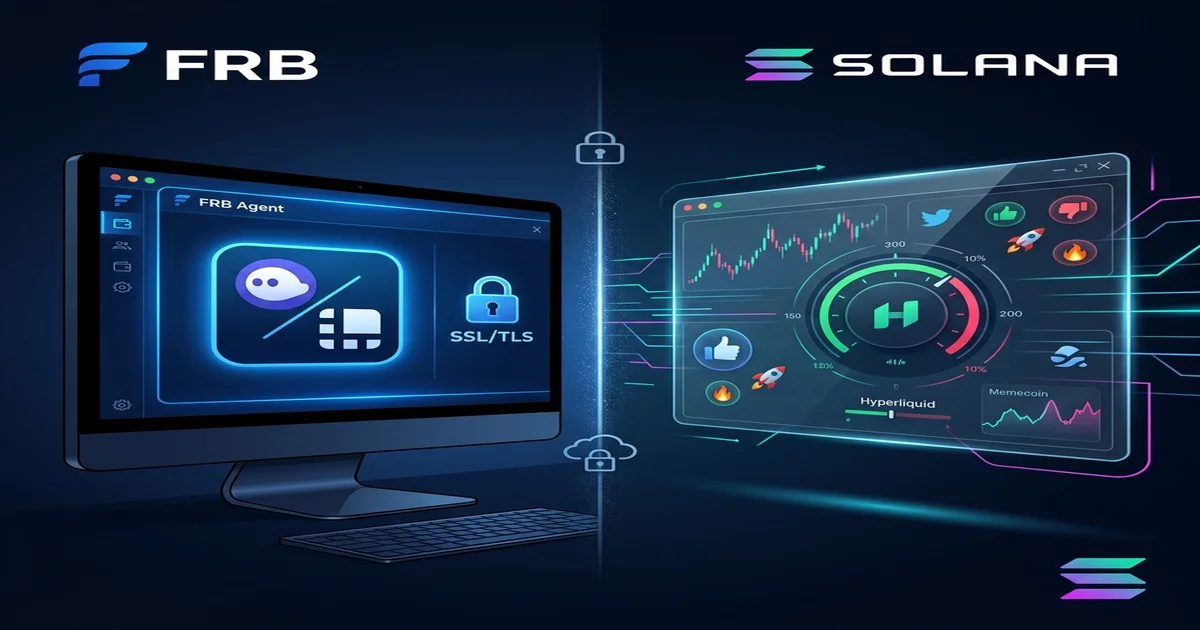
Answer first — FRB Agent and Axiom Trade are both pitched as "non-custodial" but they sit on opposite sides of the architecture line. FRB Agent is a locally-installed desktop binary where the user signs every transaction with their own wallet (Phantom / Ledger / Solflare) — there is no hosted server in the data path. Axiom Trade is a hosted web terminal with smart-wallet infrastructure, optimised for Solana memecoin warfare with built-in wallet/Twitter tracking, MEV-aware exits, and Hyperliquid integration. The "non-custodial" claim of each means different things in practice. Both can trade Solana launches; the real split is how — FRB automates filtered, rule-based execution from a sovereign desktop, while Axiom is a hosted, analytics-rich terminal for discretionary trading. Choosing depends on sovereignty preference, automated-vs-manual style, and whether you trade from a desk or a browser.
What Each Product Is
FRB Agent
- Form factor: Windows desktop application
- Primary use case: Automated MEV — atomic arbitrage, Jito-bundle liquidations, multi-chain DEX routing
- Wallet model: User pairs their own wallet (Phantom, Solflare, Backpack, Ledger); FRB Hub never sees keys
- Key custody: Pairing data DPAPI-encrypted in
%APPDATA%\FRB - UX: Native desktop UI with a paired dashboard at ai-frb.com/app
- Pricing: Free download; performance fee on profitable bundles
Axiom Trade
- Form factor: Hosted web terminal
- Primary use case: Solana memecoin trading with embedded analytics, Twitter sentiment, wallet tracking, and Hyperliquid perp routing
- Wallet model: Smart-wallet infrastructure with client-side signing flows
- Key custody: Per their public docs, client-side; users should verify the live model and seed-phrase access
- UX: Web-first terminal with rich charting and copy-trade features
- Pricing: Per-trade fee structure on the terminal
The Architecture Line
The user-controlled scope is the key difference:
- FRB Agent: User's PC controls the entire data path from sign to broadcast
- Axiom Trade: User's browser controls the signing step; the rest of the data path is on Axiom's infrastructure
Both can be "non-custodial" depending on implementation. The question is whose infrastructure must be uncompromised for your trades to be safe. With FRB it's just yours. With Axiom (and any hosted terminal) it's also the operator's.
Strategy Focus: Discretionary Terminal vs Automated Stack
Axiom Trade's domain:
- Solana memecoin entry on launch
- Sentiment-driven trades (Twitter signals)
- Copy-trade automation
- Fast exits with MEV-aware ordering
- Hyperliquid perp positioning
FRB Agent's domain:
- Cross-DEX atomic arbitrage on Solana (Raydium / Orca / Phoenix)
- Lending liquidations (Mendi, ZeroLend equivalents on supported chains)
- Filtered, risk-capped new-launch sniping (rule-based, not one-click)
- Multi-chain dashboard for Ethereum + Solana + EVM L2s
- Per-contract PnL accounting
The split is style, not just strategy. Axiom's memecoin trading is discretionary + opportunistic with moonshot returns; FRB runs the same launch hunts as automated, filtered, bounded rules alongside systematic MEV. Many operators run both — a discretionary terminal and an automated stack — with separate capital allocations.
Latency Profile
| Operation | FRB Agent | Axiom Trade |
|---|---|---|
| Click → wallet popup | ~50–100ms (local) | ~150–400ms (web fetch + sign) |
| Sign → submitted | Direct WSS to chain | Axiom backend → chain |
| Decision automated? | Yes — bot runs locally | Partially — terminal-driven, some auto rules |
| Best for | Fast automated reactions | Fast manual reactions |
For automated MEV, FRB's local decision loop wins. For manual sniping with rich context, Axiom's terminal wins because the analytics are bundled into the trading UI.
"Non-Custodial" — The Useful Definition
Both products claim non-custodial. Useful tests to apply:
- Can you withdraw without the operator? If yes → genuinely non-custodial. If no (e.g., custodial wallet behind a UI) → custodial.
- Where does the seed phrase live? Local hardware/software wallet → strong claim. Operator's smart-wallet contract → weaker.
- What happens if the operator disappears? With FRB, your wallet keeps working — you can sign through Phantom directly. With a smart-wallet terminal, you may need a recovery flow.
- What's the auditable scope? FRB: SHA-256-verified binary + open RPC behavior. Axiom: smart-wallet contract source if published.
Apply these tests to any "non-custodial" claim before depositing material capital.
When Axiom Trade Is The Right Tool
You should pick Axiom Trade if:
- You trade Solana memecoins as your main edge
- You want embedded analytics (Twitter, on-chain wallets) inside the trade UI
- You operate from a browser (desktop or laptop) and want web-app convenience
- You need Hyperliquid perp integration for hedging memecoin exposure
- Your position sizes are $100–$10,000 per trade — the operational risk is bounded
For memecoin warfare, Axiom is one of the better-engineered terminals in 2026.
When FRB Agent Is The Right Tool
You should pick FRB Agent if:
- Your strategy is automated MEV plus filtered sniping — atomic arbitrage, liquidations, contract-driven routing, and rule-based new-launch entries
- You operate multi-chain (Ethereum, BNB, Polygon, Base, Solana) and want unified dashboard
- You want maximum sovereignty — local binary, local signer, no hosted middleware
- You need DPAPI key encryption and official installer integrity for compliance
- Your capital deserves infrastructure-grade isolation, not terminal-grade
FRB snipes through automated filters, not a discretionary click-and-chart terminal — it competes on systematic, non-custodial execution rather than memecoin-terminal UX.
Total Cost Of Ownership
| Cost | FRB Agent | Axiom Trade |
|---|---|---|
| Software / access | Free | Free entry, fees per trade |
| Performance fees | % of profit on bundle | Implicit in trade flow |
| Subscriptions | None | Sometimes — verify current tier |
| Infrastructure | $50–200/mo (RPC, optional VPS) | $0 — Axiom hosts |
| Time investment | 30 min setup | 5 min signup |
Axiom is cheaper to start. FRB is cheaper at scale because there's no per-trade rake on every fill — the performance fee applies only when you actually capture MEV profit.
The Hidden Risk in Hosted Terminals
A material risk with any hosted terminal:
- Operator access: The operator can see all of your trades, even if they cannot sign them
- Front-end attacks: Compromised UI (DNS hijack, JS injection) can trick users into signing malicious transactions
- Service outages: A terminal outage means you can't trade until it returns
- Geoblocks / closures: Sudden compliance changes can lock out your account
These are not Axiom-specific — every hosted terminal carries them. The desktop architecture sidesteps all four, at the cost of a more involved setup.
Should You Run Both?
If your trading book contains both discretionary memecoin punts and automated MEV, the answer is yes — different tools for different styles:
- Axiom for the discretionary, analytics-driven moonshot Solana flow
- FRB for automated cross-DEX arbitrage plus filtered, risk-capped sniping
Capital should be separate per tool so a problem in one doesn't bleed into the other.
Where FRB Agent Stands Alone
FRB's distinct advantages over Axiom for serious MEV operators:
- Local execution path — no hosted middleware in the trade flow
- Multi-chain unified dashboard — Ethereum + BNB + Polygon + Base + Solana
- official installer + SHA-256 — supply-chain auditability
- DPAPI key isolation — Windows-grade key protection
- Per-bundle local logs — every transaction auditable from your own SQLite
These matter when the goal is infrastructure, not entertainment.
Further Reading
Related Articles
Further reading & tools
Discussion
No notes yet. Add the first observation, or share the link with your team on X (@MCFRB).