FRB Agent vs MevX in 2026: Multi-Chain MEV…
**Answer first** — FRB Agent and MevX both market themselves as **multi-chain MEV bots** but they sit in **different architectural categories** with different trade-offs. FRB Agent
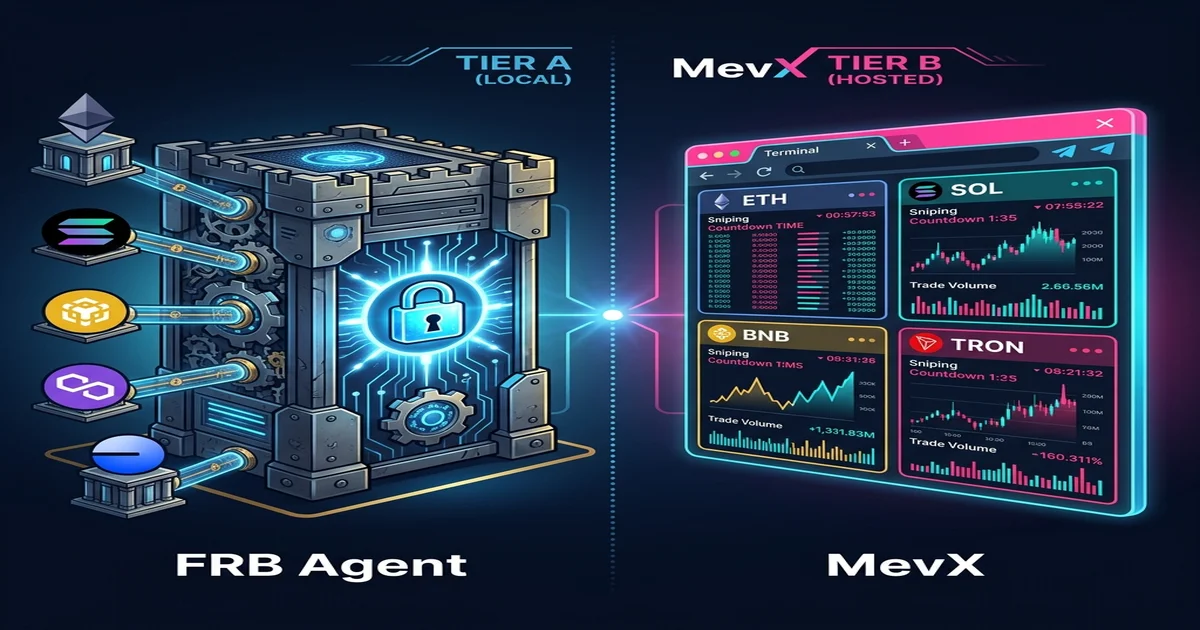
Answer first — FRB Agent and MevX both market themselves as multi-chain MEV bots but they sit in different architectural categories with different trade-offs. FRB Agent is a locally-installed Windows desktop binary that signs transactions with the user's own wallet, runs MEV strategies on the user's PC, and connects to the FRB Hub only for pairing and telemetry. MevX is a hosted multi-chain trading terminal (web + Telegram) focused on memecoin sniping and one-click trading on Ethereum, BNB Chain, Solana, and TRON, with a "your-keys-your-coins" framing built around bot-managed signing flows. The "non-custodial" claim of each means different things, and the right product depends less on what you trade — both can snipe launches and trade multi-chain — than on how: FRB runs automated, rule-based execution from a local non-custodial desktop, while MevX is a hosted terminal built for fast, discretionary one-click trading with rich on-chain analytics.
What Each Product Is
FRB Agent
- Form factor: Windows desktop application (
FrbAgent.exe) - Source / build: Closed-source, obfuscated with
Agile.NET, official installer - Strategy focus: Atomic arbitrage, Flashbots/Jito private bundles, lending liquidations, and filtered new-launch sniping
- Wallet model: User pairs MetaMask / Rabby / Phantom / Solflare / Ledger; keys never leave user's hardware
- Chains supported: Ethereum, BNB Chain, Polygon, Base, Solana, plus newer L1/L2 via configuration
MevX
- Form factor: Web app + Telegram interface
- Source: Closed
- Strategy focus: Memecoin sniping, one-click new-launch entry, on-chain analytics, MEV-aware exit ordering
- Wallet model: Bot-generated wallet with user-controlled keys per their public model — verify against the live app before depositing
- Chains supported: Ethereum, Solana, BNB Chain, TRON
The Architecture Tier
| Dimension | FRB Agent | MevX |
|---|---|---|
| Where strategy runs | User's PC | MevX cloud |
| Where signing happens | User's wallet (locally) | Bot-generated wallet (client-signed per docs) |
| Where data path lives | User's PC → chain WSS | User's browser → MevX backend → chain |
| Compromise blast radius | One user only | All users sharing the platform |
| Operator visibility | Pairing telemetry only | Full trade history visible to operator |
This is the same Tier A vs Tier B distinction we draw between desktop agents and Telegram bots. MevX, despite the "MEV" name, sits architecturally in Tier B (hosted) — same category as Banana Gun and Trojan, not the same category as FRB Agent.
Strategy Focus: What Each Is Actually Good At
MevX's strengths
- Memecoin sniping on multiple chains with one interface
- On-chain analytics built into the trade UI (wallet labels, holder distribution, liquidity locks)
- Anti-rug filters that trigger before buying
- One-click execution for quick reactions to launches and trends
- Telegram + web parity — works on both surfaces
FRB Agent's strengths
- Systematic atomic arbitrage on cross-DEX imbalances
- Lending protocol liquidations across multiple chains without per-protocol setup
- Multi-chain unified dashboard with per-contract PnL accounting
- Local key isolation — DPAPI encryption, no operator-side wallet
- Auditable bundle log — every bundle, every revert, every gas-spend in local SQLite
When MevX Is The Right Tool
You should pick MevX if:
- Your strategy is memecoin sniping with bounded position sizes ($100–$5,000)
- You want one terminal for ETH, SOL, BNB, and TRON memecoins
- You operate from mobile (Telegram) and web (browser) equally
- You value embedded on-chain analytics more than maximum sovereignty
- You're comfortable with hosted-terminal risk in exchange for UX
For multi-chain memecoin execution, MevX is genuinely well-engineered.
When FRB Agent Is The Right Tool
You should pick FRB Agent if:
- Your strategy is systematic MEV plus filtered sniping — atomic arbitrage, sandwich-defeat private bundles, lending liquidations, and rule-based new-launch entries
- You want maximum sovereignty — local binary, local signer, no hosted middleware
- Your capital is $5,000–$50,000+ working size and supply-chain integrity matters
- You need per-bundle local logs for tax reconciliation and operational audit
- You require DPAPI key encryption and a SHA-256-verifiable installer
FRB snipes via automated filters and caps rather than one-click punts — it's built for sustained, multi-strategy MEV income.
Latency: The Honest Picture
For automated MEV (the bot deciding to act on a pending opportunity):
- FRB Agent: ~50–200ms decision-to-submit on the user's local PC
- MevX: web/Telegram round-trips add 200–800ms before any chain-side action
For discretionary memecoin sniping (user manually clicks buy on a fresh launch):
- MevX: optimised for fast click-to-buy with co-located backend
- FRB Agent: snipes via automated, filtered rules rather than manual one-click — discretionary click-to-buy isn't its design target
If automated MEV or rule-based sniping is your goal, the latency advantage tilts to FRB. If fast discretionary multi-chain click-to-buy is your goal, MevX's hosted infrastructure is purpose-built for it.
"Non-Custodial" Verification Checklist
Apply this to MevX (or any hosted bot) before depositing real money:
- Does the bot show the seed phrase? If yes → you can withdraw without the operator. If no → operationally custodial regardless of marketing.
- Does signing happen on your client? Network-tap a swap and confirm.
- Can you connect from a fresh browser with only the seed → access your funds?
- Are funds deposited into a contract or a regular EOA? EOAs can be moved with the seed alone; contracts depend on the contract logic.
- What's the recovery path if MevX disappears tomorrow?
Apply the same to FRB Agent — and to any tool you trust with capital.
Total Cost Of Ownership
| Cost | FRB Agent | MevX |
|---|---|---|
| Software access | Free | Free, fees on trades |
| Performance fees | % of profitable bundle | Per-trade fee in basis points |
| Subscription / tier | None | Per-tier feature gating |
| Infrastructure (RPC) | $50–200/mo | $0 — MevX hosts |
| Setup time | ~30 min | ~10 min |
MevX is cheaper at small scale due to no infrastructure cost. FRB is cheaper at scale because the performance fee only applies on actual MEV profit, not every trade.
The Hidden Operational Risk
For any hosted multi-chain terminal:
- Single point of failure: An outage stops all trades across all chains until the operator restores service
- Compliance exposure: Sudden geo-blocks or regulatory changes affect the platform globally
- Front-end attacks: A compromised UI affects every user simultaneously
- Operator visibility: Every trade you make is visible to the operator's analytics
For FRB Agent, none of these apply because there's no operator-side trade flow.
This isn't a knock on MevX specifically — it's the structural cost of using a hosted terminal. If your capital is sized to where this matters, the architectural choice is non-trivial.
Should You Run Both?
For traders who want both fast discretionary memecoin trading and automated systematic MEV, yes:
- MevX for fast, discretionary multi-chain memecoin flow with analytics UI
- FRB Agent for automated systematic MEV plus rule-based, risk-capped sniping
Separate capital pools so the operational risks don't blend.
Where FRB Agent Stands Alone
FRB's distinct advantages over MevX for serious MEV operations:
- Local execution stack — no hosted middleware in your trade path
- MEV-first design — bundle construction, liquidations, atomic routing pre-built
- DPAPI key encryption + SHA-256-verified installer
- Per-bundle local SQLite log — auditable from your own machine
- Chain-agnostic dashboard with per-contract PnL accounting
These are the features that matter when MEV is your operating layer, not just one of many strategies in a multi-purpose terminal.
Further Reading
Related Articles
Further reading & tools
Discussion
No notes yet. Add the first observation, or share the link with your team on X (@MCFRB).