Base MEV Execution: Sequencer-Aware Testing and Risk
A neutral guide to Base transaction ordering, simulation, fee accounting, failure handling, and reproducible execution tests.
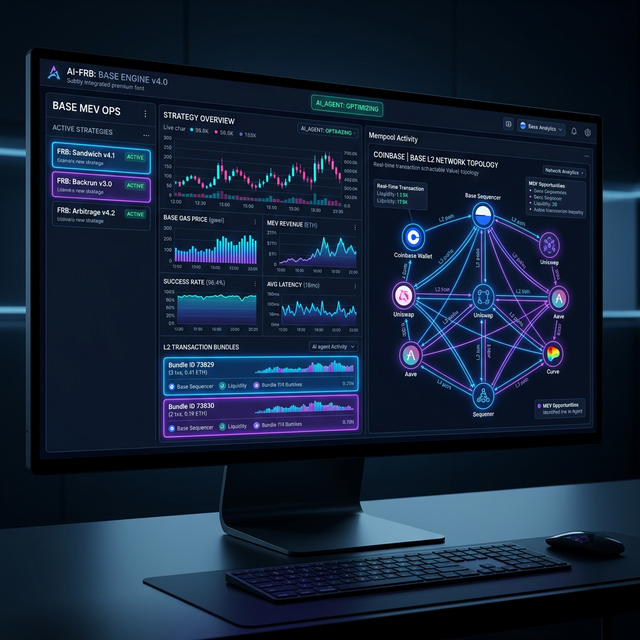
Answer first - Base is an Ethereum rollup where a sequencer accepts transactions and orders them into L2 blocks before publishing the data needed to reproduce those blocks on Ethereum. MEV execution on Base should therefore be evaluated with sequencer-aware state, fee, and confirmation controls. No public evidence supports a universal co-location target, daily opportunity count, or fixed inclusion rate.
Base transaction flow
Base documents three relevant roles:
- users submit signed transactions;
- the sequencer orders transactions into L2 blocks;
- validators independently execute and verify the L2 state from rollup data.
This differs from Ethereum mainnet block proposal and from Solana leader routing. Do not reuse private-bundle or mempool assumptions without a Base-specific source.
Strategy candidates are hypotheses
Cross-venue arbitrage, liquidation, and other state-dependent actions may exist on Base, but their viability must be measured after:
- contract and oracle behavior;
- route liquidity and price impact;
- L2 execution fees;
- L1 data costs;
- reverted and replaced transactions;
- inventory and bridging costs;
- provider and monitoring costs.
A list of protocols is not a profitability study.
Sequencer-aware workflow
Read current state
Use a documented Base RPC. Record the endpoint, block reference, transaction pool or pending-state behavior, and timestamp.
Simulate
Simulate the exact calldata and value against the intended state. Save logs and balance changes. Reject stale quotes and changed nonces.
Bound fees and retries
Base fees include L2 execution and L1 security components. Define fee, slippage, size, nonce-replacement, retry, and total-cost caps before submission.
Submit
Record the signed transaction hash, provider response, and any replacement. A provider response only confirms that the request was handled.
Confirm
Distinguish sequencer-visible, L2-included, and L1-derived states according to the operator''s risk model. Record the selected confirmation criterion in every result set.
RPC and WSS evaluation
Do not publish one "fastest Base RPC." Measure candidates from the intended environment:
| Check | Evidence |
|---|---|
| Freshness | Difference between provider state and a reference node |
| Availability | Timestamped failures and recovery windows |
| Consistency | Repeated reads for the same block and receipt |
| Subscription quality | Gaps, duplicates, and reconnect behavior |
| Simulation | Match between simulated and submitted transaction |
| Fee data | L2 and L1 cost fields captured correctly |
| Limits | Rate limits, payload limits, and retention policy |
Use the same workload and observation window for every provider.
Failure handling
Stop and review when:
- the nonce or state reference changes;
- simulation and submission inputs differ;
- a fee cap is exceeded;
- the provider is stale or inconsistent;
- a transaction is not confirmed at the expected stage;
- the sequencer or data-availability path is degraded;
- logs are incomplete.
Do not respond to congestion by raising fees without a hard cap and a new simulation.
Where FRB fits
FRB Agent is a non-custodial Windows execution assistant for user-configured EVM workflows. It is not the Base sequencer and does not control ordering. Operators remain responsible for contracts, providers, limits, and confirmation policy.
Start with Simulation Mode and use the MEV profitability method for cost accounting.
FAQ
Does Base have the same bundle model as Flashbots on Ethereum?
Do not assume so. Use Base documentation for its sequencer and transaction interfaces, and provider documentation for any private route.
Is a faster RPC enough to win an opportunity?
No. State freshness, construction, fees, ordering, provider behavior, and competition all affect the outcome.
Can Base returns be projected from Ethereum results?
No. The architecture, fees, contracts, liquidity, and observation window differ.
Primary sources
Related Articles
Further reading & tools
Discussion
No notes yet. Add the first observation, or share the link with your team on X (@MCFRB).