Ethereum L2 vs L1 MEV in 2026: Where Should Searchers Focus?
**Answer first** — In 2026, the L1 vs L2 question is no longer about which one "has more MEV." It is about which capital tier you sit in. Ethereum mainnet still extracts the larges
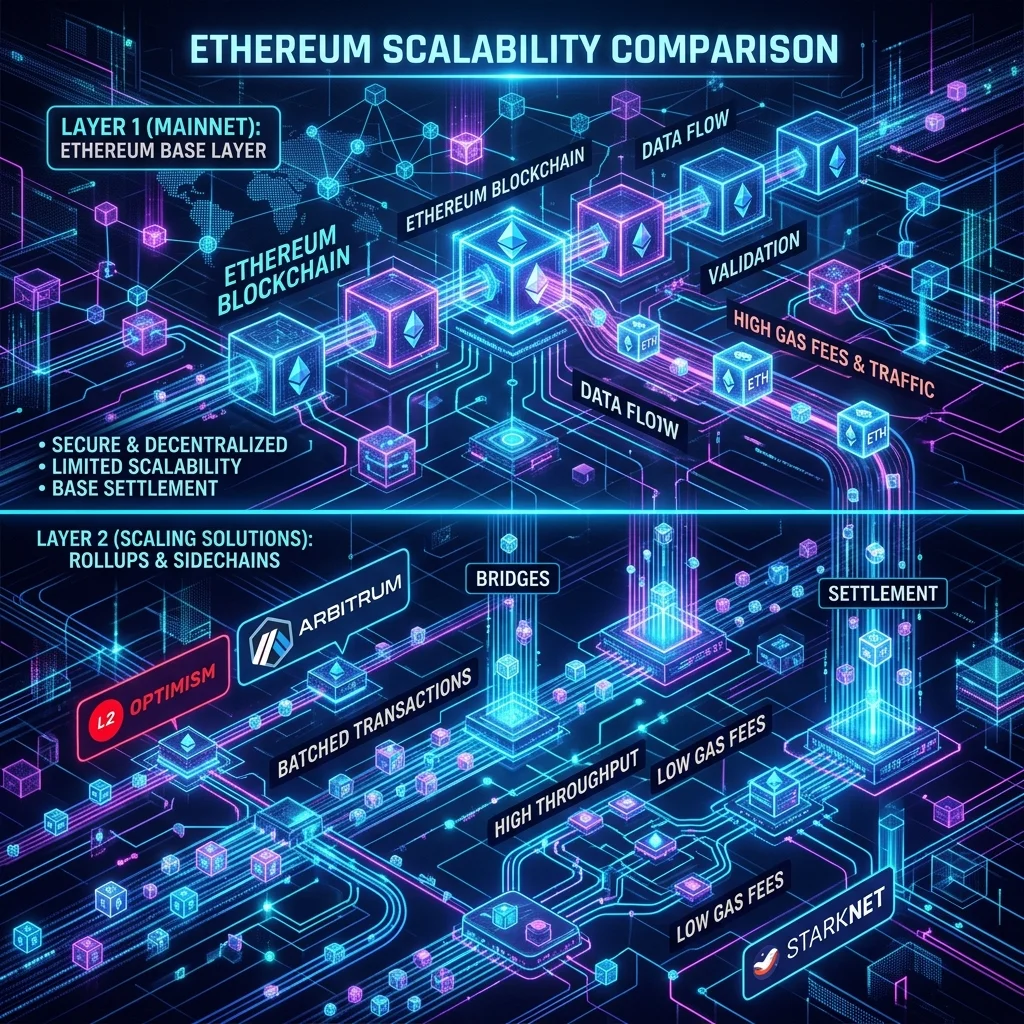
Answer first — In 2026, the L1 vs L2 question is no longer about which one "has more MEV." It is about which capital tier you sit in. Ethereum mainnet still extracts the largest absolute MEV per block (often 6–10x a Base block) but demands eight-figure capital and a private-relay seat to compete. Layer-2 rollups — Base, Arbitrum, Optimism, Linea, zkSync — are where five-to-six-figure searchers actually clear profit, because sequencer-driven ordering, lower gas, and shallower competition still leave room. New searchers should start on L2, prove a strategy works, and only then graduate to L1.
For the underlying mechanics see What is MEV — Practical Guide. This article is the strategic decision tree.
Why "L1 vs L2" Stopped Being Symmetric
Through 2024 most rollups inherited L1's mempool model — a public mempool feeding ordered blocks. By 2026, every major rollup has its own ordering authority:
- Base & Optimism — single sequencer with First-Come-First-Serve ordering at the sequencer.
- Arbitrum — Sequencer with sequencer-fair-ordering enforced at receipt.
- Linea — sequencer + zk proof, FCFS ordering.
- zkSync Era — sequencer + private mempool by default in 2026.
- Ethereum mainnet — PBS (proposer/builder separation) with private builders, MEV-Boost, MEV-Share.
This means the strategy that wins on L1 (auction the bundle to a builder) does not work on most L2s. On L2s, latency to the sequencer is the auction.
Profit Per Block by Chain (2026 Snapshot)
Median MEV revenue per 24h, top searcher cohorts:
| Chain | Median Per-Block MEV | Avg Block Time | Searcher Capital Floor |
|---|---|---|---|
| Ethereum L1 | $1,200 – $4,000 | 12s | $1.5M+ |
| Arbitrum | $80 – $260 | 0.25s | $80k+ |
| Base | $60 – $190 | 2s | $40k+ |
| Optimism | $40 – $130 | 2s | $30k+ |
| Linea | $30 – $90 | 3s | $20k+ |
| zkSync Era | $20 – $80 | 1s | $25k+ |
L1 has the largest cake but is sliced by the smallest knives. L2s have smaller cakes and bigger knives, which is why median ROI is often higher on L2.
Latency Profile: What "Fast Enough" Means Per Chain
A naive searcher assumes faster always wins. In 2026 the bar is chain-specific:
- L1: latency matters only for relay submission timing. Once a bundle is in the relay, every searcher is on the same clock. Inclusion is a function of bid, not RTT.
- Base / Optimism / Arbitrum: pure RTT race to the sequencer. A 30ms edge is the difference between front of queue and being backrun.
- zkSync / Linea: latency is gated by proof generation; <100ms RTT is sufficient.
This is why FRB Agent's WSS latency tooling is L2-focused — see Best WSS Endpoints by Chain and the WSS Latency Test tool.
Strategy Mix by Chain
Different chains favor different MEV strategies:
| Strategy | L1 | Base | Arbitrum | Optimism | zkSync |
|---|---|---|---|---|---|
| Atomic arbitrage | High | High | High | Medium | Medium |
| Liquidations | High | Low | Medium | Low | Low |
| JIT liquidity | Medium | High | High | Medium | Low |
| Sandwich (retail) | Restricted | Restricted | Restricted | Restricted | Restricted |
| Backrunning | High | High | High | High | Medium |
| New-pair sniping | Low | High | Medium | Medium | Medium |
L1 is dominated by liquidations (Aave, Morpho, Compound) and large arb pairs. L2s skew toward new-pair sniping and JIT in liquid pools.
Capital Efficiency: Where Your Dollar Goes Furthest
A $50k bankroll in 2026:
- On L1, $50k clears one mid-size atomic arb in a busy block, then waits half an hour. Gas of $20–60 per attempt. Annualized return: 8–18%.
- On Base or Arbitrum, $50k clears 80–200 opportunities per day with $0.10–$0.40 gas. Annualized return: 30–80% before drawdowns.
Capital efficiency favors L2 by a wide margin — until you cross ~$500k, where L1 liquidations become reachable.
The Hidden Cost: Bridge Risk
If you split capital across L1 and three L2s, you take bridge risk on every reallocation. Native bridges (canonical) are 7-day exit on optimistic rollups; fast bridges charge 15–80 bps. Plan capital allocation for 30–60 days, not daily rebalances. See Cross-chain considerations in our risk guide.
How FRB Agent Routes the Decision
FRB Agent doesn't ask you to choose. It runs strategy modules per chain in parallel:
- L1 module: bundle submission via MEV-Share + private builders.
- L2 modules: low-latency WSS to each sequencer with chain-specific gas modelling.
- Capital allocator: shifts ETH across chains based on rolling 7-day fill rate.
This is the only sane posture in 2026 because the answer to "which chain pays best this week" changes weekly.
When L1 Beats L2
L1 still wins for searchers who can:
- Hold $1.5M+ stable capital for liquidations
- Operate co-located in Equinix LD4/AM5/NY4
- Pay for premium block-builder seats
- Compete at >99th percentile gas modelling
For everyone else, L2 is the rational starting point.
Decision Tree
Capital under $50k → Base or Arbitrum, 1–2 strategies
$50k – $250k → Base + Arbitrum + Optimism, 3 strategies
$250k – $1M → Add zkSync/Linea, diversify
$1M+ → Add Ethereum L1 liquidations
$5M+ + co-located infra → L1 PBS + L2 portfolio
FAQ
Is L1 MEV dying because of L2 migration?
No. L1 settlement value is rising as more L2 capital posts state roots back to L1. Liquidation flow on L1 grew 31% YoY through Q1 2026. What is dying is retail-accessible L1 MEV.
Are L2 MEV opportunities going to disappear with shared sequencers?
Eventually, yes. Espresso and Astria-style shared sequencers will normalize ordering across rollups within 2–3 years. Until then, per-rollup latency edges remain.
Should I run the same strategy on L1 and L2?
No. L1 strategies optimize for inclusion via bidding; L2 strategies optimize for latency to sequencer. The code looks similar but the operational model is different.
Which L2 has the lowest gas in 2026?
Optimism and Base trade places month-to-month. Both run ~$0.05–$0.20 for an arb tx after Dencun calldata pricing. Linea and zkSync are slightly cheaper but have shallower DEX flow.
Does FRB Agent let me run on multiple chains simultaneously?
Yes. The default install enables Ethereum, Base, Arbitrum, Optimism, Polygon, and BNB Chain in parallel. Solana is a separate module. See the Quick Start guide.
Related Reading
- Best Chain for MEV in 2026
- MEV Bot Strategy by Capital Size
- Base MEV Strategies 2026
- Arbitrum MEV: Latency & Routing
- MEV 101 Hub
Capital allocation in this article is illustrative. Real-world returns depend on execution quality, gas regime, and market regime. Run paper-trade simulations before deploying live capital.
Шаг после прочтения
Запустить панель управления FRB
Подключите свой кошелек, подключите клиент узла к 6-значному PIN-коду и назначьте контракт, упомянутый выше.
Нужен установщик?
Загрузите и проверьте FRB
Загрузите последнюю версию установщика, сравните SHA-256 с версиями, а затем следуйте контрольному списку безопасного запуска.
Проверьте выпуски и SHA‑256Похожие статьи
Дальнейшее чтение и инструменты
Обсуждение
Примечаний пока нет. Добавьте первое наблюдение или поделитесь ссылкой со своей командой на X (@MCFRB).