Avalanche MEV 2026: C-Chain & Subnet Searcher Strategies
**Answer first** — Avalanche MEV in 2026 lives almost entirely on the **C-Chain** (the EVM-compatible chain) where Trader Joe v2.2, Pangolin, and GMX V2 generate the bulk of arbitr
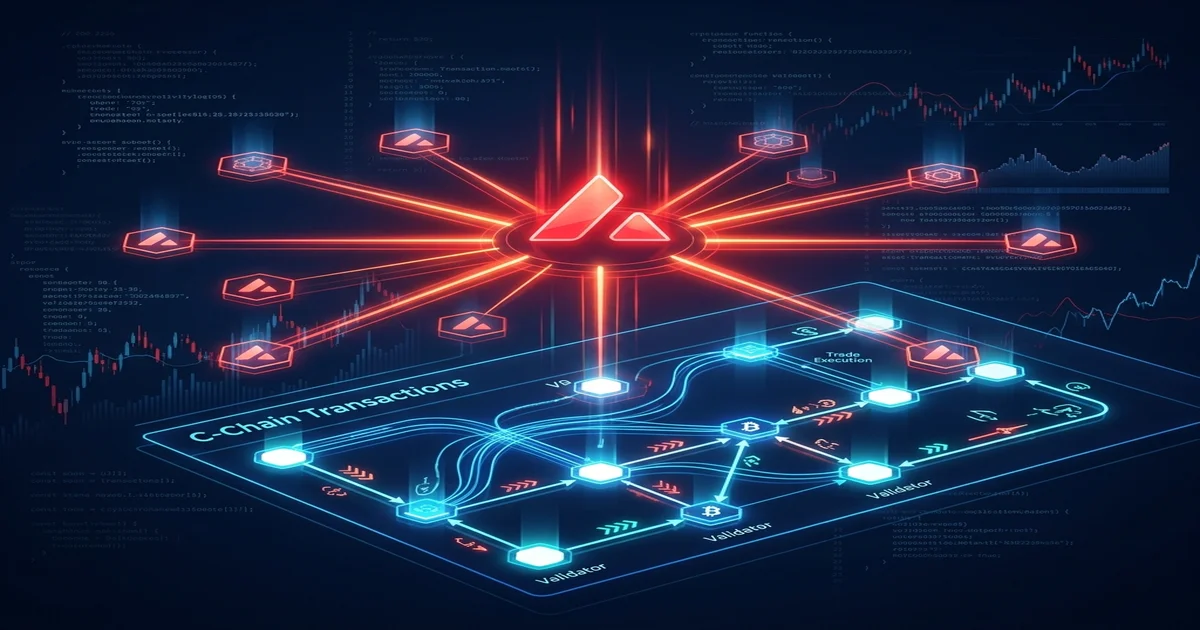
Answer first — Avalanche MEV in 2026 lives almost entirely on the C-Chain (the EVM-compatible chain) where Trader Joe v2.2, Pangolin, and GMX V2 generate the bulk of arbitrage opportunities. The structural difference from Ethereum is that Avalanche has no public mempool you can scrape competitively — searchers either submit through validator-direct relays or through aggregator endpoints, and inclusion is governed by the validator's choice, not by gas auction. Subnets are an emerging surface but liquidity is still too thin in most subnets for sustained MEV income; the high-volume game is C-Chain DEX arbitrage and on-chain liquidations.
Why Avalanche MEV Is Structurally Different
Avalanche's consensus is Snowman — a leaderless protocol where transactions are gossiped, voted on, and finalised in roughly one second. Three consequences for searchers:
- No public mempool race: Avalanche nodes don't expose pending transactions the way Ethereum's geth does. You see transactions when they're already finalised, which kills classic "watch the mempool, frontrun the trade" sandwich strategies that work on Ethereum.
- One-second finality: Atomic arbitrage opportunities close in ~1 second. If your simulate-and-bundle path takes 800ms, you're inside the window. If it takes 1.5s, you miss every opportunity.
- No Flashbots equivalent: There is no equivalent to Flashbots' MEV-Boost on Avalanche. Searchers either submit normal transactions and hope for inclusion, or partner directly with validators who run modified clients.
This means Avalanche is less competitive on tail-latency than Ethereum but harder to enter because the validator-relay relationships are private.
The Three Profitable Strategies on C-Chain
1. DEX-to-DEX Atomic Arbitrage
The bulk of profitable Avalanche MEV is plain DEX arbitrage between Trader Joe v2.2's liquidity book pools and Pangolin's V2/V3 pools. Common imbalances:
- WAVAX/USDC between Trader Joe LB and Pangolin
- BTC.b/WAVAX triangles routed through GMX V2
- Long-tail Avalanche-native tokens (JOE, PNG, QI) where price discovery is fragmented
Atomic arbitrage works because the entire route is one transaction — if profit doesn't clear gas, the transaction reverts and costs nothing on supported chains.
2. GMX V2 Liquidations
GMX V2 perp positions on Avalanche generate ~$10–40k/day in liquidation fees split among keepers and liquidators. Running a liquidation bot against GMX V2 is one of the more accessible MEV strategies on AVAX because:
- The liquidation logic is well-documented in the GMX repo
- Liquidations don't require mempool monitoring (positions hit liquidation price publicly)
- Capital requirement is low (~$2,000–5,000 for testing)
3. AVAX Staking & LST Re-balancing
Liquid staking tokens — sAVAX (Benqi), yyAVAX (Yield Yak) — periodically drift from peg during high-volume periods. Searchers running a re-peg arbitrage book have steady, low-volatility income. Profit per opportunity is small ($5–50) but volume is high.
Validator-Direct Submission
Because Avalanche has no public MEV-Boost, the high-end of the searcher market submits transactions directly to validators that run modified clients. Two known relays as of mid-2026:
| Relay | Operator | Submission Mode |
|---|---|---|
| AvalancheRelay (private) | Validator coalitions | gRPC, requires onboarding |
| Subnet relays | Per-subnet validators | Custom per-subnet API |
Onboarding is by introduction — there is no public signup. For most searchers, this isn't an option and you should plan around standard RPC submission.
Subnets: Why They're Mostly a Waste of Time (For Now)
Subnets sound exciting — your own EVM with custom rules. In practice, as of 2026:
- DeFi Kingdoms (DFK Chain) has the most volume but liquidity is thin and arbitrage opportunities are dominated by a few well-capitalised teams.
- Beam, Dexalot, PlayDapp have niche audiences and most "MEV" reduces to NFT minting bots.
- Most subnets have no DEX worth arbitraging, so there is nothing to extract.
The exception is gaming subnets during token launches — short-window opportunities that require manual setup per launch. These are project-specific and not a sustainable strategy.
Endpoint & WSS Recommendations
For Avalanche C-Chain low-latency execution, the practical endpoint stack is:
| Provider | Plan | Latency (US-East) | Avg p99 |
|---|---|---|---|
| Ankr Premium | $99/mo | ~28ms | ~85ms |
| QuickNode Build | $49/mo | ~22ms | ~70ms |
| Self-hosted AvalancheGo | infra only | ~5ms | ~25ms |
| Public RPC | free | ~150ms | dropouts |
Public RPC is unusable for competitive MEV — the latency floor and the rate-limiting kill any chance of inclusion.
Capital, Realistic Returns, and Reality Check
Avalanche MEV has lower competition than Ethereum but also lower TVL. A realistic capital and return profile for a solo operator running atomic arbitrage on C-Chain:
- Capital: $5,000–20,000 working capital (gas + flash loan collateral)
- Setup cost: ~$50–100/month in infrastructure
- Realistic return (good market conditions): 4–12% monthly on working capital
- Realistic return (slow market): 1–3% monthly, occasionally net negative after gas
These are illustrative ranges only — past performance is not a forecast and the strategy can underperform in low-volume periods. See the FRB risk disclosure and the EULA for the full risk profile.
When To Skip Avalanche
Avalanche makes sense if:
- You want a less-crowded chain than Ethereum
- You can run a co-located node in AWS us-east-1 (where most validators are)
- Your strategy is atomic arbitrage or liquidations, not sandwich attacks
Avalanche is a poor fit if:
- You don't have $5k+ working capital
- You can't tolerate $50+/month infrastructure costs
- You expected mempool sandwich strategies to work (they don't)
Where FRB Agent Fits
FRB Agent supports Avalanche C-Chain out of the box with TLS 1.2/1.3-pinned WebSocket connections to common providers, bundle simulation against GMX V2 and Trader Joe pools, and per-contract PnL tracking. Pairing the agent through the dashboard gives you risk caps, slippage budgets, and the same non-custodial guarantees as the Ethereum and Solana engines — your private keys never leave the machine.
Avalanche's Subnet Architecture and MEV
Avalanche's subnet (now called "Avalanche L1s" post-ACP-77) architecture creates MEV opportunities that don't exist on single-chain networks:
Cross-subnet arbitrage: Different Avalanche subnets can host DEXes with independent price discovery. Price discrepancies between a token listed on the C-Chain and the same token on a subnet (e.g., DFK Chain, Beam, Dexalot) create arbitrage opportunities. The challenge is cross-chain latency — subnet-to-C-Chain messaging adds 1–5 second latency, limiting this to slower strategies.
Subnet-specific MEV: Individual subnets have their own validators and their own transaction ordering. Gaming subnets (several have launched on Avalanche) generate on-chain economic activity with MEV characteristics — item purchases, marketplace listings, auction settlements — that don't exist on generalist DeFi chains.
Glacier API for MEV data: Avalanche provides the Glacier API for historical on-chain data with better query performance than raw RPC. For backtesting Avalanche MEV strategies, Glacier is significantly more efficient than replaying raw block data. Configure FRB Agent's historical data pipeline to use Glacier endpoints for Avalanche-specific strategy development.
The subnet architecture means Avalanche MEV is a collection of smaller, distinct markets rather than one unified market like Ethereum. Each subnet has its own competition level and opportunity characteristics — operators who pick one subnet to specialize in often find lower competition than operators scanning the entire Avalanche ecosystem broadly.
Further Reading
- How MEV Bots Make Money — the universal economics
- Best Chain for MEV in 2026 — Avalanche compared to L1/L2 alternatives
- MEV Capital Requirements 2026 — sizing your working capital
- Liquidation MEV Strategy 2026 — applies directly to GMX V2 on AVAX
- Cross-Chain Arbitrage MEV 2026 — cross-subnet strategies
Шаг после прочтения
Запустить панель управления FRB
Подключите свой кошелек, подключите клиент узла к 6-значному PIN-коду и назначьте контракт, упомянутый выше.
Нужен установщик?
Загрузите и проверьте FRB
Загрузите последнюю версию установщика, сравните SHA-256 с версиями, а затем следуйте контрольному списку безопасного запуска.
Проверьте выпуски и SHA‑256Похожие статьи
Дальнейшее чтение и инструменты
Обсуждение
Примечаний пока нет. Добавьте первое наблюдение или поделитесь ссылкой со своей командой на X (@MCFRB).