Solana
Simulated route
$124.50 model
Example
Ethereum
Private bundle
$840.12 model
Example
BNB
Liquidation test
$45.20 model
Example
Base
Arbitrage test
$12.05 model
Example
Solana
Jito bundle
$310.00 model
Example
Polygon
Route check
$8.45 model
Example
Solana
Simulated route
$124.50 model
Example
Ethereum
Private bundle
$840.12 model
Example
BNB
Liquidation test
$45.20 model
Example
Base
Arbitrage test
$12.05 model
Example
Solana
Jito bundle
$310.00 model
Example
Polygon
Route check
$8.45 model
Example
ComplianceAwareness 阶段⏱ 5 分钟阅读

Wallet Hygiene for MEV Traders: A 2026 Self-Custody Playbook

**Answer first** — A MEV trader needs at least three wallet tiers: a *hot strategy wallet* (small float, signs every tx, lives on your VPS), a *warm treasury wallet* (bulk capital,

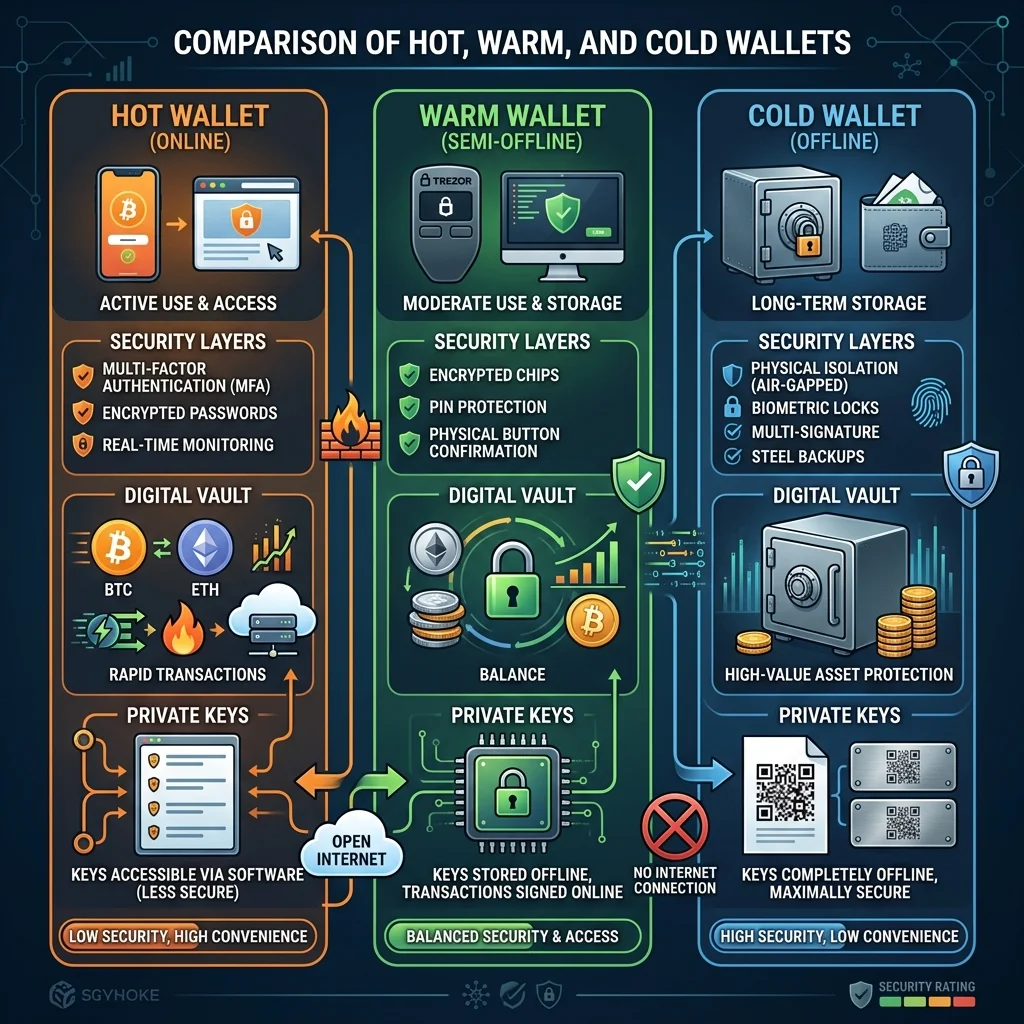
Layered wallet architecture diagram for MEV operators with hot, warm, and cold tiers
FR
FRB 团队MEV 专家
最近更新
#Security#Wallet#MEV#Self-Custody#Operations

Answer first — A MEV trader needs at least three wallet tiers: a hot strategy wallet (small float, signs every tx, lives on your VPS), a warm treasury wallet (bulk capital, hardware-secured, signs only sweeps and top-ups), and a cold reserve (long-term holdings, never signs anything operational). Anyone running everything from a single hot wallet is one VPS compromise away from total loss. The setup takes 30 minutes; the alternative is paying for that 30 minutes in five-figure increments.

If you haven't read Crypto Trading Bot Security Best Practices, do that first. This article is the wallet-specific deep-dive.

Why Single-Wallet Operations Fail

A typical compromise scenario:

  1. Operator runs FRB Agent on a VPS.
  2. The bot signs every fill from the same wallet that holds all bankroll.
  3. VPS is compromised — through a stolen SSH key, a poisoned dependency, or a malicious package update.
  4. Attacker reads the wallet's private key from the bot's config.
  5. Entire bankroll drained in one block.

Step 4 is the failure point that wallet hygiene prevents. The hot wallet should never have material capital exposure.

The Three-Tier Architecture

┌─────────────────────┐
│   Cold Reserve      │  Hardware-only, never online
│   (>50% of stack)   │  Multisig, ideally
└─────────┬───────────┘
          │ Manual transfer (rare)
          ▼
┌─────────────────────┐
│   Warm Treasury     │  Hardware-secured, signs sweeps + top-ups
│   (35–45% of stack) │  Online but inactive between operations
└─────────┬───────────┘
          │ Top-up: weekly
          │ Sweep: weekly
          ▼
┌─────────────────────┐
│   Hot Strategy      │  On VPS, signs every fill
│   (5–15% of stack)  │  Limited to ~1 week of working capital
└─────────────────────┘

The proportions are tunable. The separation is not.

Hot Strategy Wallet Rules

The wallet your bot signs from. Configure for blast-radius minimization:

  1. Never funded above 1 week of working capital. Compromise loses one week, not one bankroll.
  2. No token approvals to unfamiliar contracts. Use approval revoker tools weekly.
  3. Per-strategy isolation if practical. Liquidation and arb wallets separated means a bug in one doesn't drain the other.
  4. Unique keypair generated specifically for the VPS. Never reuse a key from another machine.
  5. Backup: yes, but encrypted and offline. A photographed seed phrase isn't a backup.

Warm Treasury Wallet Rules

The middle tier — bulk capital, but online and ready to top up the hot wallet.

  1. Hardware wallet (Ledger, Trezor, GridPlus). Mnemonic never typed into software.
  2. Distinct seed phrase from cold reserve. A compromise of warm shouldn't expose cold.
  3. Signing requires physical confirmation. No "sign anything" sessions.
  4. Connected only during operations. Disconnect between top-ups.
  5. Whitelisted destinations. Top-ups only go to your own hot wallet address.

Cold Reserve Rules

Long-term capital. Treat it as if it's unspendable.

  1. Multisig where practical. 2-of-3 or 3-of-5 with geographic distribution of signers.
  2. No online exposure. Air-gapped signing for any movement.
  3. Documented recovery path. Where are the seeds? Who knows? What happens if you're incapacitated?
  4. Periodic recovery drill. At least annually, prove you can spend from cold without exposing seeds.
  5. No DeFi exposure. Cold reserve is in native asset (ETH, BTC, SOL, stablecoins), not LP positions.

Key Storage: What Actually Works

Avoid:

  • Plaintext keys in JSON files on the VPS
  • .env files committed to any repo
  • Browser extensions on the same machine as the bot
  • Cloud-synced password managers as the only copy

Use:

  • OS-level keystore (macOS Keychain, Windows DPAPI) for hot keys
  • Hardware wallets for warm
  • Air-gapped signing for cold
  • Encrypted backup on a hardware-encrypted USB stored in a separate physical location

FRB Agent stores hot wallet keys via the OS keystore by default — see Security for the implementation.

Approval Hygiene

Token approvals are how 80% of "I was hacked" incidents happen. The pattern:

  1. You approve a router contract for unlimited spend.
  2. The router has a vulnerability or is replaced via proxy upgrade.
  3. Attacker drains your wallet using the standing approval.

Mitigations:

  • Use bounded approvals (amount = 2 × expected_trade_size), not MAX_UINT.
  • Revoke approvals weekly via Revoke.cash or similar.
  • Never approve to unverified contracts.
  • Audit approval list per wallet monthly.

Wallet Rotation

Rotate hot wallet keys quarterly:

  1. Generate new keypair.
  2. Update FRB Agent config.
  3. Sweep old wallet to warm treasury.
  4. Burn the old key (delete from all backups).
  5. Resume operations on new wallet.

A rotated wallet that gets compromised exposes zero capital. A 12-month-old hot wallet exposes 12 months of accumulated approvals and any forgotten capital.

VPS Security (The Non-Wallet Half)

Wallet hygiene only works if the VPS itself isn't trivially compromised:

  • SSH key auth only. No password login.
  • Firewall to only required outbound ports. Block lateral movement.
  • Automated security updates.
  • No other workloads on the same VPS. Especially not browser-based ones.
  • Monitoring: alert on any process spawning that isn't FRB Agent.
  • Snapshot before deploy. Roll back instantly on anomaly.

For full setup see VPS Setup for Crypto Bots.

Above $50k, multisig the warm treasury:

  • Safe (formerly Gnosis Safe) is the standard
  • 2-of-3 with: yourself, a hardware wallet, and a recovery key held by a trusted third party
  • Or 3-of-5 with geographic distribution if you want max resilience

Cost: ~$5–20 per multisig tx. Worth it.

What Happens When Things Go Wrong

If you suspect compromise:

  1. Pause the bot immediately. Don't try to "trade through" suspicion.
  2. Move warm and cold capital to fresh wallets. Use hardware-only signing.
  3. Investigate the VPS. Check for unexpected processes, modified binaries, new SSH keys.
  4. Rotate every key the VPS could access.
  5. Forensics: pull logs to a separate machine for review.

Speed matters. The first 30 minutes after detection determine whether warm capital survives.

Recovery Drills

You should be able to:

  • Recover hot wallet in 10 minutes (low stakes, easy)
  • Recover warm wallet in 1 hour with hardware (moderate)
  • Recover cold reserve in 4–24 hours (high friction by design)

If you've never tested, you don't actually know. Run a recovery drill quarterly with $1 in each wallet to verify the path.

FAQ

Do I need a hardware wallet for hot strategy capital?

No — hot wallets need to sign automatically, which doesn't work with hardware wallets. Hot wallet keys live in OS keystore. Hardware is for warm and cold.

Can FRB Agent sign with a hardware wallet?

Not for active strategy execution (latency makes it impractical). Only for periodic top-ups, which can be initiated from the dashboard with a hardware-attached wallet.

Is multisig necessary for everyone?

Below $50k bankroll, the operational complexity of multisig outweighs the security benefit for most users. Above $50k, the math flips.

What about MPC wallets (Fireblocks, Copper, etc.)?

Excellent for institutions. Generally over-engineered (and over-priced) for individual operators below seven figures.

How often should I rotate keys?

Hot: quarterly minimum. Warm: yearly. Cold: only after suspected compromise or signer change.


This article is operational guidance, not security audit. Specific risks depend on your stack, jurisdiction, and threat model. Consult a security professional for high-value setups.

阅读后的下一步

启动 FRB 控制台

连接您的钱包,通过 6 位 PIN 码配对节点客户端,然后分配上述合约。

需要安装程序?

下载并验证 FRB

获取最新安装程序,将 SHA‑256 与 Releases 对比,然后按照安全启动清单操作。

查看 Releases 和 SHA‑256
分享𝕏 推特in LinkedInf Facebook

相关文章

延伸阅读与工具

讨论

暂无笔记。添加第一条观察,或在以下平台与团队分享链接 X (@MCFRB).

留下笔记
笔记仅存储在您的本地浏览器中。

掌控脉动

扩展您的执行能力

通过探索完整的 FRB 工具包来最大化您的优势。从机构级遥测到随时可导出的策略脚本。

CTA

安装 FRB 代理

下载经过验证的 Windows 版本并检查 SHA-256。

CTA

阅读快速入门文档

与运营和合规团队分享 15 分钟的设置流程。

CTA

启动控制面板

配对节点客户端并实时监控 Ops Pulse。

准备进化了吗?

迈出下一步

无论您是在验证终端安全,还是在启动您的第一个交易包,FRB 之旅都从这里开始。

推荐

安装 FRB 代理

安全的 Windows 版本,通过 SHA-256 验证以确保最高完整性。

推荐

阅读快速入门文档

15 分钟掌握设置流程:从钱包配对到第一个交易包。

推荐

启动控制面板

实时监控您的 Ops Pulse 并管理交易路由。