Solana
Simulated route
$124.50 model
Example
Ethereum
Private bundle
$840.12 model
Example
BNB
Liquidation test
$45.20 model
Example
Base
Arbitrage test
$12.05 model
Example
Solana
Jito bundle
$310.00 model
Example
Polygon
Route check
$8.45 model
Example
Solana
Simulated route
$124.50 model
Example
Ethereum
Private bundle
$840.12 model
Example
BNB
Liquidation test
$45.20 model
Example
Base
Arbitrage test
$12.05 model
Example
Solana
Jito bundle
$310.00 model
Example
Polygon
Route check
$8.45 model
Example
ComplianceEvaluation 阶段⏱ 6 分钟阅读

MEV Bot Scams vs Legitimate Tools: How to Tell the Difference (2026 Guide)

**Answer first** — In 2026, over **$2.3 billion** was lost to fake MEV bots and crypto trading scams. Legitimate MEV tools share these characteristics: non-custodial architecture (

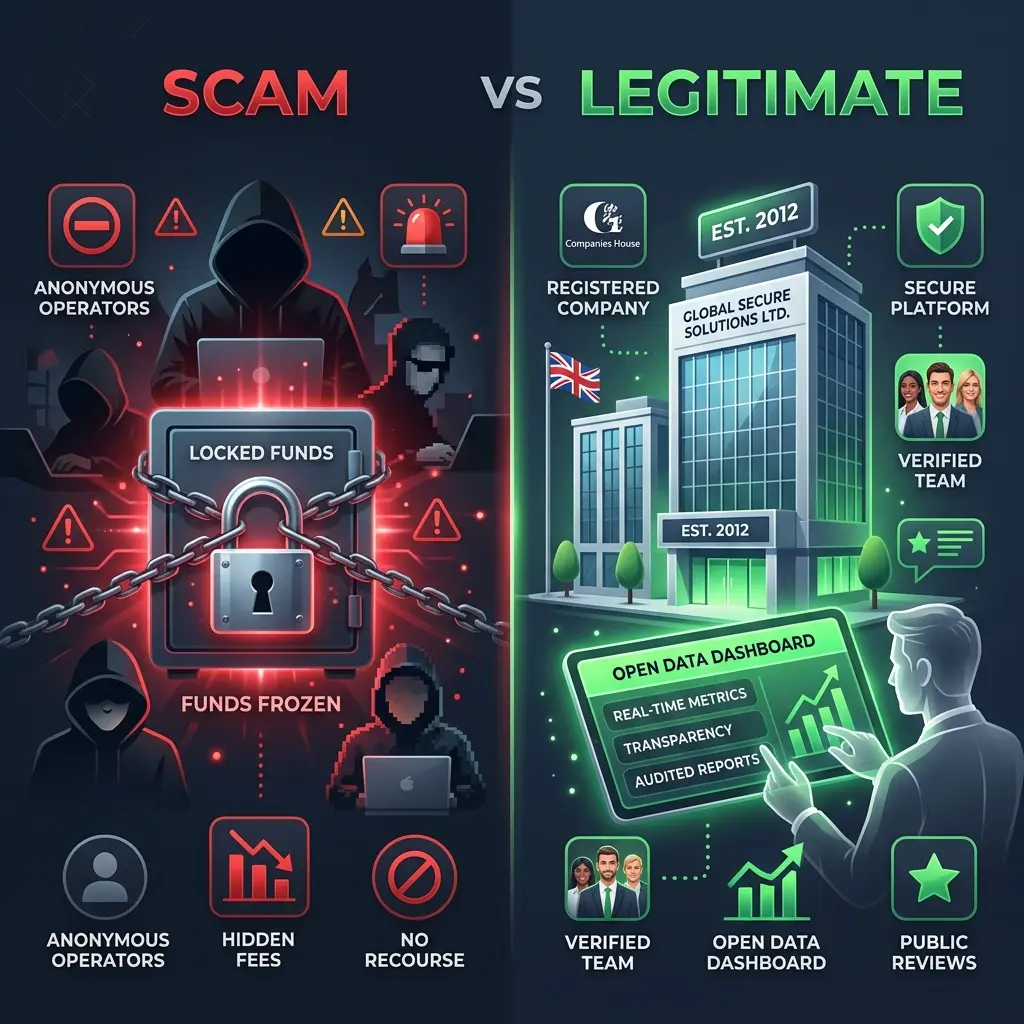
Security comparison showing red flags of MEV scams versus legitimate tools
FR
FRB 团队MEV 专家
最近更新
#Security#Scam Detection#MEV#Guide#Trust

Answer first — In 2026, over $2.3 billion was lost to fake MEV bots and crypto trading scams. Legitimate MEV tools share these characteristics: non-custodial architecture (keys stay on your device), verifiable on-chain performance data, registered business entities, no guaranteed return promises, and transparent fee structures. Below is a complete guide to telling the difference.

The Scale of the Problem

According to blockchain security firm Chainalysis, fake trading bots and "automated arbitrage" schemes were the #3 crypto scam category in 2025-2026. The typical scam works like this:

  1. Promise "guaranteed daily returns" of 1-5%
  2. Ask you to deposit funds to a contract or wallet they control
  3. Show fake dashboard numbers for a few weeks
  4. Disappear with your funds (rug pull)

The 10-Point Legitimacy Checklist

Use this checklist to evaluate ANY MEV bot or crypto trading tool:

🔴 Red Flags (Run Away)

# Red Flag Why It's Dangerous
1 "Guaranteed returns" MEV is inherently variable. No one can guarantee profits
2 Send funds to their wallet Legitimate tools never need custody of your assets
3 No company registration Anonymous teams can disappear without accountability
4 Referral/recruitment bonuses Classic Ponzi structure — profits come from new deposits
5 No simulation/demo mode If you can't test without risking money, something is wrong

🟢 Legitimacy Signals (Good Signs)

# Signal How to Verify
6 Non-custodial Keys stored locally, never transmitted
7 Verifiable performance On-chain TX hashes, not screenshots
8 Registered entity Check Companies House, SEC, or local registry
9 Honest risk disclosure Published pages explaining what can go wrong

Common Scam Patterns in 2026

Pattern 1: The "YouTube Tutorial" Scam

Someone posts a tutorial: "Deploy this smart contract and earn ETH automatically." The contract contains a backdoor that drains your wallet.

How to avoid: Never deploy contracts from unknown sources. Verify ALL code on Etherscan before interacting.

Pattern 2: The "Telegram Bot" Scheme

A Telegram bot promises automated trading. You deposit funds to start. The dashboard shows profits, but withdrawal requests are delayed, then denied.

How to avoid: If you must send funds to start, it's custodial. If it's custodial, your funds are at risk. Choose non-custodial alternatives.

Pattern 3: The "AI-Powered" Fraud

Marketing claims "AI" but the product is a simple script — or nothing at all. Often paired with fake testimonials and doctored screenshots.

How to avoid: Ask for live demonstrations, published performance data with TX hashes, and technical documentation.

Pattern 4: The "Free Bot" Malware

Download a "free trading bot" that actually installs malware to steal your wallet keys and browser session data.

How to avoid: Only download from verified sources. Check SHA-256 hashes. Run in a VM first.

How FRB Agent Passes the Checklist

Criteria FRB Agent Evidence
No guaranteed returns Risk Disclosure
Non-custodial Keys stay local — Security docs
Registered entity UK Companies House #15290321
No referral scheme Revenue from MEV only — Performance
Simulation mode Built-in Anvil fork simulation
Verifiable performance Performance Dashboard
Honest risk disclosure Published on website
SHA-256 verified releases Hash published with every download
Transparent fees 20% performance fee only, $0 otherwise

How to Investigate Any Crypto Tool

Step 1: Google "[tool name] + scam"

Read what others say. Check Reddit, Twitter, and crypto forums.

Step 2: Check Company Registration

Step 3: Verify On-Chain Claims

If they claim performance, ask for wallet addresses and TX hashes. Check on:

Step 4: Test in Simulation First

Any legitimate tool will let you test without risking real funds. If they don't offer this, don't use them.

Step 5: Start Small

Even after verification, start with the minimum amount. Scale only after seeing consistent, verifiable results.

Why Scam Bots Are Getting Harder to Detect

The "send us your private key" scam of 2020 is obvious to most users now. In 2026, scam MEV bots have evolved to mimic legitimate tool characteristics while hiding the fraud deeper in the flow.

The sophisticated 2026 scam pattern:

  1. Legitimate-looking download page with real company branding
  2. Non-custodial interface — you "keep your keys" in the app
  3. The app runs for 7–14 days legitimately, showing real (small) profits
  4. Once trust is established, the app requests a wallet signature for "strategy optimization"
  5. The signature is actually an approve() transaction granting the attacker's contract unlimited spending on your wallet tokens
  6. Tokens are drained within seconds

This pattern is nearly undetectable without technical expertise, because:

  • The tool appears non-custodial (your key is on your machine)
  • You see real positive results initially
  • The drain happens through a contract interaction that looks like a legitimate strategy transaction

How to defend against this pattern:

  • Only interact with contracts in your allowlist (FRB enforces this)
  • Review every contract interaction that requests spending approval — the amount should be specific, not unlimited
  • Use a dedicated trading wallet that doesn't hold long-term savings
  • Revoke unlimited approvals regularly through tools like Revoke.cash

The "YouTube Script" Attack Surface

One of the highest-volume attack vectors in 2026 is YouTube tutorials that teach users to "deploy a MEV bot" using a provided contract template. The tutorial is legitimate-looking, the smart contract code is shown in full, and the presenter walks through the deployment carefully.

What the video doesn't show: A hidden function in the contract code that allows the deployer (the scammer) to drain any ETH sent to the contract. The function is obfuscated in the contract code and not explained in the tutorial.

Defense: Never deploy a smart contract to mainnet from a tutorial without:

  1. Having the code reviewed by someone you trust with Solidity expertise
  2. Verifying the contract on Etherscan after deployment and reading every function
  3. Testing on a testnet first with a tiny amount before mainnet deployment

FRB Agent doesn't require you to deploy any contracts. All execution happens through audited, existing DEX and builder contracts. If any tool asks you to deploy a custom contract as part of setup, treat this as a red flag requiring thorough verification.

Technical Verification: Going Beyond the Checklist

For users with technical capability, deeper verification is possible:

Verify FRB's signing process: Using Windows Sysinternals Process Monitor, you can verify that FRB Agent:

  • Reads your key file from the encrypted storage location
  • Calls the Windows DPAPI CryptUnprotectData function to decrypt it
  • Signs the transaction data locally
  • Sends only the signed transaction bytes (not the key) to the network endpoint

This confirms non-custodial operation at the OS level, not just at the marketing level.

Verify network traffic: Using Wireshark or Windows Firewall Logging, verify that FRB Agent's network traffic:

  • Goes only to known Flashbots, Jito, and RPC endpoints
  • Does not include any data that could represent a private key (private keys are 32 bytes of random data — there are detectable patterns)

These are advanced steps, but they provide the strongest possible verification of a tool's claimed security properties.

Conclusion

The crypto bot space is full of scams — but legitimate tools exist. The key is verification: check registrations, demand on-chain proof, insist on non-custodial architecture, never trust guaranteed returns, and be alert to the more sophisticated 2026 attack patterns that appear legitimate on the surface.

Verify FRB for yourself: Trust Verification Page | Performance Data

Related Reading:

阅读后的下一步

启动 FRB 控制台

连接您的钱包,通过 6 位 PIN 码配对节点客户端,然后分配上述合约。

需要安装程序?

下载并验证 FRB

获取最新安装程序,将 SHA‑256 与 Releases 对比,然后按照安全启动清单操作。

查看 Releases 和 SHA‑256
分享𝕏 推特in LinkedInf Facebook

相关文章

延伸阅读与工具

讨论

暂无笔记。添加第一条观察,或在以下平台与团队分享链接 X (@MCFRB).

留下笔记
笔记仅存储在您的本地浏览器中。

掌控脉动

扩展您的执行能力

通过探索完整的 FRB 工具包来最大化您的优势。从机构级遥测到随时可导出的策略脚本。

CTA

安装 FRB 代理

下载经过验证的 Windows 版本并检查 SHA-256。

CTA

阅读快速入门文档

与运营和合规团队分享 15 分钟的设置流程。

CTA

启动控制面板

配对节点客户端并实时监控 Ops Pulse。

准备进化了吗?

迈出下一步

无论您是在验证终端安全,还是在启动您的第一个交易包,FRB 之旅都从这里开始。

推荐

安装 FRB 代理

安全的 Windows 版本,通过 SHA-256 验证以确保最高完整性。

推荐

阅读快速入门文档

15 分钟掌握设置流程:从钱包配对到第一个交易包。

推荐

启动控制面板

实时监控您的 Ops Pulse 并管理交易路由。