5 Automated Crypto Yield and Trading Strategies to Evaluate in 2026
**Answer first** — Automated crypto strategies can generate yield or trading returns, but every category carries distinct risks. Liquid staking, stablecoin lending, grid trading, M
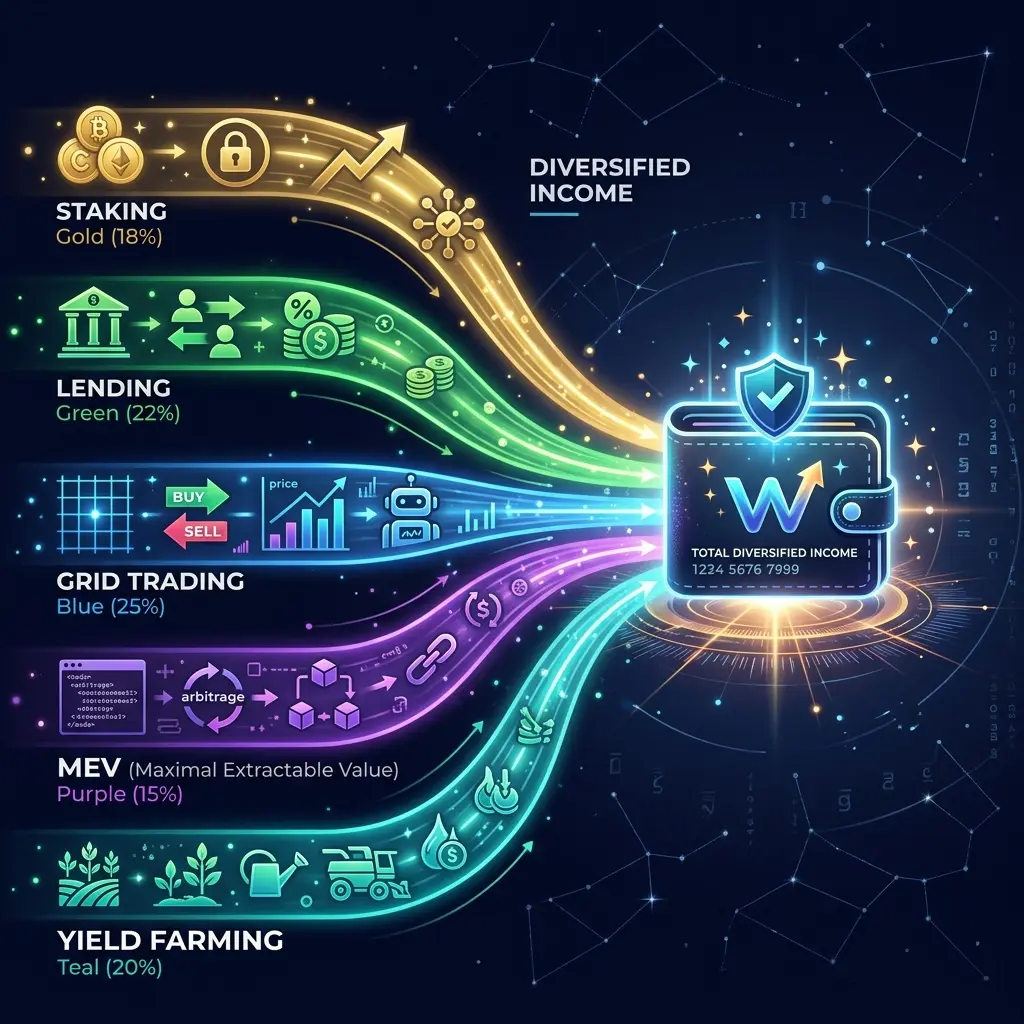
Answer first — Automated crypto strategies can generate yield or trading returns, but every category carries distinct risks. Liquid staking, stablecoin lending, grid trading, MEV execution, and yield aggregator vaults each have different risk profiles, capital requirements, and operational overhead. This guide evaluates all five against a consistent framework — including what can go wrong — so you can make an informed allocation decision. None of these strategies guarantee returns, and allocation decisions should be proportional to your understanding and tolerance for each risk type.
The Honest Context First
Many "automated crypto income" guides exist primarily to onboard users to a specific platform. This guide takes a different approach: evaluate each strategy by its actual risk-return characteristics, flag the most common failure modes, and help you identify which strategies are appropriate for your situation.
Base rate: Most automated crypto yield strategies underperform simple ETH staking over a 12-month period when you account for:
- Smart contract risk and protocol failure events
- Tax treatment of frequent small gains
- Opportunity cost of capital locked in liquidity positions
- Time spent on operations (rebalancing, monitoring, incident response)
That doesn't mean they're wrong to pursue — higher complexity strategies can produce higher returns. It means you should enter with realistic expectations.
Strategy 1: Liquid Staking (Lowest Risk)
Expected yield: 3.5–5.5% APY (varies with Ethereum validator economics) Risk level: Low Setup time: 5 minutes Operational overhead: Near-zero
Liquid staking is the simplest form of automated crypto yield. You deposit ETH into a liquid staking protocol (Lido, Rocket Pool, Coinbase cbETH), receive a liquid token (stETH, rETH, cbETH) that appreciates daily as staking rewards accumulate, and can redeem or use the token in DeFi at any time.
What makes it low-risk compared to alternatives:
- The yield source is Ethereum consensus layer rewards — not trading profit or protocol revenue that can disappear
- Major protocols (Lido, Rocket Pool) have been operating since 2020 with no critical failure events
- Liquid staking tokens can typically be redeemed within 1–7 days if you need to exit
Risks that exist:
- Smart contract risk: A critical bug in the liquid staking protocol could affect your deposit. No protocol is immune.
- Validator slashing: If validators in the pool are penalized, the staking token value decreases. Lido and Rocket Pool have insurance mechanisms that reduce but don't eliminate this risk.
- Depeg risk: stETH has historically traded at a slight discount to ETH during market stress (the June 2022 depeg reached 5%). If you need to sell during a stress event, you may not get full ETH value.
- Concentration risk: Lido holds approximately 30% of all staked ETH. Systemic Lido failure would have broader Ethereum ecosystem impacts — this is a known governance concern.
Best platforms by risk profile:
- Lowest risk: Rocket Pool (decentralized, permissionless validators, ETH-native insurance)
- Largest liquidity: Lido (stETH most widely accepted in DeFi)
- Regulatory clarity: Coinbase cbETH (US-regulated entity)
Strategy 2: Stablecoin Lending (Low-Medium Risk)
Expected yield: 4–14% APY (varies significantly with borrowing demand) Risk level: Low-Medium Setup time: 10 minutes Operational overhead: Low (monitor rates monthly)
Depositing USDC, DAI, or USDT into lending protocols (Aave V3, Compound III, Morpho) earns interest from borrowers. The yield is variable — it rises when demand for borrowing is high and falls when demand is low. During bull market periods, leveraged traders borrowing to buy crypto push rates to 10–15%. During quiet periods, rates may drop to 3–5%.
Why stablecoin lending is lower-risk than trading:
- You're not exposed to crypto price volatility directly — you lend stablecoins and receive stablecoins plus interest
- Overcollateralization requirements protect lenders — borrowers must post 130–200% collateral relative to their borrow value
- Established protocols have multi-year track records with billions in TVL
Risks that exist:
- Smart contract vulnerability: Aave V3 has not had a critical exploit, but protocol risk is real. Diversify across two or three protocols rather than concentrating in one.
- Stablecoin depeg: If the stablecoin you lend loses its peg (USDC depegged briefly during the SVB collapse in March 2023), the value of your deposits decreases.
- Utilization rate volatility: If borrowing demand drops suddenly, your yield drops. You don't lose principal — you earn less.
- Governance risk: Protocol parameter changes approved by governance can affect collateral requirements or yield distribution in ways that affect your position.
Practical allocation: Keep stablecoin lending positions in protocols with $500M+ TVL and active security monitoring. Diversify across two protocols. Don't lock in long-term positions — keep the ability to exit within hours if protocol conditions change.
Strategy 3: Automated Grid Trading (Medium Risk)
Expected yield: 8–25% APY in sideways markets, negative in trending markets Risk level: Medium Setup time: 30 minutes Operational overhead: Weekly monitoring
Grid trading bots place buy orders at regular price intervals below the current price and sell orders above it. As the price oscillates, the bot buys low and sells high repeatedly within the configured range. Profit accumulates from the spread between each buy and sell.
Where it works: Grid trading performs well in low-volatility, sideways markets — when the price stays within your configured range and oscillates frequently. In these conditions, the bot can execute dozens of profitable cycles per day.
Where it fails: In strongly trending markets, a downward trend causes the bot to accumulate a large position as the price moves below your range (buying all the way down). If the price doesn't recover to the top of your range before you exit, you realize a loss on the accumulated position. Grid trading is not a hedge against directional price moves.
Configuration risks:
- Setting the range too narrow creates many cycles but high transaction cost that erodes profit
- Setting the range too wide creates fewer cycles with lower frequency
- Not setting a stop-loss boundary is the most common way grid traders suffer large losses
Recommended approach: Configure grid ranges based on recent 90-day volatility, set a stop-loss trigger at the bottom of your range, and monitor weekly. Increase allocation only in confirmed sideways market periods.
Strategy 4: MEV Execution with Local Agents (Medium-High Risk)
Expected yield: Variable — 10–40% annually under favorable conditions Risk level: Medium-High Setup time: 30–60 minutes Operational overhead: Regular monitoring, periodic strategy review
MEV (Maximal Extractable Value) execution captures on-chain arbitrage: price differences between DEXes, liquidation events on lending protocols, and new token launch opportunities. MEV is not passive — it requires active strategy configuration, ongoing monitoring, and periodic adjustment as the competitive landscape evolves.
Why FRB Agent for MEV:
- Non-custodial — keys stay on your local machine or hardware wallet
- Private bundle submission — trades are invisible to competing bots until confirmed
- Multi-chain support — Ethereum, BNB Chain, Polygon, Base, Solana
- Simulation mode — test strategy logic before committing real capital
Realistic return ranges and their conditions:
| Condition | Monthly return range |
|---|---|
| High market volatility, favorable gas | 20–40% |
| Normal market, moderate competition | 8–20% |
| Low volatility, compressed margins | 0–8% |
| Adverse (honeypots, misconfiguration) | Negative |
These ranges assume correctly configured strategies running on appropriate infrastructure. Returns are not guaranteed and are highly sensitive to market conditions.
Risk factors specific to MEV:
- Execution risk: bundle inclusion is probabilistic. A correctly-configured strategy may still miss opportunities due to higher-tipped competition.
- Gas cost risk: unexpected gas spikes can turn a profitable session negative if gas caps aren't properly configured
- Strategy staleness: MEV strategies that were profitable three months ago may not be profitable today if competition has increased
- Honeypot exposure: on-chain contracts designed to appear profitable but drain bot gas budgets
Before committing capital: run FRB Agent in simulation mode for 7+ days and review projected inclusion rates and PnL. Follow the setup guide at /install to verify the installer before running.
Strategy 5: Yield Aggregator Vaults (Medium Risk)
Expected yield: 10–30% improvement over manual farming, absolute yields vary Risk level: Medium Setup time: 10 minutes Operational overhead: Low (quarterly review)
Yield aggregator vaults (Beefy Finance, Yearn Finance, Convex) automatically harvest, compound, and optimize your liquidity mining positions. They solve a specific operational problem: manually harvesting rewards and compounding them is gas-inefficient for small positions and time-consuming for large ones. Aggregators batch operations across many depositors to reduce per-user gas costs.
What aggregators do well:
- Auto-compounding increases effective APY by 15–30% compared to manual harvesting for positions above $10,000
- Strategy diversification — a single vault deposit may farm multiple protocols simultaneously
- Automated rebalancing across liquidity pools as yield rates change
Risks that exist:
- Multi-layer smart contract risk: Your deposit passes through the aggregator's contracts plus the underlying protocol's contracts. If either has a vulnerability, your deposit is at risk.
- Strategy deprecation: Aggregator vaults sometimes deprecate strategies after protocol changes. If you're not monitoring, your funds may sit in a deprecated vault earning minimal yield.
- Fee structure opacity: Some aggregators charge performance fees that aren't obvious at deposit time. Verify the fee structure before depositing.
- Liquidity concentration: Popular vaults can become so large that their exits move markets. If many depositors exit simultaneously, slippage can reduce actual returns below projected yields.
Recommended vaults for lower risk: Beefy Finance single-asset staking vaults (no impermanent loss risk), Convex for CRV-ecosystem positions. Avoid vaults with unaudited underlying protocols.
Red Flags: Identifying Automated Yield Scams
The automated crypto yield space contains significant fraud. Common patterns:
| Red Flag | Why It's Dangerous |
|---|---|
| "Guaranteed 1% daily" returns | No legitimate strategy produces fixed daily returns — markets are variable |
| "Send crypto to this wallet" | Legitimate platforms use smart contracts, not manual wallets |
| No published smart contract addresses | Can't verify where your funds go |
| No audit reports on the smart contracts | Unaudited = unknown vulnerability profile |
| Requires recruiting other users for yield | Classic Ponzi structure where early users are paid from late users' deposits |
| Anonymous team with no legal entity | No accountability if they disappear |
FRB Agent is verifiable against the first and last criteria: it operates on performance-fee-only (no guaranteed returns), and FRB Labs Ltd is a registered UK entity (Companies House #15290321) — documented in the Trust Verification Guide.
Example Risk Allocation Framework
This is not a recommendation — it's an example framework for how risk-tiered allocation might look:
| Strategy | Example allocation | Primary risk |
|---|---|---|
| Liquid staking (Rocket Pool) | 40% | Smart contract, slashing |
| Stablecoin lending (Aave V3) | 30% | Smart contract, depeg |
| Grid trading (BTC/USDC, defined range) | 15% | Directional move, stop-loss configuration |
| MEV execution (FRB, ETH/Base) | 10% | Execution, competition, gas |
| Yield aggregator vaults | 5% | Multi-layer smart contract |
Adjust based on your own risk tolerance, capital size, and operational bandwidth. Lower allocations to higher-risk categories; higher allocations to lower-risk categories if you're prioritizing capital preservation.
Conclusion
Automated crypto yield requires research, skepticism, and ongoing monitoring. The strategies in this guide span from near-passive (liquid staking) to operationally active (MEV execution). Choose strategies proportional to the time you can allocate to monitoring and adjustment.
Start with simulation before committing real capital to any active strategy. For MEV specifically, download FRB Agent, verify the build, and run simulation mode for 7+ days before enabling live execution.
阅读后的下一步
启动 FRB 控制台
连接您的钱包,通过 6 位 PIN 码配对节点客户端,然后分配上述合约。
相关文章
延伸阅读与工具
讨论
暂无笔记。添加第一条观察,或在以下平台与团队分享链接 X (@MCFRB).