Solana
Simulated route
$124.50 model
Example
Ethereum
Private bundle
$840.12 model
Example
BNB
Liquidation test
$45.20 model
Example
Base
Arbitrage test
$12.05 model
Example
Solana
Jito bundle
$310.00 model
Example
Polygon
Route check
$8.45 model
Example
Solana
Simulated route
$124.50 model
Example
Ethereum
Private bundle
$840.12 model
Example
BNB
Liquidation test
$45.20 model
Example
Base
Arbitrage test
$12.05 model
Example
Solana
Jito bundle
$310.00 model
Example
Polygon
Route check
$8.45 model
Example
ComplianceEvaluation 阶段⏱ 6 分钟阅读

Backrun vs Sandwich: When to Use Each Strategy

**Answer first** — A **backrun** trades immediately *after* a target transaction, capturing arbitrage value the target left behind by moving a pool out of equilibrium. A **sandwich

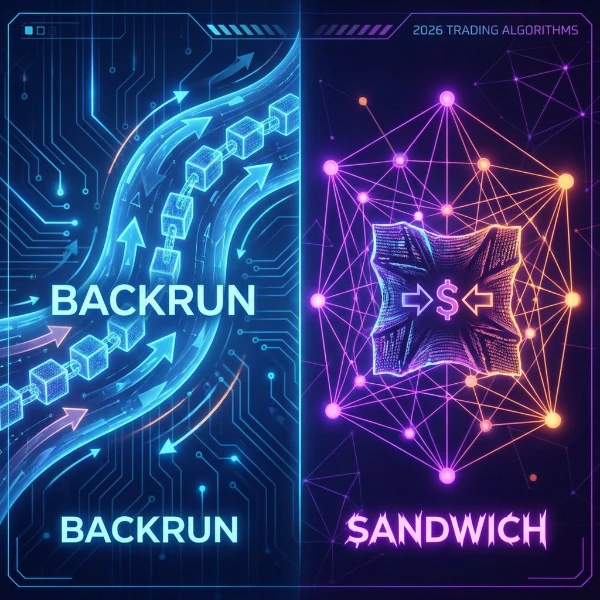
Backrun vs Sandwich strategy comparison
FR
FRB 团队MEV 专家
最近更新
#backrun#sandwich#arbitrage#mev strategies#routing#risk#ethics

Answer first — A backrun trades immediately after a target transaction, capturing arbitrage value the target left behind by moving a pool out of equilibrium. A sandwich trades both before and after the target — the front-run buys, the target's swap pushes the price, then the back-run sells at the worse price the target created. Mechanically the difference is one extra transaction; ethically and operationally it's a chasm. Backruns are positive-sum (they restore prices toward equilibrium and don't worsen outcomes for the target user); sandwiches are explicitly extractive (the target user gets a worse fill because of the sandwich). In 2026 most serious MEV operations run backruns and explicitly disable sandwich logic — both because the regulatory direction is unfavourable and because protocol-side defences (private RPCs, MEV-Share, sandwich-resistant routers, MEV-Blocker rebates) increasingly route ordinary user flow away from sandwich-able mempool exposure. FRB Agent ships with sandwich strategies disabled by default; the working policy in 2026 is to keep them off unless your jurisdiction and counterparty pool both genuinely permit them.

Mastery path

Mechanics, side by side

Property Backrun Sandwich
Number of transactions 1 (yours) + 1 reference (target) 3 (your front, target, your back)
Where you appear in the block Immediately after target Before and after target
Effect on target's fill None (target executes against the same state they expected) Worse (your front moves price against them)
Profit source Pool returns to equilibrium; you capture the spread Target pays inflated price; you capture the difference
Atomicity requirement Single tx (yours), or bundle (yours + target ref) Bundle of 3 txs, all-or-nothing
Typical magnitude Small per opportunity; high frequency Variable; can be large on individual targets
Protocol response Generally tolerated; integrated into MEV-Share rebates Increasingly blocked (private RPCs, sandwich-resistant routers)

The single biggest difference: a backrun makes nobody worse off than they were before. The target user's transaction would have moved the pool whether you backran them or not — the arbitrage value was created by their trade and would otherwise be captured by someone else (or remain as transient pool imbalance until the next arbitrageur). A sandwich, by contrast, makes the target's fill worse than it would have been in the absence of your bot.

When backrun is the right tool

  • Liquid AMM swaps moving price meaningfully. A trader executes $200k against ETH/USDC; the pool moves; you trade against the post-swap state to capture the imbalance. Pure arbitrage.
  • Liquidations on lending protocols. A position becomes liquidatable; the liquidation transaction moves collateral; you backrun to capture associated arbitrage between liquidator-received collateral and current market.
  • Cross-DEX rebalancing. A swap on Uniswap moves price; the price differential against Sushi/Curve creates a cross-DEX arb opportunity; you take the arbitrage.

In all three cases your transaction lands the price closer to fair value. The protocol benefits, the arbitrage market benefits, and no individual is materially worse off.

When sandwich is theoretically applicable but operationally unwise

There are pool conditions and target-user conditions where a sandwich's economics work — wide-tolerance swaps, illiquid pools where slippage is high to begin with. Most operators in 2026 still avoid them because:

  • Regulatory direction. Several jurisdictions are explicitly studying sandwich attacks as market-manipulation analogues. The legal posture is moving toward "this is harmful and at minimum requires disclosure."
  • Reputation cost. Public association with sandwich extraction limits institutional partnerships and counterparty access. The economics of one trade are dwarfed by the long-tail business cost.
  • Protocol-side defences are working. Flashbots Protect, MEV-Blocker, MEV-Share, and increasing adoption of sandwich-resistant routing (CoW Swap, MEV-protected RPCs in major wallets) mean the addressable surface for sandwiches shrinks every quarter.
  • Counterparty pools shift. When wallets default-route users through sandwich-protective endpoints, the population still hitting the public mempool is increasingly not an unsuspecting retail user — it's protocol smart contracts, other bots, or users who've explicitly chosen direct submission. The economics of sandwiching that population are different.

For these reasons FRB Agent disables sandwich strategies by default. They can be enabled but it requires explicit configuration plus a policy acknowledgement.

A working decision tree

For any opportunity:

  1. Is the target a normal user submitting through a public-mempool RPC? If yes, default to backrun-only — this is the population for whom sandwich is most ethically and regulatorily problematic.
  2. Is the pool deep and liquid? If yes, backrun economics work; sandwich economics are usually thin anyway because slippage tolerance is low.
  3. Is the trigger transaction itself a contract-to-contract action (DEX router, aggregator, automated strategy)? Then backrun is still the right tool — there's no individual user being harmed, but the dynamics are pure arbitrage.
  4. Is your jurisdiction's regulatory position on sandwich extraction unclear or hostile? If yes, treat sandwich as off-limits.

The default for FRB Agent and for serious operators in 2026 is: backrun only. If the question is whether to enable sandwich, the answer is almost always no.

Operational discipline either way

Whether backrun or (rarely) sandwich:

  • Always simulate against a fork at current head before signing. The biggest losses come from sim-vs-reality drift, not from "the strategy was wrong."
  • Always reference the trigger tx explicitly in the bundle. Without an explicit targetTxHash-equivalent, your backrun can land in a different block than the trigger and have no effect.
  • Always cap slippage tightly per pool class. Slippage caps don't get widened to make trades land — they get tightened.
  • Always track realised vs simulated PnL. A persistent gap (>10% over 100+ trades) is a model bug, not statistical noise.

Backrunning on Solana vs Ethereum

The mechanics of backrunning differ significantly between Solana and Ethereum, and strategies designed for one chain don't transfer directly to the other.

Ethereum backrunning: The standard pattern is submitting a bundle via eth_sendBundle where your backrun transaction is explicitly referenced to the trigger transaction. The bundle guarantees atomicity — your backrun lands in the same block as the trigger or not at all. This is essential for GMX backrunning on Arbitrum, Uniswap V3 tick arb on Ethereum, and AAVE liquidation pairs.

Solana backrunning via Jito: Jito bundles provide the same atomicity guarantee on Solana — your backrun and the trigger transaction are in the same bundle and execute atomically. The key difference is that Solana has no traditional mempool; the trigger transaction must either be in your bundle or already confirmed before you submit. For Jito-based backrunning, the pattern is typically to backrun a confirmed (already-landed) transaction in the next block rather than co-bundling.

Speed considerations: On Ethereum's 12-second blocks, you have substantial time to detect a trigger, simulate your response, and submit a bundle for the same block. On Solana's ~400ms blocks, the window from detecting a trigger to submission is measured in milliseconds. Yellowstone gRPC subscription (versus standard WSS) is effectively mandatory for competitive Solana backrunning — standard WebSocket endpoints add 100-200ms of detection lag that eliminates most of the window.

References

阅读后的下一步

启动 FRB 控制台

连接您的钱包,通过 6 位 PIN 码配对节点客户端,然后分配上述合约。

需要安装程序?

下载并验证 FRB

获取最新安装程序,将 SHA‑256 与 Releases 对比,然后按照安全启动清单操作。

查看 Releases 和 SHA‑256
分享𝕏 推特in LinkedInf Facebook

相关文章

延伸阅读与工具

讨论

暂无笔记。添加第一条观察,或在以下平台与团队分享链接 X (@MCFRB).

留下笔记
笔记仅存储在您的本地浏览器中。

掌控脉动

扩展您的执行能力

通过探索完整的 FRB 工具包来最大化您的优势。从机构级遥测到随时可导出的策略脚本。

CTA

安装 FRB 代理

下载经过验证的 Windows 版本并检查 SHA-256。

CTA

阅读快速入门文档

与运营和合规团队分享 15 分钟的设置流程。

CTA

启动控制面板

配对节点客户端并实时监控 Ops Pulse。

准备进化了吗?

迈出下一步

无论您是在验证终端安全,还是在启动您的第一个交易包,FRB 之旅都从这里开始。

推荐

安装 FRB 代理

安全的 Windows 版本,通过 SHA-256 验证以确保最高完整性。

推荐

阅读快速入门文档

15 分钟掌握设置流程:从钱包配对到第一个交易包。

推荐

启动控制面板

实时监控您的 Ops Pulse 并管理交易路由。