Solana
Simulated route
$124.50 model
Example
Ethereum
Private bundle
$840.12 model
Example
BNB
Liquidation test
$45.20 model
Example
Base
Arbitrage test
$12.05 model
Example
Solana
Jito bundle
$310.00 model
Example
Polygon
Route check
$8.45 model
Example
Solana
Simulated route
$124.50 model
Example
Ethereum
Private bundle
$840.12 model
Example
BNB
Liquidation test
$45.20 model
Example
Base
Arbitrage test
$12.05 model
Example
Solana
Jito bundle
$310.00 model
Example
Polygon
Route check
$8.45 model
Example
TraderConversion 阶段⏱ 6 分钟阅读

EU MiCA & Trading Bots 2026: What Changes for MEV and DeFi Operators

**Answer first** — The EU's Markets in Crypto-Assets Regulation (MiCA), fully applicable since December 2024, does **not** regulate non-custodial trading bots or MEV operators dire

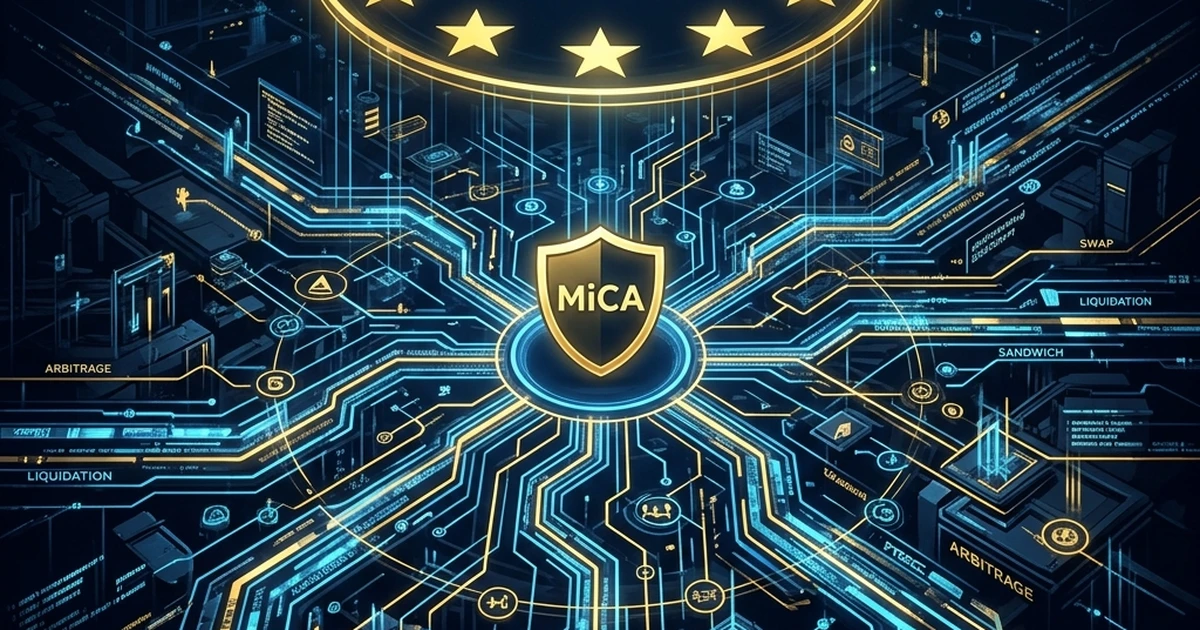
EU MiCA regulation impact on trading bots and MEV operators 2026
FR
FRB 团队MEV 专家
最近更新
#regulation#EU#MiCA#crypto law#DeFi

Answer first — The EU's Markets in Crypto-Assets Regulation (MiCA), fully applicable since December 2024, does not regulate non-custodial trading bots or MEV operators directly. MiCA targets crypto-asset service providers (CASPs) — exchanges, custodial wallet providers, stablecoin issuers, and advisory services. A non-custodial desktop bot that executes your own transactions using your own keys is not a CASP and falls outside MiCA's scope. What MiCA does affect: the exchanges you use to fund your wallet, the stablecoins you trade, and the broader liquidity environment in EU markets.

What MiCA Actually Covers

MiCA (Regulation (EU) 2023/1114) entered into force in June 2023 and has been fully applicable since December 30, 2024. It creates a harmonised regulatory framework for crypto-assets across all 27 EU member states, replacing the patchwork of national regulations that previously applied.

MiCA covers:

  • Asset-referenced tokens (ARTs) — stablecoins backed by multiple assets or currencies
  • E-money tokens (EMTs) — stablecoins backed by a single fiat currency (e.g. EURC)
  • Crypto-asset service providers (CASPs) — exchanges, brokers, custodians, portfolio managers, transfer services, advisers
  • Issuers of significant crypto assets — large-scale stablecoin issuers

MiCA explicitly does not cover:

  • Truly decentralised DeFi protocols — where no identifiable legal entity is in control
  • Non-custodial wallets and software — tools where the user holds their own keys
  • NFTs (with some caveats on fractionalized NFTs)
  • Central bank digital currencies (CBDCs)

The European Securities and Markets Authority (ESMA) has confirmed that non-custodial software falls outside MiCA's CASP definition because the software does not hold client assets or provide a service "on behalf of" a client.

The CASP Definition and Why Bots Aren't Covered

A CASP under MiCA is any legal entity that provides crypto-asset services on a professional basis. The services include: custody, operating a trading platform, exchange, advisory, portfolio management, transfer services.

The critical element is "on behalf of clients". A trading bot that executes transactions on behalf of its own user — with the user's own keys, signing their own transactions — is not providing a service "on behalf of clients." There is one user (the bot operator) and the bot is their tool.

This is the same logic that exempts non-custodial wallet software: MetaMask doesn't hold your assets; FRB Agent doesn't hold your assets. Both are tools, not services.

Where this breaks down: if you build a bot-as-a-service where users deposit funds and you execute strategies — that is portfolio management "on behalf of clients" and would require CASP authorisation.

MiCA's Impact on the Exchanges You Use

While MiCA doesn't directly regulate your bot, it heavily regulates the on-ramps you use. Centralised exchanges operating in the EU (Coinbase Europe, Kraken, Bitstamp, Bitpanda) must now hold CASP licences and comply with:

  • DORA (Digital Operational Resilience Act) — IT security requirements
  • Travel Rule — sender/receiver identity information must accompany crypto transfers above €1,000
  • Enhanced KYC — stricter identity verification requirements

The Travel Rule has specific implications for MEV operators who move funds between wallets. When you withdraw from a MiCA-compliant exchange to your hot wallet, the exchange must collect and transmit your wallet address information. This is already standard practice at major exchanges; MiCA harmonises it across the EU.

MiCA's Impact on Stablecoins

MiCA introduces strict requirements for stablecoin issuers, which affects the DEX liquidity landscape significantly.

What changed:

  • USDT (Tether) is not MiCA-compliant as of 2026 — several EU exchanges delisted it for EU users, though it remains accessible through DeFi
  • USDC (Circle) obtained MiCA compliance through its European structure — EURC is a fully MiCA-compliant EUR stablecoin
  • Algorithmic stablecoins face effective prohibition under MiCA's ART rules

For MEV and arbitrage operators:

  • The USDT/USDC split in EU-accessible pools may create persistent arbitrage opportunities as EU-regulated and unregulated liquidity separates
  • Curve and Uniswap pools have already seen liquidity rebalancing between USDT and USDC as EU institutional players shifted away from USDT
  • EURC/USD arb becomes more relevant as euro-denominated stablecoins gain liquidity

DeFi and MiCA: The "Fully Decentralised" Exemption

MiCA contains an explicit carve-out: crypto-asset services provided "in a fully decentralised manner without any intermediary" are not subject to MiCA's CASP requirements.

ESMA published guidance in 2025 interpreting this exemption. The key factors determining whether a DeFi protocol qualifies:

  1. No central point of control — governance is fully on-chain with no entity capable of unilaterally pausing or modifying the protocol
  2. No fee collection by an identifiable entity — if a legal entity collects protocol fees, it may be a CASP
  3. No user funds in custody — all assets remain in user-controlled wallets at all times

Major DeFi protocols (Uniswap, Curve, Aave) have debated how to structure their EU presence in light of this. Most have concluded that the protocol itself is exempt but the front-end interface may be subject to additional rules.

For MEV operators interacting directly with contracts (not through front-ends), the DeFi exemption is largely irrelevant — you're never the subject of regulation, the protocols you interact with may be.

Market Abuse Regulation (MAR) and MEV

MiCA extends the EU's Market Abuse Regulation (MAR) to cover crypto markets. Under MiCA-MAR, the following are prohibited in regulated crypto markets:

  • Market manipulation — creating artificial price signals
  • Insider trading — trading on material non-public information
  • Front-running (in the traditional sense) — trading against client order flow on a regulated platform

Important nuance for MEV: MiCA-MAR applies to crypto asset service providers and their clients on those platforms. On-chain MEV — extracting value from the public mempool through arbitrage, liquidations, and back-running — is not conducted on a regulated platform. It occurs at the blockchain protocol level, which remains outside MiCA's direct scope.

ESMA has signalled it is monitoring DeFi MEV and may propose specific DeFi-focused rules in future legislation (MiCA II or equivalent). For now, on-chain MEV is not regulated under MiCA-MAR.

Country-Level Additions Within the EU

MiCA harmonises but doesn't fully pre-empt national crypto rules in some areas:

  • Germany (BaFin): Had an advanced crypto regulatory framework pre-MiCA. Post-MiCA, BaFin enforces MiCA requirements but retains some national competences. German bot operators should verify the BaFin position on any bot-as-a-service structure.
  • France (AMF): The AMF operates the PSAN (Prestataires de Services sur Actifs Numériques) registration regime, which transitions to MiCA. French operators previously registered under PSAN transition automatically.
  • Netherlands (DNB): The Dutch Central Bank enforces MiCA within the Netherlands. The Netherlands has historically been a crypto-friendly jurisdiction.

Practical Compliance Checklist for EU Bot Operators

Area MiCA Requirement For Non-Custodial Bot Operators
CASP registration Required for service providers ✅ Not required — not a CASP
Stablecoin compliance USDC/EURC preferred ⚠️ Use MiCA-compliant stables for EU exchanges
Travel Rule Exchange-level ✅ Handled by exchanges
Market abuse rules Applies on regulated platforms ✅ Not applicable to on-chain MEV
Tax reporting National laws apply ⚠️ Each EU country has different rules
DeFi protocol interaction Exempt if fully decentralised ✅ Covered by DeFi exemption

Tax: Each EU Country Still Has Its Own Rules

MiCA does not harmonise crypto taxation — that remains under national law. Key variations:

  • Germany: Crypto held over 1 year is tax-free (no capital gains on long-term holdings). Staking income is taxable. Frequent trading may be classified as business income.
  • Portugal: Previously tax-free for most crypto gains; new rules (2023) tax gains on crypto held under 1 year. Long-term holdings remain favourable.
  • Netherlands: Crypto taxed as Box 3 (wealth tax on assumed return), not capital gains.
  • France: 30% flat tax on crypto gains (Prélèvement Forfaitaire Unique — PFU).
  • Spain: Progressive rates 19–28% on crypto gains.

If you're an EU-based bot operator, check the specific rules in your member state.

Further Reading

阅读后的下一步

启动 FRB 控制台

连接您的钱包,通过 6 位 PIN 码配对节点客户端,然后分配上述合约。

需要安装程序?

下载并验证 FRB

获取最新安装程序,将 SHA‑256 与 Releases 对比,然后按照安全启动清单操作。

查看 Releases 和 SHA‑256
分享𝕏 推特in LinkedInf Facebook

相关文章

延伸阅读与工具

讨论

暂无笔记。添加第一条观察,或在以下平台与团队分享链接 X (@MCFRB).

留下笔记
笔记仅存储在您的本地浏览器中。

掌控脉动

扩展您的执行能力

通过探索完整的 FRB 工具包来最大化您的优势。从机构级遥测到随时可导出的策略脚本。

CTA

安装 FRB 代理

下载经过验证的 Windows 版本并检查 SHA-256。

CTA

阅读快速入门文档

与运营和合规团队分享 15 分钟的设置流程。

CTA

启动控制面板

配对节点客户端并实时监控 Ops Pulse。

准备进化了吗?

迈出下一步

无论您是在验证终端安全,还是在启动您的第一个交易包,FRB 之旅都从这里开始。

推荐

安装 FRB 代理

安全的 Windows 版本,通过 SHA-256 验证以确保最高完整性。

推荐

阅读快速入门文档

15 分钟掌握设置流程:从钱包配对到第一个交易包。

推荐

启动控制面板

实时监控您的 Ops Pulse 并管理交易路由。