Solana
Simulated route
$124.50 model
Example
Ethereum
Private bundle
$840.12 model
Example
BNB
Liquidation test
$45.20 model
Example
Base
Arbitrage test
$12.05 model
Example
Solana
Jito bundle
$310.00 model
Example
Polygon
Route check
$8.45 model
Example
Solana
Simulated route
$124.50 model
Example
Ethereum
Private bundle
$840.12 model
Example
BNB
Liquidation test
$45.20 model
Example
Base
Arbitrage test
$12.05 model
Example
Solana
Jito bundle
$310.00 model
Example
Polygon
Route check
$8.45 model
Example
InfraEvaluation 阶段⏱ 5 分钟阅读

Block Builders Explained: Flashbots, Beaverbuild, Titan & The 2026 Auction

**Answer first** — In 2026, three to five block builders win >85% of Ethereum L1 slots: Beaverbuild, Titan, Rsync, BuilderNet, and Flashbots Builder. Each runs a different ordering

Diagram of Ethereum PBS pipeline from searcher to builder to relay to proposer
FR
FRB 团队MEV 专家
最近更新
#MEV#Builders#Flashbots#Ethereum#Infrastructure

Answer first — In 2026, three to five block builders win >85% of Ethereum L1 slots: Beaverbuild, Titan, Rsync, BuilderNet, and Flashbots Builder. Each runs a different ordering algorithm and pays validators different fees. As a searcher, you don't pick one builder — you submit your bundle to all major relays and let the auction decide. But understanding which builder favors which kind of flow lets you tune bid strategy and bundle structure for higher inclusion.

For PBS context, see Flashbots Bundles Explained and MEV-Share vs Private Relays.

The PBS Pipeline in 30 Seconds

[Searcher] → [Builder] → [Relay] → [Proposer]
   ↑            ↑          ↑           ↑
 bundles    builds full  validates   chooses
            block        and bids    highest
                         on behalf   bid

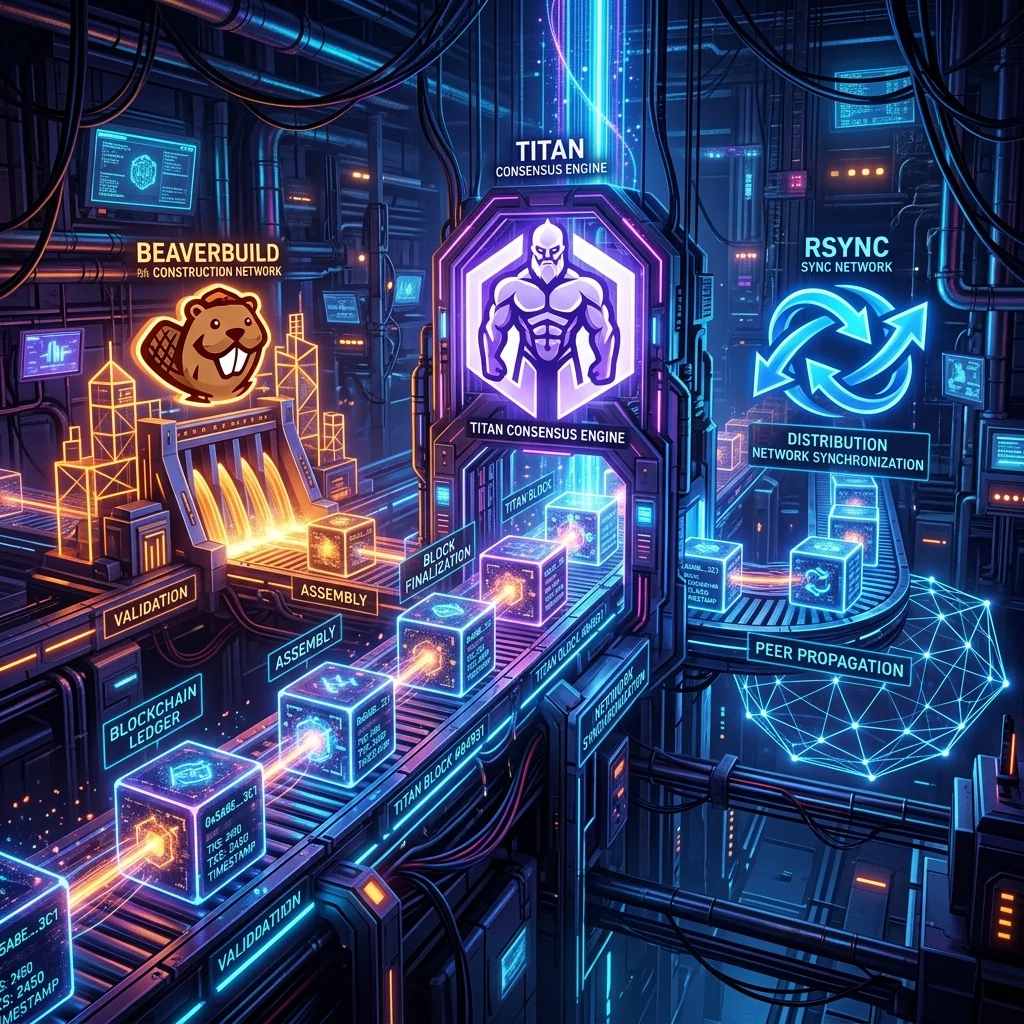
A searcher submits a bundle (one or more ordered transactions). Builders compete to assemble the most valuable block by combining bundles + public mempool txs. Relays act as auction houses — they receive builder blocks, hold blinded headers, and forward the highest-bid one to the proposer.

In 2026 the dominant relays are Flashbots, Ultra Sound, BloXroute, and Aestus. Most builders submit to all of them.

The 2026 Builder Landscape

Approximate 2026 share of relayed blocks (rolling 30-day):

Builder Share Notable
Beaverbuild ~32% Aggressive bid, vertically integrated with retail flow
Titan ~24% Strong arb integration, fast block construction
Rsync ~14% Backed by Coinbase Ventures, low-latency US-East
BuilderNet ~9% Decentralized open-source, growing share
Flashbots Builder ~7% Reference implementation, OFAC-compliant
Others ~14% Long tail

These shift week to week. Track current shares at the Flashbots transparency dashboard and our Performance benchmarks.

How Each Builder Differs

Beaverbuild

  • Aggressive bid policy: returns more value to proposers, higher inclusion rate.
  • Has direct retail order flow integrations (private RPC endpoints used by some wallets).
  • Strict on bundle reverts — failed bundles get scored down.

Titan

  • Co-located in Frankfurt and Northern Virginia.
  • Excellent block construction algorithm; combines bundles tightly.
  • Favored by sophisticated arb searchers.

Rsync

  • US-focused infra; lowest latency from US-East searchers.
  • Selective on bundle types; rejects sandwich-against-protected flow.

BuilderNet

  • Decentralized — multiple operators run instances.
  • Open-source codebase. Best for searchers who want auditable builder behavior.
  • Slightly higher latency than centralized builders.

Flashbots Builder

  • Reference implementation. OFAC-compliant (filters sanctioned addresses).
  • Conservative ordering. Lower revenue but predictable inclusion.

What "Submit to All" Actually Means

Modern searchers send the same bundle to multiple builders simultaneously. The first to land it in a block wins. There's no penalty for parallel submission — builders are competing, not coordinating.

FRB Agent's bundle dispatcher submits to Flashbots, Beaverbuild, Titan, Rsync, and BuilderNet by default. Operator can disable specific builders for compliance (some users disable OFAC-compliant builders for jurisdictional consistency, others disable non-compliant ones for the opposite reason).

Bid Math: How Much to Pay Builders

Your bundle includes a coinbase_transfer (a tx paying ETH to block.coinbase). That's your bid to the builder. Builder takes a cut, validator gets the rest.

Typical bid splits in 2026:

  • Builder retains: 5–15% of coinbase transfer
  • Validator receives: 85–95%
  • Effective MEV "tax" on searchers: ~10–20% across the stack

Bidding too low: bundle is rejected, gas wasted on simulation only. Bidding too high: profit eroded.

The sweet spot is the inclusion probability curve — bid the marginal dollar that flips your inclusion likelihood from "maybe" to "yes."

Latency to Relay: It Matters Less Than You Think

Relay deadlines are typically 1–2 seconds before slot completion. Most searchers are well within that window. The real bottleneck is bundle quality, not RTT.

Exception: top-of-block bundles for liquidations and arb against fresh oracle updates need to arrive in the first 200ms of the slot. For those, latency matters.

What Searchers Should Ask About a Builder

When tuning your strategy:

  1. Does this builder accept reverting transactions in bundles?
  2. What's the bundle simulation timeout?
  3. Does the builder filter sanctioned addresses?
  4. Are there minimum bundle bid requirements?
  5. Is bundle privacy guaranteed pre-inclusion?

Each builder has documented answers. FRB Agent's defaults match the union of "yes" answers across major builders.

Builder Privacy: What Leaks

Even with private bundles, certain information can leak:

  • Bundles that lose still consume builder simulation time, generating measurable timing signals.
  • Some builders publish anonymized bundle stats post-block.
  • Reverting txs in bundles are visible to relay operators if not filtered.

For maximum privacy, use MEV-Share which adds explicit hint-only flow.

Builders on L2s

Most L2s in 2026 don't have PBS at the same level as L1:

  • Base, Optimism: Sequencer is the builder. No multi-builder auction.
  • Arbitrum: Sequencer with Sequencer Fair Ordering.
  • Linea: Sequencer with proof scheduling.
  • zkSync Era: Sequencer with private mempool.

Some L2 ecosystems are exploring shared-sequencer + builder markets (Espresso, Astria), but these are early in 2026.

Builder Centralization: The Open Question

Three to five builders winning >85% of slots is a centralization concern. Mitigations being worked on:

  • Open builder participation (BuilderNet)
  • Trust-minimized builders (TEE-based attestation)
  • Distributed builder protocols (research, not production)

Searchers should care because if a builder duopoly forms, it can extract more rent. Diversifying submission across builders helps preserve competition.

How to Verify Your Bundles Land Where You Think

Each major builder publishes bundle hashes for accepted bundles. Cross-check against the included block's transactions. FRB Agent does this automatically and surfaces inclusion-by-builder analytics in the dashboard.

FAQ

Do I need to apply to a builder?

No. All major builders accept bundle submissions from any searcher to public endpoints. No application needed.

Is OFAC compliance required?

Depends on jurisdiction. US-domiciled searchers should generally use OFAC-compliant builders. Read Are MEV Bots Legal for the broader compliance picture.

Do builders give better treatment to high-volume searchers?

Some do informally. There are no documented preferential tiers, but high-volume searchers report higher inclusion rates that aren't fully explained by bid alone.

Can I run my own builder?

Yes — open-source builder codebases are public. But running a competitive builder requires significant infra investment. Most searchers don't.

How does FRB Agent pick which builder gets which bundle?

By default, every bundle is submitted to all major builders in parallel. The first to include wins. You can override per-strategy in advanced settings.


Builder market shares are estimates from public relay data and shift continuously. Verify current numbers before tuning bid strategy.

阅读后的下一步

启动 FRB 控制台

连接您的钱包,通过 6 位 PIN 码配对节点客户端,然后分配上述合约。

需要安装程序?

下载并验证 FRB

获取最新安装程序,将 SHA‑256 与 Releases 对比,然后按照安全启动清单操作。

查看 Releases 和 SHA‑256
分享𝕏 推特in LinkedInf Facebook

相关文章

延伸阅读与工具

讨论

暂无笔记。添加第一条观察,或在以下平台与团队分享链接 X (@MCFRB).

留下笔记
笔记仅存储在您的本地浏览器中。

掌控脉动

扩展您的执行能力

通过探索完整的 FRB 工具包来最大化您的优势。从机构级遥测到随时可导出的策略脚本。

CTA

安装 FRB 代理

下载经过验证的 Windows 版本并检查 SHA-256。

CTA

阅读快速入门文档

与运营和合规团队分享 15 分钟的设置流程。

CTA

启动控制面板

配对节点客户端并实时监控 Ops Pulse。

准备进化了吗?

迈出下一步

无论您是在验证终端安全,还是在启动您的第一个交易包,FRB 之旅都从这里开始。

推荐

安装 FRB 代理

安全的 Windows 版本,通过 SHA-256 验证以确保最高完整性。

推荐

阅读快速入门文档

15 分钟掌握设置流程:从钱包配对到第一个交易包。

推荐

启动控制面板

实时监控您的 Ops Pulse 并管理交易路由。