Solana
Simulated route
$124.50 model
Example
Ethereum
Private bundle
$840.12 model
Example
BNB
Liquidation test
$45.20 model
Example
Base
Arbitrage test
$12.05 model
Example
Solana
Jito bundle
$310.00 model
Example
Polygon
Route check
$8.45 model
Example
Solana
Simulated route
$124.50 model
Example
Ethereum
Private bundle
$840.12 model
Example
BNB
Liquidation test
$45.20 model
Example
Base
Arbitrage test
$12.05 model
Example
Solana
Jito bundle
$310.00 model
Example
Polygon
Route check
$8.45 model
Example
InfraEvaluation 阶段⏱ 5 分钟阅读

Validators vs Searchers: Who Wins the MEV Economy in 2026?

**Answer first** — In 2026 Ethereum's MEV pie splits roughly: 65–75% to validators (proposers), 10–18% to searchers, 8–14% to builders, and 1–3% to relays. This means validators ca

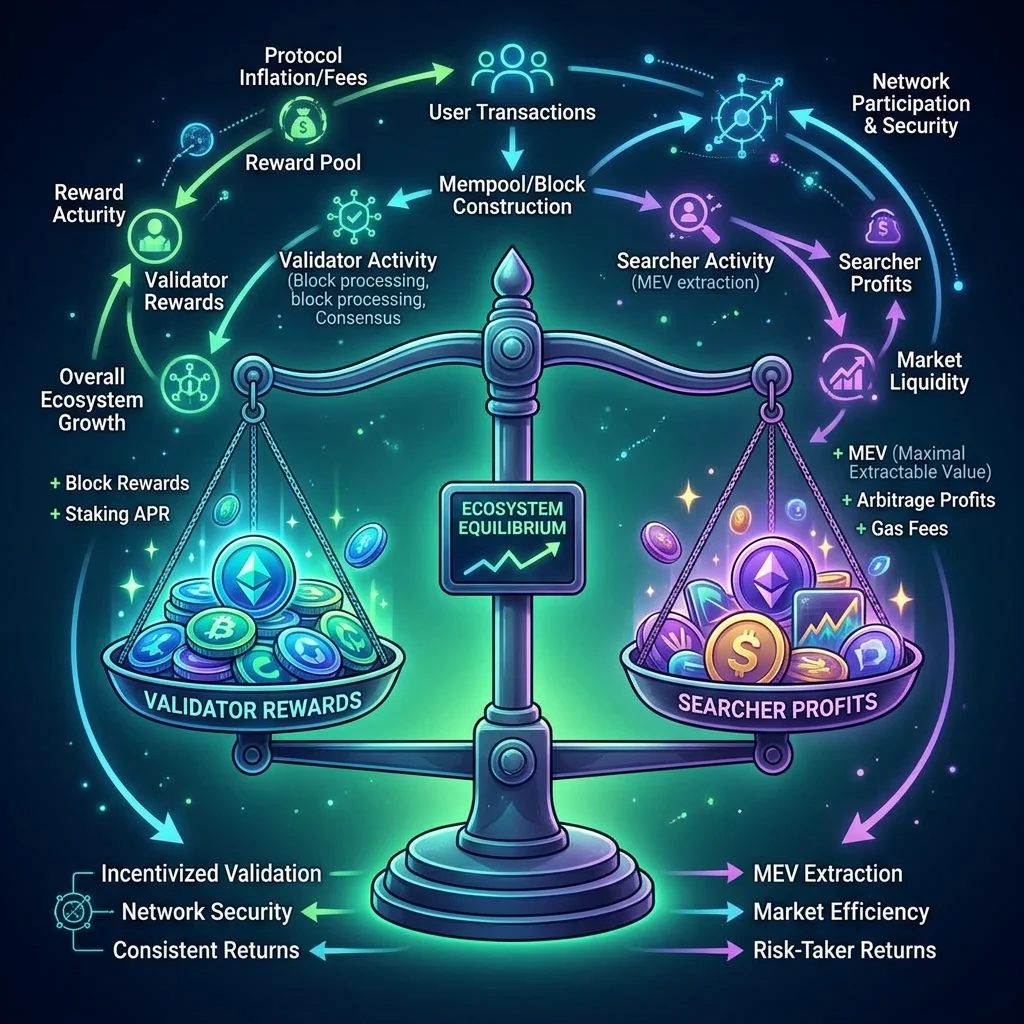
Pie chart split between validator income, searcher revenue, builder cut, and relay fees
FR
FRB 团队MEV 专家
最近更新
#MEV#Validators#Economics#PBS#Ethereum

Answer first — In 2026 Ethereum's MEV pie splits roughly: 65–75% to validators (proposers), 10–18% to searchers, 8–14% to builders, and 1–3% to relays. This means validators capture the largest absolute share — but on a per-block basis they are passive recipients, not strategists. Searchers capture less in aggregate but earn higher returns on capital and effort. The structural winner depends on what you optimize: scale (validators) or rate-of-return (searchers). The mistake everyone makes is assuming the split is fixed; it is shifting toward proposers in 2026.

The Cast of Characters

Role What They Do Capital Required Effort
Validator Proposes blocks 32 ETH per validator Minimal
Builder Constructs full blocks $1M–$10M+ infra investment High
Searcher Finds opportunities, submits bundles $5k–$10M+ High
Relay Auctions blocks to proposers Trust + infra Medium

A clean PBS pipeline:

[Searcher] → [Builder] → [Relay] → [Validator/Proposer]
   value    aggregated   auctioned    chosen for slot

Each layer takes a cut of the total MEV value flowing through.

The 2026 Split (Approximate)

Aggregate MEV revenue per Ethereum block, typical distribution:

Validator (proposer)    65–75%
Searchers (collective)  10–18%
Builders                 8–14%
Relays                   1–3%

The validator share is large because PBS competition has pushed builder bids high — proposers extract the bulk of the value via auction. This is the intended design: proposer value capture is what subsidizes proof-of-stake security.

Why the Validator Share Is Rising

Three forces in 2026:

  1. Builder competition. More builders means tighter margins; more value passes to proposer.
  2. Restaking yields demand. EigenLayer-style restaking needs validator yield up; MEV is a major component.
  3. Liquid staking pool demand. Lido, Stader, and pool-validators compete on yield, so they push relays to bid up to the validator.

Through 2025–2026, the validator share grew from ~58% to ~70% of total MEV value. This trend is likely to continue.

Searcher ROI vs Validator ROI

Aggregate share misleads. Per-dollar-of-capital, the picture flips:

Role 12-Month ROI on Capital (Median)
Solo validator (32 ETH staked) 4.2–5.8%
Liquid staking pool LP 3.4–4.6%
Mid-tier searcher 25–55%
Top-tier searcher 60–120% (volatile)
Builder operator 18–35%

A searcher with $50k working capital can outearn a validator with $100k in stake — but takes operational risk and burnout that the validator doesn't.

Capital vs Skill

The deepest insight: the more capital you have, the more you should lean toward validation/staking. The less capital you have, the more you should lean toward searching.

Why:

  • Validation pays a low % on a large absolute number. Good for retirement-grade capital.
  • Searching pays a high % but caps out. A $10M searcher can't earn 100x a $100k searcher because the opportunities aren't 100x larger.

The crossover in 2026 is around $250k–$1M working capital. Below: searcher math wins. Above: diversify into validation.

Where Builders Fit In

Builders are the unsung middle. They build full blocks from bundles + mempool flow, then bid them to relays. They must:

  • Ingest bundles from many searchers
  • Run conflict resolution (which bundles can co-exist?)
  • Optimize block ordering for max value
  • Bid aggressively but not lose money on simulation

Builder operations require capital ($1M+ infrastructure), specialized engineering, and direct relationships with searchers. There are ~10 globally relevant builders in 2026. See Block Builders Explained.

Relay Economics

Relays charge a small flat fee (often <1% of value) and act as escrow between builder and proposer. The economics are thin but the role is structurally critical — without the relay's blinded-header trust mechanism, PBS doesn't work.

Major 2026 relays: Flashbots, Ultra Sound, BloXroute, Aestus. Most are not for-profit; they exist to keep PBS open and trust-minimized.

L2 Economics Differ

L2s in 2026 don't have full PBS. Sequencer is both builder and proposer:

L2 Sequencer Take Searcher Take Notes
Base ~85% (Coinbase) ~15% Sequencer is single-operator
Arbitrum ~80% (Foundation) ~20% Sequencer Fair Ordering
Optimism ~85% (OP Labs) ~15% First-Come-First-Serve
zkSync ~90% ~10% Heavily restrictive

L2 splits look more concentrated, but absolute MEV is smaller, so searcher rate-of-return on L2 is often higher than aggregate share suggests.

What The Split Tells Searchers

If you're a searcher:

  • Don't compete with builders on infrastructure. They have 100x your capital.
  • Do compete with other searchers on signal quality and latency.
  • Bid the marginal dollar to the builder, not the average dollar.
  • Prefer chains where the searcher take is structurally higher (Arbitrum > Base > L1 for retail).

What The Split Tells Validators

If you're a validator:

  • MEV-Boost is non-optional in 2026 — non-MEV-Boost validators earn 50%+ less.
  • Choose relays carefully; OFAC-compliant vs not has jurisdictional implications.
  • Liquid restaking can amplify yield but compounds risk.
  • Solo staking still works; pool staking is purely a convenience choice.

What The Split Tells Investors

If you're allocating capital between roles:

  • Searcher allocation: high return, high effort, high variance. Up to ~$500k as core.
  • Validator allocation: low return, low effort, low variance. Ideal for the bulk after $500k.
  • Builder allocation: very few investors should attempt — capital + engineering moat is huge.

Long-Run Equilibrium

Several pressures will reshape the split through 2027–2028:

  1. Encrypted mempools (e.g. SUAVE, Shutter): could redistribute value back to users, shrinking total searcher pool.
  2. Distributed builder protocols: could compress builder margins further.
  3. L2 shared sequencers (Espresso, Astria): could create new MEV markets distinct from L1 PBS.
  4. MEV-Burn (proposed Ethereum upgrade): could divert validator MEV income to ETH-burning, reducing validator share materially.

If MEV-Burn ships, the validator share could fall from 70% to 30% within a year. That changes the entire calculus.

Practical Decision Tree

Capital: $1k–$50k        → Searcher (single chain, single strategy)
Capital: $50k–$500k      → Searcher (multi-chain, multi-strategy)
Capital: $500k–$5M       → Searcher core + start staking
Capital: $5M+            → Validator core + searcher sleeve
Capital: $50M+           → Builder consideration if engineering team available

This isn't financial advice — it's the realistic shape of where each role pays.

FAQ

Are validators really doing nothing for the MEV they receive?

They're providing the security underwriting that makes MEV extraction possible. The "passive" framing is unfair — validators are the foundation. They're just not strategists.

Can I be both a searcher and a validator?

Yes. Many top searchers also stake to capture the validator side. There's no conflict.

Will MEV ever go to zero?

Total MEV is unlikely to go to zero — wherever there's price discovery and ordering, MEV exists. But it can become much more equally distributed via privacy and encrypted ordering.

Does FRB Agent help me become a validator?

No — FRB is searcher tooling. Validators run beacon clients (Lighthouse, Prysm, etc.). Different software, different role.

Which role is most legally exposed?

Searchers running sandwich strategies have the most legal exposure. Validators, builders, and relays are mostly out-of-scope of current regulation. See Are MEV Bots Legal.


Revenue splits in this article are estimates derived from public relay data, validator dashboards, and FRB telemetry. Actual splits vary continuously.

阅读后的下一步

启动 FRB 控制台

连接您的钱包,通过 6 位 PIN 码配对节点客户端,然后分配上述合约。

需要安装程序?

下载并验证 FRB

获取最新安装程序,将 SHA‑256 与 Releases 对比,然后按照安全启动清单操作。

查看 Releases 和 SHA‑256
分享𝕏 推特in LinkedInf Facebook

相关文章

延伸阅读与工具

讨论

暂无笔记。添加第一条观察,或在以下平台与团队分享链接 X (@MCFRB).

留下笔记
笔记仅存储在您的本地浏览器中。

掌控脉动

扩展您的执行能力

通过探索完整的 FRB 工具包来最大化您的优势。从机构级遥测到随时可导出的策略脚本。

CTA

安装 FRB 代理

下载经过验证的 Windows 版本并检查 SHA-256。

CTA

阅读快速入门文档

与运营和合规团队分享 15 分钟的设置流程。

CTA

启动控制面板

配对节点客户端并实时监控 Ops Pulse。

准备进化了吗?

迈出下一步

无论您是在验证终端安全,还是在启动您的第一个交易包,FRB 之旅都从这里开始。

推荐

安装 FRB 代理

安全的 Windows 版本,通过 SHA-256 验证以确保最高完整性。

推荐

阅读快速入门文档

15 分钟掌握设置流程:从钱包配对到第一个交易包。

推荐

启动控制面板

实时监控您的 Ops Pulse 并管理交易路由。