Solana
Simulated route
$124.50 model
Example
Ethereum
Private bundle
$840.12 model
Example
BNB
Liquidation test
$45.20 model
Example
Base
Arbitrage test
$12.05 model
Example
Solana
Jito bundle
$310.00 model
Example
Polygon
Route check
$8.45 model
Example
Solana
Simulated route
$124.50 model
Example
Ethereum
Private bundle
$840.12 model
Example
BNB
Liquidation test
$45.20 model
Example
Base
Arbitrage test
$12.05 model
Example
Solana
Jito bundle
$310.00 model
Example
Polygon
Route check
$8.45 model
Example
InfraEvaluation 阶段⏱ 6 分钟阅读

Reducing Gas Waste: Private Bundles vs Public Auctions

**Answer first** — Private bundles save gas in two specific ways that don't fully overlap: **(1) atomic submission** means a failed simulation costs nothing on-chain (no gas burned

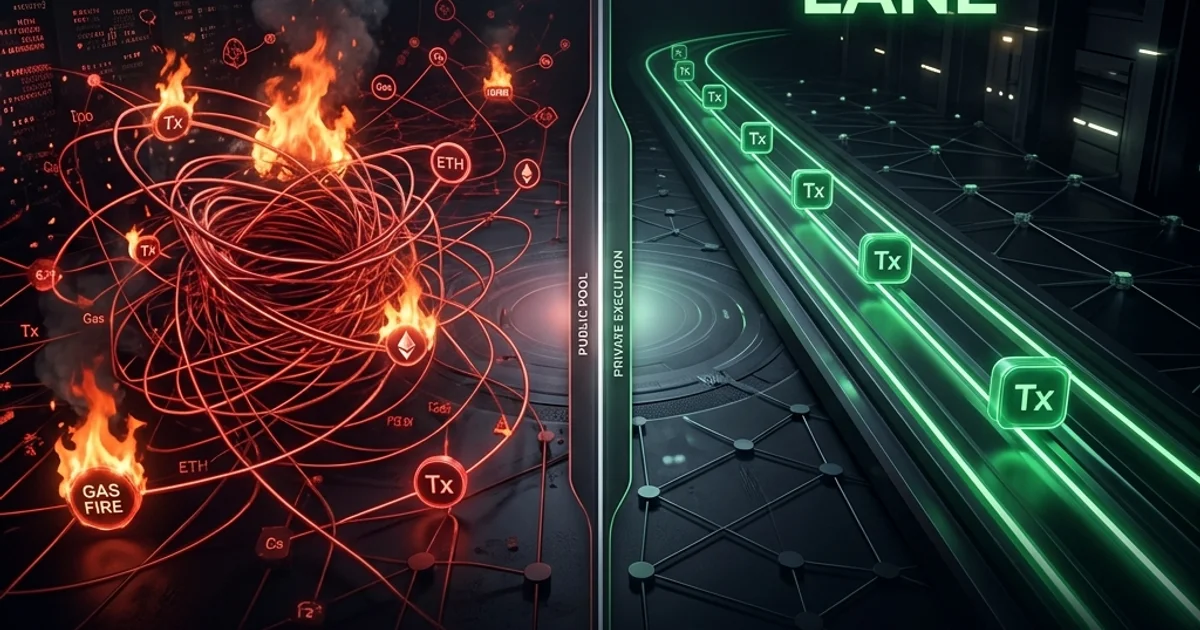
Private bundles vs public PGA: gas economics
FR
FRB 团队MEV 专家
最近更新
#gas waste#priority gas auction#flashbots vs pga#private relays#costs#inclusion

Answer first — Private bundles save gas in two specific ways that don't fully overlap: (1) atomic submission means a failed simulation costs nothing on-chain (no gas burned for reverted attempts), and (2) sealed-bid pricing means you don't bid against searchers seeing the same opportunity in the public mempool, so you pay your reservation price instead of an auction-cleared price. On Ethereum mainnet for contested opportunities, the gas savings are usually meaningful — often 20–60% of what a naive PGA bidder would pay over the same trades. On chains without bundle relays (Optimism, Base, Arbitrum, Polygon), "private bundles" don't exist as a product; the equivalent discipline is single-tx atomicity through an executor contract, plus low-latency sequencer access. The trap most operators fall into is comparing private vs public on inclusion rate alone — that misses the gas savings on rejected/reverted attempts, which is often where the bigger PnL gap lives.

Mastery path

The gas math, decomposed

Compare a private-bundle path and a public-PGA path over the same 100 attempted backruns:

Step Public PGA Private bundle (Flashbots etc.)
Trigger detected Same Same
Compute backrun Same Same
Simulate Same Same
Bid submission High priority fee, public mempool eth_sendBundle, sealed
Other searchers see your bid? Yes — they raise theirs No
If your tx loses the auction Mined anyway, possibly reverts → gas paid Not included → gas free
If your tx wins Mined, gas paid at your bid price Mined, gas paid at builder-accepted price
Reverted attempt cost Full gas, no profit Zero (relay drops the bundle)

The "if your tx loses" row is where the savings concentrate. On contested mainnet routes, naive PGA submission means every attempt costs gas regardless of outcome — including the ones that lost the bidding war and reverted on chain. Private bundle submission converts those reverted-attempt costs to zero.

When private genuinely saves real money

Three conditions where the savings are large:

  1. High contention. Opportunities visible to many searchers (large DEX swaps, liquidations cascade events, depeg scenarios). Public PGA bidding here gets out of control fast — the auction clears at uneconomic levels. Private bundles let the builder pick a winner at a sensible price.
  2. Low success-rate strategies. A backrun strategy that simulates profit on 100 candidates but only wins 30 has 70 losing attempts. Public path: gas paid on most or all of the 70. Private path: gas paid on zero of them.
  3. Frequent simulation drift. State moves between sim and send; a strategy that reverts often on chain wastes gas every revert. Bundle submission with revertingTxHashes properly used (or the relay's auto-drop on revert) eliminates that waste.

When public is acceptable

Sometimes the public mempool is genuinely the right path:

  • Uncontested opportunities on cheap chains (sub-cent gas). When gas is essentially free, the auction risk is low. The simplicity of public sends has its own value.
  • Strategies that need probe-and-retry shapes where landing matters more than perfect pricing. Some liquidation strategies fall here — first searcher to land wins, exact price less important.
  • Chains without bundle relays. Optimism, Base, Arbitrum, Polygon (unless you're using FastLane). The "public mempool" caveats on these chains are different — there isn't really a public mempool to bid against, the question is just sequencer ordering.

For these cases the discipline becomes: tight gas caps, tight slippage caps, atomic-route encoding, kill-switch on session budget. Public submission with strong caps can be safe.

The chains-without-relays case

On Optimism, Base, Arbitrum, and Polygon, the conversation is different because there's no Flashbots-equivalent bundle relay (Polygon has FastLane but it's a partial-coverage product).

The gas-waste reduction strategies on these chains:

  • Single-tx atomicity through an executor contract. Instead of two top-level sends, one contract call that does both legs and reverts on partial fill. The revert costs just the contract's setup gas, not both legs.
  • Pre-sign simulation against a chain fork at current head. Catches reverts that would otherwise pay gas on chain. The FRB Agent does this automatically.
  • Live fee re-query immediately before signing. On OP Stack chains the L1 portion of the fee shifts inside a block during blob-demand spikes; signing against a stale value is how you over-pay.

The combination gets you most of the gas-savings benefit without a bundle relay. Not zero gas waste, but bounded.

The metric trap

Operators sometimes compare private vs public on inclusion rate alone. That misses where the savings are.

Better comparison framework:

Metric Why it matters
Inclusion rate How often you land
Gas-paid-per-attempt What you pay regardless of outcome
Gas-paid-per-included-tx What landing costs
Gas-paid-per-reverted-attempt The hidden cost public hides and private eliminates
Realised-vs-sim PnL gap Whether the model is honest

Run all five over a few hundred attempts. The gas-paid-per-reverted-attempt is the one that surprises operators on first measurement — it's often a third or more of total gas cost for naive public-mempool strategies, and it's recoverable.

Working configuration

For Ethereum mainnet:

  • Default to private bundle submission through fan-out (Flashbots + Titan + beaverbuild + rsync-builder).
  • Fall back to public mempool only with strict caps (per-trade gas, slippage) and only for strategies where the contention math says public is fine.
  • Always use revertingTxHashes correctly so unintended revert paths cost zero on-chain gas.

For OP Stack / Arbitrum / Polygon:

  • Pack atomic into a single executor-contract call that reverts on partial fill.
  • Simulate against fork at current head before every send.
  • Re-query live fee state at sign time, not at strategy entry.
  • FastLane on Polygon for atomic-bundle submission with auction-priced inclusion (paired with public-mempool fallback).

Gas Accounting at Scale: Monthly PnL Impact

Running these numbers on a realistic production workload clarifies why the choice matters:

Scenario: 1,000 attempted backruns per month on Ethereum mainnet

Path Attempt cost Win rate Losses paid Total gas spend
Public PGA ~0.003 ETH per attempt 25% 750 × 0.003 = 2.25 ETH ~3.0 ETH
Private bundle ~0.004 ETH per landed tx 35% (better inclusion) 650 × 0 = 0 ETH ~1.4 ETH

The private bundle path wins by ~1.6 ETH/month in this scenario purely on eliminated reverted-attempt costs. The higher per-tx cost when you DO land is more than offset by paying nothing on losses. At 1,000 ETH in monthly extracted value, 1.6 ETH is 0.16% of gross — not huge. At 100 ETH, it's 1.6%, which is substantial. The benefit scales inversely with win rate: the worse your hit rate, the more private bundle dominates.

What changes this math:

  • Win rate above 60%: The advantage of zero-cost losses shrinks; public PGA may be competitive on simple, high-confidence strategies.
  • Gas price spikes: During base-fee surges, the cost of each reverted public attempt grows proportionally. Private paths decouple from this noise.
  • Multi-relay fan-out vs. single-relay: Fan-out to 4–5 builders raises inclusion rate substantially, which is the primary lever on top of the zero-cost-loss structure.

Track gas-paid-per-reverted-attempt monthly. If it exceeds 10% of realised PnL, private bundle switching is likely the single highest-ROI infrastructure change available.

References

阅读后的下一步

启动 FRB 控制台

连接您的钱包,通过 6 位 PIN 码配对节点客户端,然后分配上述合约。

需要安装程序?

下载并验证 FRB

获取最新安装程序,将 SHA‑256 与 Releases 对比,然后按照安全启动清单操作。

查看 Releases 和 SHA‑256
分享𝕏 推特in LinkedInf Facebook

相关文章

延伸阅读与工具

讨论

暂无笔记。添加第一条观察,或在以下平台与团队分享链接 X (@MCFRB).

留下笔记
笔记仅存储在您的本地浏览器中。

掌控脉动

扩展您的执行能力

通过探索完整的 FRB 工具包来最大化您的优势。从机构级遥测到随时可导出的策略脚本。

CTA

安装 FRB 代理

下载经过验证的 Windows 版本并检查 SHA-256。

CTA

阅读快速入门文档

与运营和合规团队分享 15 分钟的设置流程。

CTA

启动控制面板

配对节点客户端并实时监控 Ops Pulse。

准备进化了吗?

迈出下一步

无论您是在验证终端安全,还是在启动您的第一个交易包,FRB 之旅都从这里开始。

推荐

安装 FRB 代理

安全的 Windows 版本,通过 SHA-256 验证以确保最高完整性。

推荐

阅读快速入门文档

15 分钟掌握设置流程:从钱包配对到第一个交易包。

推荐

启动控制面板

实时监控您的 Ops Pulse 并管理交易路由。