Solana MEV vs Ethereum MEV: Why Jito is Winning in 2026
**Answer first** — Solana and Ethereum host different MEV markets in 2026, and which one "wins" depends entirely on the strategy class. Solana's combination of **Jito Block Engine
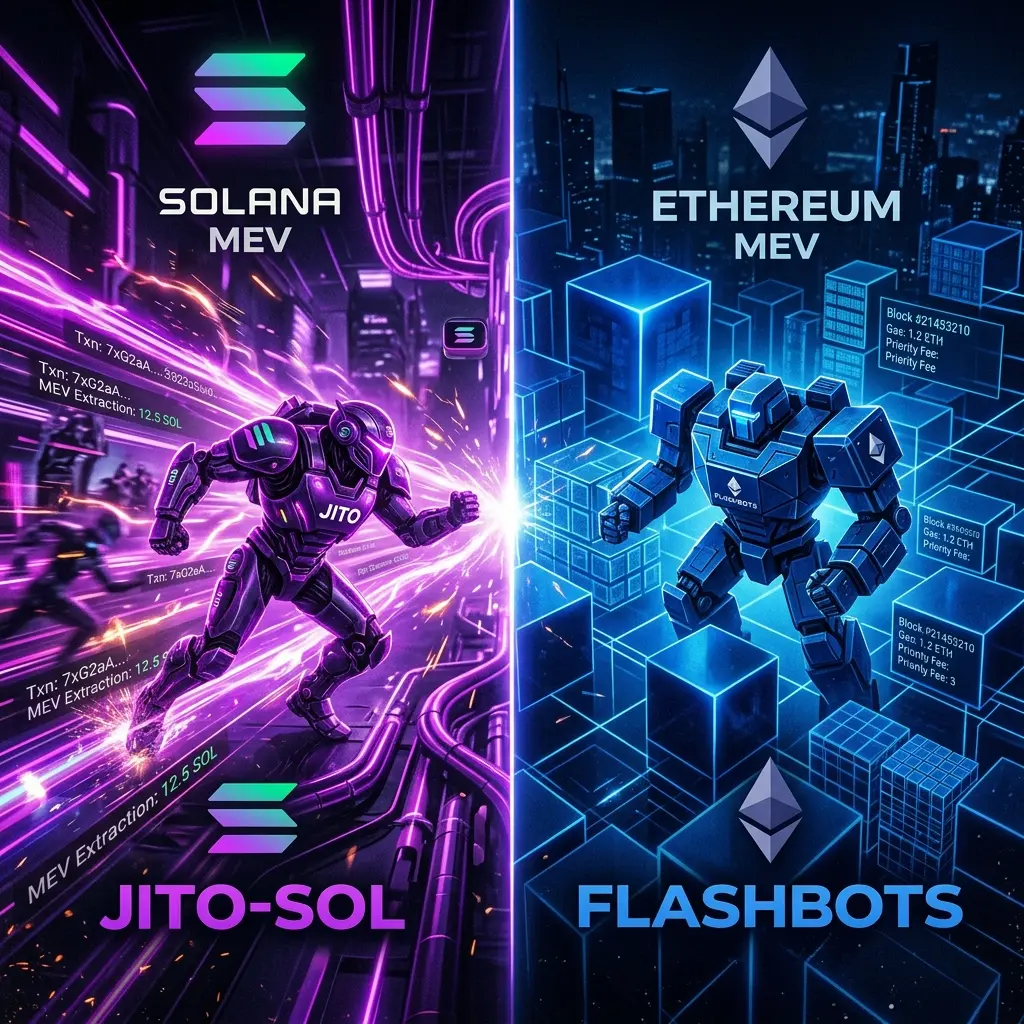
Answer first — Solana and Ethereum host different MEV markets in 2026, and which one "wins" depends entirely on the strategy class. Solana's combination of Jito Block Engine bundles (atomic execution via tip-paid bundles to participating validators), fast block production (~400 ms after Firedancer-class clients), and near-zero base transaction costs make it the rational home for high-frequency strategies — Pump.fun token sniping, micro-arbitrage between Raydium / Orca / Phoenix, and Jito-bundle backruns of large swaps. Ethereum's combination of multi-builder PBS infrastructure (Flashbots + Titan + beaverbuild + rsync-builder), deeper liquidity per pool, and mature lending-protocol ecosystems keeps it dominant for high-conviction, high-value strategies — large liquidations on Aave / Compound, complex multi-hop arbitrage on Uniswap V4, and institutional flow capture via MEV-Share. Choosing between them isn't a question of "which is better" — it's a question of which market structure fits the strategy you want to run.
Mastery path
- Solana MEV vs Ethereum MEV (current)
- Solana vs Ethereum MEV (deep)
- Jito bundles explained
- Solana Firedancer MEV strategies
What's structurally different
| Property | Ethereum mainnet | Solana |
|---|---|---|
| Block production | 12-second slots, MEV-Boost / PBS | Sub-second slots, Jito-aware validators |
| Mempool | Public peer-to-peer | None — direct submission to validators or Jito |
| Bundle mechanism | eth_sendBundle to multiple builder relays |
Jito Block Engine bundles with tip txs |
| Atomicity | Multi-tx bundles natively atomic | Bundles atomic via Jito, single-tx atomic via PDA-style routing |
| Typical strategy unit | Per-block, $5–$5,000 per opportunity | Per-slot, $0.10–$500 per opportunity |
| Cost floor | Mainnet gas (variable, often $1–$20 per send) | Sub-cent base fee + variable Jito tip |
| Market depth | Deepest per-pool DEX liquidity | Fast but smaller individual pools |
These are not improvements of one over the other — they're trade-offs. Frequency vs depth, cost vs reliability of inclusion mechanism, fast finality vs settlement-mature ecosystem.
Where Solana dominates
High-frequency, low-stake strategies. Block production at sub-second cadence means opportunities are numerous and short-lived. Pump.fun token sniping is the canonical example — a launch creates a window of seconds before initial buyers move the bonding curve; only chains with sub-slot detection plus atomic bundle inclusion can capture the first-buy economics consistently. Solana via Yellowstone gRPC + Jito is structurally suited.
Cost-sensitive arbitrage. When the spread on a $200 cross-DEX trade is 0.3%, sub-cent fees mean the trade is profitable; mainnet fees would consume the spread. Solana's Raydium ↔ Orca ↔ Phoenix arbitrage market exists because the fee math works.
Snipe-style retail-adjacent strategies. Pump.fun and similar memecoin platforms generate huge launch frequency. The strategy class is well-suited to Solana's market structure and infrastructurally adapted to Jito.
Where Ethereum dominates
High-conviction liquidations. Aave, Compound, MakerDAO host loans denominated in tens of millions of dollars. A liquidation on a $5M position has bonus economics that pay for substantial gas and competitive infrastructure investment. Solana's lending markets are smaller; the magnitude per opportunity is smaller.
Complex multi-hop arbitrage. Uniswap V4 hooks, multi-pool routing through aggregators, and the depth of Curve / Balancer / Maverick stables-and-LSDs market structure means individual arbitrage opportunities can be multi-thousand-dollar single events. Solana's pool structure is simpler; multi-hop is faster but lower-magnitude.
Institutional / OFA-aware flow. MEV-Share's hint-based OFA gives institutional searchers structured access to value-aware order flow with refund mechanics. Solana's analogue (Jito's MEV-aware paths) is younger and less mature.
Settlement-mature ecosystem. For strategies that ultimately need to settle to USD or to other chains, Ethereum's bridging, custody, and counterparty infrastructure is more mature. Solana's settlement ecosystem is improving but is meaningfully less developed.
What this means for an operator
If you're building infrastructure rather than choosing one strategy:
- Both chains are profitable — for the strategy class each is structurally suited to.
- Don't try to run Ethereum-style strategies on Solana, or vice versa. The structural assumptions don't carry; sandwich strategies designed for public mempools don't apply on Solana, and PGA-style bidding on mainnet wastes gas where private bundles save it.
- Multi-chain operation requires per-chain infrastructure. Different relay paths (Flashbots fan-out vs Jito Block Engine), different fee models (EIP-1559 + L1 data fee on Ethereum vs base + Jito tip on Solana), different mempool semantics (
eth_subscribevs Yellowstone gRPC).
The FRB Agent is built to run both with chain-appropriate infrastructure on each. The strategies are calibrated to the chain's structural strengths rather than being one-size-fits-all.
The "who's winning" framing is misleading
The question "which chain is winning MEV" is the wrong frame in 2026. Both chains support distinct, profitable MEV markets. Volume metrics get cited (weekly Jito bundle volume, mainnet block-builder revenue) but they measure different things on different chains and aggregating them as "winners" implies a competition that doesn't actually exist at the operator level.
What matters for an individual operator: pick strategies that match the market structure of the chain they're on, and don't pretend the structural assumptions transfer. That framing leads to working systems on both chains.
Practical Migration: Moving Capital Between Chains
Operators who started on Ethereum and want to add Solana (or vice versa) face specific infrastructure steps that aren't just "configure a new wallet":
Adding Solana to an Ethereum-primary setup:
- Set up Yellowstone gRPC connection — this is the Solana equivalent of WSS, but uses a different protocol (protobuf over gRPC rather than JSON-RPC over WebSocket). FRB Agent handles this natively; standalone setups need a Yellowstone-compatible node provider (Triton One, Helius dedicated, QuickNode Solana).
- Configure Jito Block Engine credentials — Jito requires authentication unlike Flashbots' permissionless relay. Register at
jito.networkand add your keypair to FRB's Solana config. - Fund a separate Solana execution wallet — don't reuse your Ethereum wallet. SOL-denominated gas is separate from ETH-denominated gas. Maintain at least 2 SOL in the execution wallet at all times for tips and base fees.
- Start in Solana simulation mode — Solana's execution model (PDAs, compute units, account rent) has different failure modes than EVM chains. 24-48 hours of simulation before live capital.
Migrating capital from Ethereum to Solana: The operational question is whether returns on Solana justify the opportunity cost of reducing Ethereum allocation. For operators with under $50K capital, Solana often produces better risk-adjusted returns because Ethereum's gas costs make small-capital L1 strategies marginal. Above $100K, Ethereum's higher per-opportunity magnitude justifies maintaining both.
The 2026 Infrastructure Checklist by Chain
For operators who want a quick-reference on what each chain actually requires before going live:
Ethereum mainnet:
- Flashbots relay access (permissionless — no registration required)
- At minimum 2 additional builder endpoints (Titan, beaverbuild, rsync-builder) for fan-out
- WSS subscription to
eth_subscribe('newPendingTransactions')on a commercial node eth_sendBundleintegration with fallback toeth_sendRawTransactionon relay failure- Per-bundle gas simulation against current mainnet state (stale forks cause consistent losses)
Solana:
- Jito Block Engine credentials (requires registration at jito.network)
- Yellowstone gRPC subscription for real-time account and transaction feeds (replaces WebSocket for serious volume)
- At least 2 SOL permanently in the execution wallet for tips and base fees — running out mid-session is a common first-week failure
- Separate execution wallet from the Ethereum wallet — SOL and ETH denominations don't mix, and wallet management is cleaner when chains are separated from day one
Operators running both chains need both infrastructure stacks maintained independently. Neither chain's tooling transfers to the other.
References
阅读后的下一步
启动 FRB 控制台
连接您的钱包,通过 6 位 PIN 码配对节点客户端,然后分配上述合约。
相关文章
延伸阅读与工具
讨论
暂无笔记。添加第一条观察,或在以下平台与团队分享链接 X (@MCFRB).