Solana
Simulated route
$124.50 model
Example
Ethereum
Private bundle
$840.12 model
Example
BNB
Liquidation test
$45.20 model
Example
Base
Arbitrage test
$12.05 model
Example
Solana
Jito bundle
$310.00 model
Example
Polygon
Route check
$8.45 model
Example
Solana
Simulated route
$124.50 model
Example
Ethereum
Private bundle
$840.12 model
Example
BNB
Liquidation test
$45.20 model
Example
Base
Arbitrage test
$12.05 model
Example
Solana
Jito bundle
$310.00 model
Example
Polygon
Route check
$8.45 model
Example
TraderConversion 阶段⏱ 6 分钟阅读

FRB Agent vs Axiom Trade in 2026: Desktop MEV vs Solana Power-User Terminal

**Answer first** — FRB Agent and Axiom Trade are both pitched as "non-custodial" but they sit on **opposite sides of the architecture line**. FRB Agent is a **locally-installed des

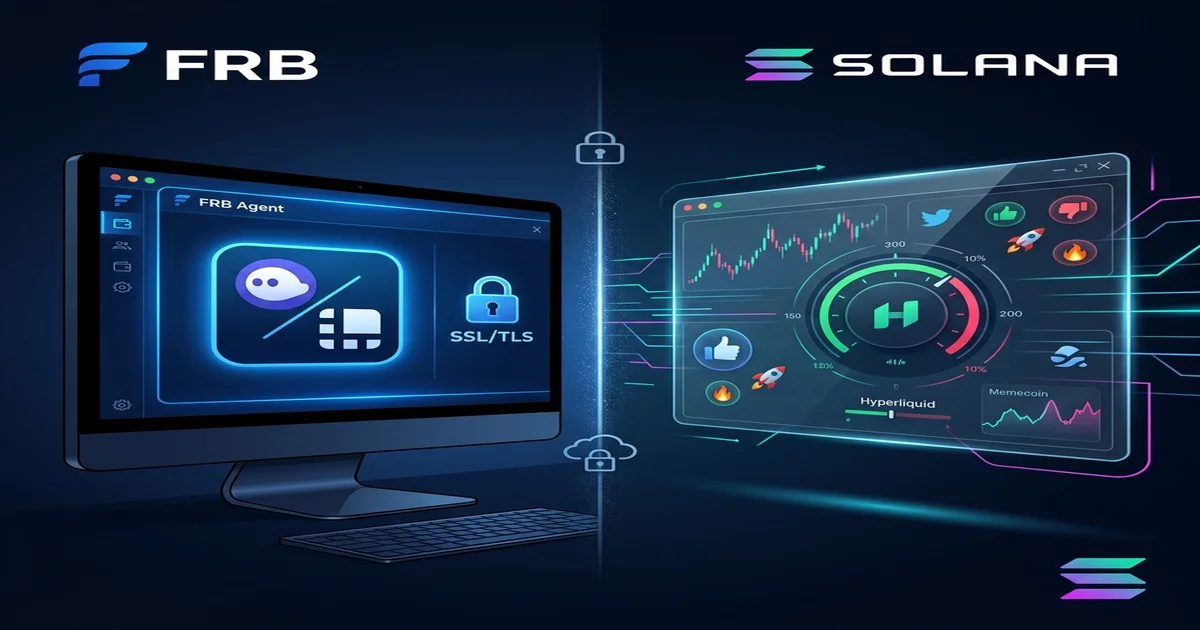
FRB Agent desktop interface compared with Axiom Trade Solana web terminal showing different non-custodial models
FR
FRB 团队MEV 专家
最近更新
#FRB#Axiom Trade#Solana#Comparison#Non-Custodial

Answer first — FRB Agent and Axiom Trade are both pitched as "non-custodial" but they sit on opposite sides of the architecture line. FRB Agent is a locally-installed desktop binary where the user signs every transaction with their own wallet (Phantom / Ledger / Solflare) — there is no hosted server in the data path. Axiom Trade is a hosted web terminal with smart-wallet infrastructure, optimised for Solana memecoin warfare with built-in wallet/Twitter tracking, MEV-aware exits, and Hyperliquid integration. The "non-custodial" claim of each means different things in practice. Both can trade Solana launches; the real split is how — FRB automates filtered, rule-based execution from a sovereign desktop, while Axiom is a hosted, analytics-rich terminal for discretionary trading. Choosing depends on sovereignty preference, automated-vs-manual style, and whether you trade from a desk or a browser.

What Each Product Is

FRB Agent

  • Form factor: Windows desktop application
  • Primary use case: Automated MEV — atomic arbitrage, Jito-bundle liquidations, multi-chain DEX routing
  • Wallet model: User pairs their own wallet (Phantom, Solflare, Backpack, Ledger); FRB Hub never sees keys
  • Key custody: Pairing data DPAPI-encrypted in %APPDATA%\FRB
  • UX: Native desktop UI with a paired dashboard at ai-frb.com/app
  • Pricing: Free download; performance fee on profitable bundles

Axiom Trade

  • Form factor: Hosted web terminal
  • Primary use case: Solana memecoin trading with embedded analytics, Twitter sentiment, wallet tracking, and Hyperliquid perp routing
  • Wallet model: Smart-wallet infrastructure with client-side signing flows
  • Key custody: Per their public docs, client-side; users should verify the live model and seed-phrase access
  • UX: Web-first terminal with rich charting and copy-trade features
  • Pricing: Per-trade fee structure on the terminal

The Architecture Line

The user-controlled scope is the key difference:

  • FRB Agent: User's PC controls the entire data path from sign to broadcast
  • Axiom Trade: User's browser controls the signing step; the rest of the data path is on Axiom's infrastructure

Both can be "non-custodial" depending on implementation. The question is whose infrastructure must be uncompromised for your trades to be safe. With FRB it's just yours. With Axiom (and any hosted terminal) it's also the operator's.

Strategy Focus: Discretionary Terminal vs Automated Stack

Axiom Trade's domain:

  • Solana memecoin entry on launch
  • Sentiment-driven trades (Twitter signals)
  • Copy-trade automation
  • Fast exits with MEV-aware ordering
  • Hyperliquid perp positioning

FRB Agent's domain:

  • Cross-DEX atomic arbitrage on Solana (Raydium / Orca / Phoenix)
  • Lending liquidations (Mendi, ZeroLend equivalents on supported chains)
  • Filtered, risk-capped new-launch sniping (rule-based, not one-click)
  • Multi-chain dashboard for Ethereum + Solana + EVM L2s
  • Per-contract PnL accounting

The split is style, not just strategy. Axiom's memecoin trading is discretionary + opportunistic with moonshot returns; FRB runs the same launch hunts as automated, filtered, bounded rules alongside systematic MEV. Many operators run both — a discretionary terminal and an automated stack — with separate capital allocations.

Latency Profile

Operation FRB Agent Axiom Trade
Click → wallet popup ~50–100ms (local) ~150–400ms (web fetch + sign)
Sign → submitted Direct WSS to chain Axiom backend → chain
Decision automated? Yes — bot runs locally Partially — terminal-driven, some auto rules
Best for Fast automated reactions Fast manual reactions

For automated MEV, FRB's local decision loop wins. For manual sniping with rich context, Axiom's terminal wins because the analytics are bundled into the trading UI.

"Non-Custodial" — The Useful Definition

Both products claim non-custodial. Useful tests to apply:

  1. Can you withdraw without the operator? If yes → genuinely non-custodial. If no (e.g., custodial wallet behind a UI) → custodial.
  2. Where does the seed phrase live? Local hardware/software wallet → strong claim. Operator's smart-wallet contract → weaker.
  3. What happens if the operator disappears? With FRB, your wallet keeps working — you can sign through Phantom directly. With a smart-wallet terminal, you may need a recovery flow.
  4. What's the auditable scope? FRB: SHA-256-verified binary + open RPC behavior. Axiom: smart-wallet contract source if published.

Apply these tests to any "non-custodial" claim before depositing material capital.

When Axiom Trade Is The Right Tool

You should pick Axiom Trade if:

  • You trade Solana memecoins as your main edge
  • You want embedded analytics (Twitter, on-chain wallets) inside the trade UI
  • You operate from a browser (desktop or laptop) and want web-app convenience
  • You need Hyperliquid perp integration for hedging memecoin exposure
  • Your position sizes are $100–$10,000 per trade — the operational risk is bounded

For memecoin warfare, Axiom is one of the better-engineered terminals in 2026.

When FRB Agent Is The Right Tool

You should pick FRB Agent if:

  • Your strategy is automated MEV plus filtered sniping — atomic arbitrage, liquidations, contract-driven routing, and rule-based new-launch entries
  • You operate multi-chain (Ethereum, BNB, Polygon, Base, Solana) and want unified dashboard
  • You want maximum sovereignty — local binary, local signer, no hosted middleware
  • You need DPAPI key encryption and official installer integrity for compliance
  • Your capital deserves infrastructure-grade isolation, not terminal-grade

FRB snipes through automated filters, not a discretionary click-and-chart terminal — it competes on systematic, non-custodial execution rather than memecoin-terminal UX.

Total Cost Of Ownership

Cost FRB Agent Axiom Trade
Software / access Free Free entry, fees per trade
Performance fees % of profit on bundle Implicit in trade flow
Subscriptions None Sometimes — verify current tier
Infrastructure $50–200/mo (RPC, optional VPS) $0 — Axiom hosts
Time investment 30 min setup 5 min signup

Axiom is cheaper to start. FRB is cheaper at scale because there's no per-trade rake on every fill — the performance fee applies only when you actually capture MEV profit.

The Hidden Risk in Hosted Terminals

A material risk with any hosted terminal:

  • Operator access: The operator can see all of your trades, even if they cannot sign them
  • Front-end attacks: Compromised UI (DNS hijack, JS injection) can trick users into signing malicious transactions
  • Service outages: A terminal outage means you can't trade until it returns
  • Geoblocks / closures: Sudden compliance changes can lock out your account

These are not Axiom-specific — every hosted terminal carries them. The desktop architecture sidesteps all four, at the cost of a more involved setup.

Should You Run Both?

If your trading book contains both discretionary memecoin punts and automated MEV, the answer is yes — different tools for different styles:

  • Axiom for the discretionary, analytics-driven moonshot Solana flow
  • FRB for automated cross-DEX arbitrage plus filtered, risk-capped sniping

Capital should be separate per tool so a problem in one doesn't bleed into the other.

Where FRB Agent Stands Alone

FRB's distinct advantages over Axiom for serious MEV operators:

  1. Local execution path — no hosted middleware in the trade flow
  2. Multi-chain unified dashboard — Ethereum + BNB + Polygon + Base + Solana
  3. official installer + SHA-256 — supply-chain auditability
  4. DPAPI key isolation — Windows-grade key protection
  5. Per-bundle local logs — every transaction auditable from your own SQLite

These matter when the goal is infrastructure, not entertainment.

Further Reading

阅读后的下一步

启动 FRB 控制台

连接您的钱包,通过 6 位 PIN 码配对节点客户端,然后分配上述合约。

需要安装程序?

下载并验证 FRB

获取最新安装程序,将 SHA‑256 与 Releases 对比,然后按照安全启动清单操作。

查看 Releases 和 SHA‑256
分享𝕏 推特in LinkedInf Facebook

相关文章

延伸阅读与工具

讨论

暂无笔记。添加第一条观察,或在以下平台与团队分享链接 X (@MCFRB).

留下笔记
笔记仅存储在您的本地浏览器中。

掌控脉动

扩展您的执行能力

通过探索完整的 FRB 工具包来最大化您的优势。从机构级遥测到随时可导出的策略脚本。

CTA

安装 FRB 代理

下载经过验证的 Windows 版本并检查 SHA-256。

CTA

阅读快速入门文档

与运营和合规团队分享 15 分钟的设置流程。

CTA

启动控制面板

配对节点客户端并实时监控 Ops Pulse。

准备进化了吗?

迈出下一步

无论您是在验证终端安全,还是在启动您的第一个交易包,FRB 之旅都从这里开始。

推荐

安装 FRB 代理

安全的 Windows 版本,通过 SHA-256 验证以确保最高完整性。

推荐

阅读快速入门文档

15 分钟掌握设置流程:从钱包配对到第一个交易包。

推荐

启动控制面板

实时监控您的 Ops Pulse 并管理交易路由。