Crypto Arbitrage Bot Guide 2026: How Cross-DEX Arbitrage Works
**Answer first** — A crypto arbitrage bot exploits price differences for the same asset across different exchanges or pools. In 2026, the three main types are: **Cross-DEX arbitrag
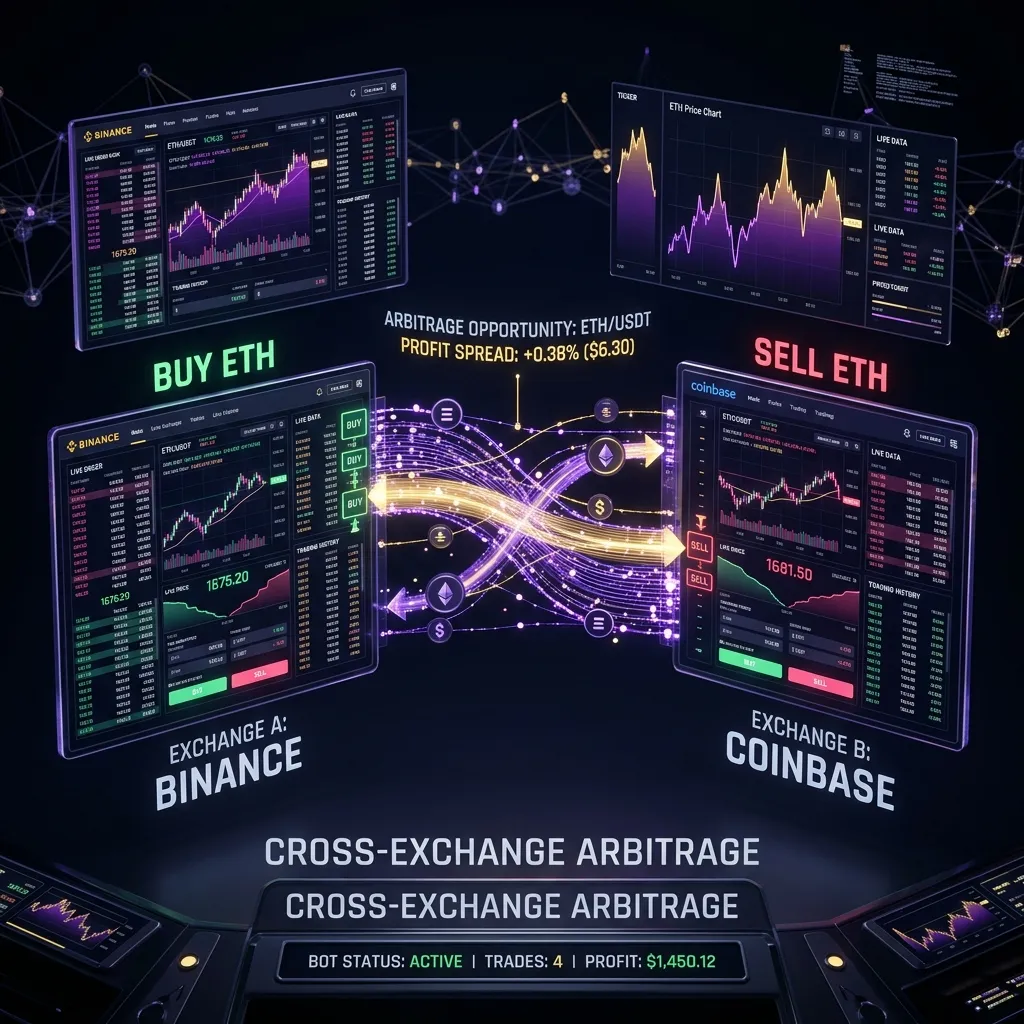
Answer first — A crypto arbitrage bot exploits price differences for the same asset across different exchanges or pools. In 2026, the three main types are: Cross-DEX arbitrage (buy on Uniswap, sell on SushiSwap), triangular arbitrage (exploit price loops within a single DEX), and cross-chain arbitrage (exploit differences between Ethereum and Solana). Success requires private relay submission to prevent front-running — FRB Agent provides this via Flashbots and Jito bundles. Inclusion rates depend on chain conditions, fee competition, and relay coverage; expect noticeably higher consistency than public-mempool sends, not a fixed number.
What Is Crypto Arbitrage?
Arbitrage is the practice of buying an asset where it's cheap and simultaneously selling where it's more expensive. In crypto, price discrepancies exist because:
- DEXs use automated market makers (AMMs) with independent pricing
- Large trades move prices on individual pools
- Information travels slowly between chains
- Liquidity varies across venues
Arbitrage is a market efficiency mechanism — it corrects price differences, benefiting all market participants. It's the most ethically clean MEV strategy.
Types of Crypto Arbitrage
1. Cross-DEX Arbitrage
Buy on one DEX, sell on another. The most common and accessible form.
Example: WETH is $3,410 on Uniswap V3 and $3,415 on SushiSwap → Buy on Uniswap, sell on SushiSwap, profit $5 minus gas.
| Metric | Details |
|---|---|
| Complexity | Medium |
| Outcome profile | Depends on spreads, gas, latency, and failed attempts |
| Capital Needed | $500+ |
| Gas Costs | Moderate (two swaps per trade) |
| Best Platform | FRB Agent |
2. Triangular Arbitrage
Exploit pricing loops within a single DEX. Trade A→B→C→A, ending with more of A than you started.
Example: On Uniswap V3: ETH → USDC → DAI → ETH. If the loop yields >0 ETH after gas, it's profitable.
| Metric | Details |
|---|---|
| Complexity | High |
| Outcome profile | Depends on path liquidity, gas, and price movement |
| Capital Needed | $1,000+ |
| Gas Costs | Higher (three swaps) |
| Best Platform | FRB Agent |
3. Cross-Chain Arbitrage
Exploit price differences between chains (e.g., ETH on Uniswap vs. SOL-wrapped ETH on Raydium).
| Metric | Details |
|---|---|
| Complexity | Very High |
| Outcome profile | Variable |
| Capital Needed | $5,000+ |
| Risk | Bridge risk, timing risk |
| Best Platform | FRB Agent (multi-chain) |
Why Most Arbitrage Bots Fail
The Front-Running Problem
If you submit an arbitrage transaction to the public mempool, other searchers see it and can:
- Copy your trade with higher gas → they execute first, you get nothing
- Sandwich your trade → they profit from your price impact
This is why 95% of amateur arbitrage bots are unprofitable — they submit to the public mempool and get systematically front-run.
The Solution: Private Relay Submission
FRB Agent solves this by routing every arbitrage through Flashbots private bundles (Ethereum) or Jito bundles (Solana). Your transaction is invisible until it's included in a block.
| Submission Method | Visibility | Front-Run Risk | Inclusion |
|---|---|---|---|
| Public Mempool | Everyone sees | 🔴 High | Low |
| Flashbots (via FRB) | Only builder | 🟢 None | High (varies with builder coverage) |
| Jito (via FRB) | Only validator | 🟢 None | High (varies with slot leader and tip levels) |
How FRB Agent Executes Arbitrage
1. 📡 Monitor pools across all supported DEXs
2. 🧮 Calculate profit after gas + slippage + FRB fee
3. 🧪 Simulate trade in Anvil fork (pre-validate profitability)
4. 📦 Bundle transactions atomically (all-or-nothing)
5. 🔐 Sign locally (keys never leave your machine)
6. 🚀 Submit via Flashbots/Jito private relay
7. ✅ Profit credited — 20% fee auto-deducted
Key Advantages
- Atomic execution: Both legs execute in the same block or neither does (no partial fills)
- Pre-simulation: Anvil fork validates profitability before risking gas
- Multi-builder: Simultaneously submits to Flashbots, Titan, BloXroute, Beaver
- Multi-chain: Run arbitrage on ETH, BSC, Base, Polygon, Arbitrum, Optimism, Solana
Setting Up Your Arbitrage Bot
Step 1: Download FRB Agent
Download here — free, SHA-256-verified, Windows only.
Step 2: Connect Your Wallet
Use the local encrypted bridge. Your private key never leaves your machine.
Step 3: Configure Strategy
Select "Cross-DEX Arbitrage" and set parameters:
- Minimum profit: 0.005 ETH (adjust based on gas costs)
- Maximum gas: 50 gwei
- Slippage tolerance: 0.3%
- Target DEXs: Uniswap V2/V3, SushiSwap, Curve
Step 4: Simulate
Run simulation for 7+ days against live blockchain state. Monitor win rate, average profit, and gas costs.
Step 5: Go Live
Start with small capital ($500). Scale up after 14 days of consistent live results.
Arbitrage by Chain
| Chain | Opportunity | Gas Cost | DEXs | FRB Support |
|---|---|---|---|---|
| Ethereum | Highest value, most competitive | $2–$20 | Uniswap, Sushi, Curve | ✅ |
| BSC | Good volume, less competition | $0.05–$0.30 | PancakeSwap, BiSwap | ✅ |
| Base | Growing fast, low competition | $0.01–$0.10 | Aerodrome, BaseSwap | ✅ |
| Solana | Very fast, Jito bundles | <$0.01 | Raydium, Orca, Jupiter | ✅ |
| Arbitrum | L2 opportunities | $0.05–$0.30 | Camelot, SushiSwap | ✅ |
[!TIP] Beginner tip: Start arbitrage on Base or BSC — lower gas costs mean smaller minimum trades and less capital at risk. FRB Agent supports all chains.
FAQ
Q: Is crypto arbitrage profitable in 2026? A: Yes, with proper infrastructure. Private relay submission via FRB Agent is essential — public mempool arbitrage is unprofitable due to front-running.
Q: How much capital do I need for arbitrage? A: $500 minimum on L2s/BSC. $1,000+ on Ethereum L1 due to gas costs.
Q: Is arbitrage risk-free? A: No. Risks include smart contract bugs, slippage, gas cost spikes, and execution failure. Simulation helps mitigate these.
Q: Does FRB Agent charge for failed trades? A: No. FRB only charges 20% on profitable trades. Failed simulations cost nothing. Failed on-chain transactions only cost gas.
Common Setup Mistakes
Operators who configure arbitrage correctly on day one spend far less time debugging in weeks 2–4. The most common early mistakes:
Setting minimum profit too low. A $0.50 minimum profit sounds conservative, but after gas and the performance fee, it's often negative net. A realistic minimum for ETH L1 is 0.003–0.005 ETH; for L2s, $0.50–$2 USD-equivalent depending on current gas.
Slippage tolerance too tight on illiquid routes. Setting 0.1% slippage on a mid-cap pair that normally trades at 0.3% spread means rejecting almost every trade. Calibrate slippage per route based on the pair's typical spread, not a single global setting.
Not updating the target DEX list after protocol upgrades. Uniswap V3 is not the same as Uniswap V4. Curve V2 is not V1. When a DEX upgrades, the contract address changes, the fee structure may change, and strategies configured against old addresses silently stop finding opportunities while continuing to run.
Watching the wrong metric. New operators often obsess over inclusion rate and ignore realised-vs-simulated PnL gap. A 90% inclusion rate with a 40% PnL gap means the strategy is consistently landing but consistently earning less than simulated — the model is wrong and scaling up makes it worse, not better.
Q: How long until my arbitrage bot is consistently profitable? Expect 4–6 weeks on L2s or BNB Chain with $5K+ capital and consistent monitoring. See the full timeline breakdown.
Related Reading
- MEV vs CEX Arbitrage 2026
- DEX Aggregator MEV 2026: 1inch, Matcha, Paraswap, CoW
- Cross-Chain Arbitrage MEV 2026
- Advanced ETH Arbitrage Strategies
References
阅读后的下一步
启动 FRB 控制台
连接您的钱包,通过 6 位 PIN 码配对节点客户端,然后分配上述合约。
相关文章
延伸阅读与工具
讨论
暂无笔记。添加第一条观察,或在以下平台与团队分享链接 X (@MCFRB).